
vadimdemedes/ink
🌈 React for interactive command-line apps
Build with Backblaze B2
SDKs, agent skills, IDE extensions, and reference pipelines from Backblaze Labs. All open source.
Loading star history...
Use Cases & Benefits
- Provides a React-based framework for building interactive command-line interface (CLI) applications using familiar component and Flexbox layout paradigms.
- Enables developers to create complex, styled, and dynamic CLIs with React's declarative UI model and Yoga-powered Flexbox layouts, simplifying terminal UI development.
- Use for building type-safe, interactive CLI tools with React components and hooks in TypeScript or JavaScript environments.
- Use for creating visually rich terminal dashboards or status monitors that require flexible layouts and real-time updates.
- Use for developing CLI-based games or utilities that benefit from React's component lifecycle and state management in a terminal context.
About ink


React for CLIs. Build and test your CLI output using components.


Ink provides the same component-based UI building experience that React offers in the browser, but for command-line apps. It uses Yoga to build Flexbox layouts in the terminal, so most CSS-like properties are available in Ink as well. If you are already familiar with React, you already know Ink.
Since Ink is a React renderer, all features of React are supported. Head over to the React website for documentation on how to use it. Only Ink's methods are documented in this readme.
Install
npm install ink react
Usage
import React, {useState, useEffect} from 'react';
import {render, Text} from 'ink';

const Counter = () => {
	const [counter, setCounter] = useState(0);

	useEffect(() => {
		const timer = setInterval(() => {
			setCounter(previousCounter => previousCounter + 1);
		}, 100);

		return () => {
			clearInterval(timer);
		};
	}, []);

	return <Text color="green">{counter} tests passed</Text>;
};

render(<Counter />);
Feel free to play around with the code and fork this Repl at https://repl.it/@vadimdemedes/ink-counter-demo.
Who's Using Ink?
- Codex - An agentic coding tool made by OpenAI.
- Claude Code - An agentic coding tool made by Anthropic.
- Gemini CLI - An agentic coding tool made by Google.
- GitHub Copilot for CLI - Just say what you want the shell to do.
- Canva CLI - CLI for creating and managing Canva Apps.
- Cloudflare's Wrangler - The CLI for Cloudflare Workers.
- Linear - Linear built an internal CLI for managing deployments, configs, and other housekeeping tasks.
- Gatsby - Gatsby is a modern web framework for blazing-fast websites.
- tap - A Test-Anything-Protocol library for JavaScript.
- Terraform CDK - Cloud Development Kit (CDK) for HashiCorp Terraform.
- Specify CLI - Automate the distribution of your design tokens.
- Twilio's SIGNAL - CLI for Twilio's SIGNAL conference. Blog post.
- Typewriter - Generates strongly-typed Segment analytics clients from arbitrary JSON Schema.
- Prisma - The unified data layer for modern applications.
- Blitz - The Fullstack React Framework.
- New York Times - NYT uses Ink's
kyt- a toolkit that encapsulates and manages the configuration for web apps. - tink - A next-generation runtime and package manager.
- Inkle - A Wordle game.
- loki - Visual regression testing tool for Storybook.
- Bit - Build, distribute, and collaborate on components.
- Remirror - Your friendly, world-class editor toolkit.
- Prime - Open-source GraphQL CMS.
- emoj - Find relevant emojis.
- emma - Find and install npm packages easily.
- npm-check-extras - Check for outdated and unused dependencies, and run update/delete actions on selected ones.
- swiff - Multi-environment command-line tools for time-saving web developers.
- share - Share files quickly.
- Kubelive - A CLI for Kubernetes that provides live data about the cluster and its resources.
- changelog-view - View changelogs.
- cfpush - Interactive Cloud Foundry tutorial.
- startd - Turn your React component into a web app.
- wiki-cli - Search Wikipedia and read article summaries.
- garson - Build interactive, config-based command-line interfaces.
- git-contrib-calendar - Display a contributions calendar for any Git repository.
- gitgud - Interactive command-line GUI for Git.
- Autarky - Find and delete old
node_modulesdirectories to free up disk space. - fast-cli - Test your download and upload speeds.
- tasuku - Minimal task runner.
- mnswpr - A Minesweeper game.
- lrn - Learning by repetition.
- turdle - A Wordle game.
- Shopify CLI - Build apps, themes, and storefronts for the Shopify platform.
- ToDesktop CLI - All-in-one platform for building Electron apps.
- Walle - A full-featured crypto wallet for EVM networks.
- Sudoku - A Sudoku game.
- Sea Trader - A Taipan!-inspired trading simulator game.
- srtd - Live-reloading SQL templates for Supabase projects.
- tweakcc - Customize your Claude Code styling.
- argonaut - Manage Argo CD resources.
- Qodo Command - Build, run, and manage AI agents.
(PRs welcome. Append new entries at the end. Repos must have 100+ stars and showcase Ink beyond a basic list picker.)
Contents
- Getting Started
- Components
- Hooks
- API
- Testing
- Using React Devtools
- Screen Reader Support
- Useful Components
- Useful Hooks
- Examples
Getting Started
Use create-ink-app to quickly scaffold a new Ink-based CLI.
npx create-ink-app my-ink-cli
Alternatively, create a TypeScript project:
npx create-ink-app --typescript my-ink-cli
Manual JavaScript setup
Ink requires the same Babel setup as you would do for regular React-based apps in the browser.
Set up Babel with a React preset to ensure all examples in this readme work as expected.
After installing Babel, install @babel/preset-react and insert the following configuration in babel.config.json:
npm install --save-dev @babel/preset-react
{
	"presets": ["@babel/preset-react"]
}
Next, create a file source.js, where you'll type code that uses Ink:
import React from 'react';
import {render, Text} from 'ink';

const Demo = () => <Text>Hello World</Text>;

render(<Demo />);
Then, transpile this file with Babel:
npx babel source.js -o cli.js
Now you can run cli.js with Node.js:
node cli
If you don't like transpiling files during development, you can use import-jsx or @esbuild-kit/esm-loader to import a JSX file and transpile it on the fly.
Ink uses Yoga, a Flexbox layout engine, to build great user interfaces for your CLIs using familiar CSS-like properties you've used when building apps for the browser.
It's important to remember that each element is a Flexbox container.
Think of it as if every <div> in the browser had display: flex.
See <Box> built-in component below for documentation on how to use Flexbox layouts in Ink.
Note that all text must be wrapped in a <Text> component.
Components
<Text>
This component can display text and change its style to make it bold, underlined, italic, or strikethrough.
import {render, Text} from 'ink';

const Example = () => (
	<>
		<Text color="green">I am green</Text>
		<Text color="black" backgroundColor="white">
			I am black on white
		</Text>
		<Text color="#ffffff">I am white</Text>
		<Text bold>I am bold</Text>
		<Text italic>I am italic</Text>
		<Text underline>I am underline</Text>
		<Text strikethrough>I am strikethrough</Text>
		<Text inverse>I am inversed</Text>
	</>
);

render(<Example />);
Note: <Text> allows only text nodes and nested <Text> components inside of it. For example, <Box> component can't be used inside <Text>.
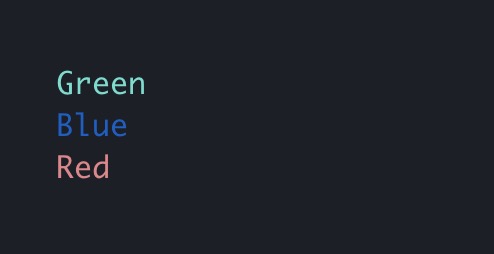
color
Type: string
Change text color. Ink uses chalk under the hood, so all its functionality is supported.
<Text color="green">Green</Text>
<Text color="#005cc5">Blue</Text>
<Text color="rgb(232, 131, 136)">Red</Text>
backgroundColor
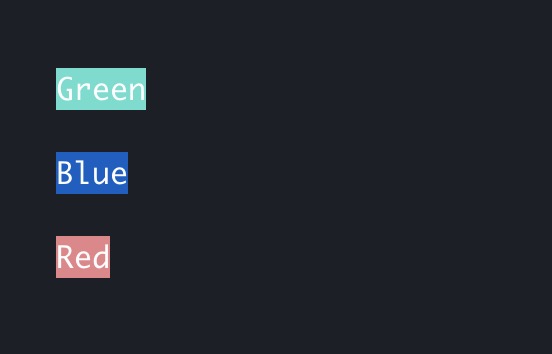
Type: string
Same as color above, but for background.
<Text backgroundColor="green" color="white">Green</Text>
<Text backgroundColor="#005cc5" color="white">Blue</Text>
<Text backgroundColor="rgb(232, 131, 136)" color="white">Red</Text>
dimColor
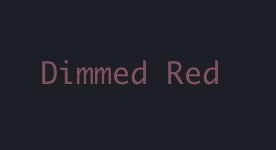
Type: boolean
Default: false
Dim the color (make it less bright).
<Text color="red" dimColor>
	Dimmed Red
</Text>
bold
Type: boolean
Default: false
Make the text bold.
italic
Type: boolean
Default: false
Make the text italic.
underline
Type: boolean
Default: false
Make the text underlined.
strikethrough
Type: boolean
Default: false
Make the text crossed with a line.
inverse
Type: boolean
Default: false
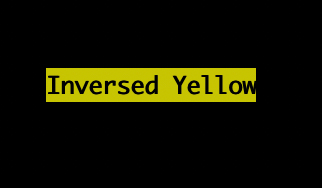
Invert background and foreground colors.
<Text inverse color="yellow">
	Inversed Yellow
</Text>
wrap
Type: string
Allowed values: wrap truncate truncate-start truncate-middle truncate-end
Default: wrap
This property tells Ink to wrap or truncate text if its width is larger than the container.
If wrap is passed (the default), Ink will wrap text and split it into multiple lines.
If truncate-* is passed, Ink will truncate text instead, resulting in one line of text with the rest cut off.
<Box width={7}>
	<Text>Hello World</Text>
</Box>
//=> 'Hello\nWorld'

// `truncate` is an alias to `truncate-end`
<Box width={7}>
	<Text wrap="truncate">Hello World</Text>
</Box>
//=> 'Hello…'

<Box width={7}>
	<Text wrap="truncate-middle">Hello World</Text>
</Box>
//=> 'He…ld'

<Box width={7}>
	<Text wrap="truncate-start">Hello World</Text>
</Box>
//=> '…World'
<Box>
<Box> is an essential Ink component to build your layout.
It's like <div style="display: flex"> in the browser.
import {render, Box, Text} from 'ink';

const Example = () => (
	<Box margin={2}>
		<Text>This is a box with margin</Text>
	</Box>
);

render(<Example />);
Dimensions
width
Type: number string
Width of the element in spaces. You can also set it as a percentage, which will calculate the width based on the width of the parent element.
<Box width={4}>
	<Text>X</Text>
</Box>
//=> 'X   '
<Box width={10}>
	<Box width="50%">
		<Text>X</Text>
	</Box>
	<Text>Y</Text>
</Box>
//=> 'X    Y'
height
Type: number string
Height of the element in lines (rows). You can also set it as a percentage, which will calculate the height based on the height of the parent element.
<Box height={4}>
	<Text>X</Text>
</Box>
//=> 'X\n\n\n'
<Box height={6} flexDirection="column">
	<Box height="50%">
		<Text>X</Text>
	</Box>
	<Text>Y</Text>
</Box>
//=> 'X\n\n\nY\n\n'
minWidth
Type: number
Sets a minimum width of the element. Percentages aren't supported yet; see https://github.com/facebook/yoga/issues/872.
minHeight
Type: number
Sets a minimum height of the element. Percentages aren't supported yet; see https://github.com/facebook/yoga/issues/872.
Padding
paddingTop
Type: number
Default: 0
Top padding.
paddingBottom
Type: number
Default: 0
Bottom padding.
paddingLeft
Type: number
Default: 0
Left padding.
paddingRight
Type: number
Default: 0
Right padding.
paddingX
Type: number
Default: 0
Horizontal padding. Equivalent to setting paddingLeft and paddingRight.
paddingY
Type: number
Default: 0
Vertical padding. Equivalent to setting paddingTop and paddingBottom.
padding
Type: number
Default: 0
Padding on all sides. Equivalent to setting paddingTop, paddingBottom, paddingLeft and paddingRight.
<Box paddingTop={2}>Top</Box>
<Box paddingBottom={2}>Bottom</Box>
<Box paddingLeft={2}>Left</Box>
<Box paddingRight={2}>Right</Box>
<Box paddingX={2}>Left and right</Box>
<Box paddingY={2}>Top and bottom</Box>
<Box padding={2}>Top, bottom, left and right</Box>
Margin
marginTop
Type: number
Default: 0
Top margin.
marginBottom
Type: number
Default: 0
Bottom margin.
marginLeft
Type: number
Default: 0
Left margin.
marginRight
Type: number
Default: 0
Right margin.
marginX
Type: number
Default: 0
Horizontal margin. Equivalent to setting marginLeft and marginRight.
marginY
Type: number
Default: 0
Vertical margin. Equivalent to setting marginTop and marginBottom.
margin
Type: number
Default: 0
Margin on all sides. Equivalent to setting marginTop, marginBottom, marginLeft and marginRight.
<Box marginTop={2}>Top</Box>
<Box marginBottom={2}>Bottom</Box>
<Box marginLeft={2}>Left</Box>
<Box marginRight={2}>Right</Box>
<Box marginX={2}>Left and right</Box>
<Box marginY={2}>Top and bottom</Box>
<Box margin={2}>Top, bottom, left and right</Box>
Gap
gap
Type: number
Default: 0
Size of the gap between an element's columns and rows. A shorthand for columnGap and rowGap.
<Box gap={1} width={3} flexWrap="wrap">
	<Text>A</Text>
	<Text>B</Text>
	<Text>C</Text>
</Box>
// A B
//
// C
columnGap
Type: number
Default: 0
Size of the gap between an element's columns.
<Box columnGap={1}>
	<Text>A</Text>
	<Text>B</Text>
</Box>
// A B
rowGap
Type: number
Default: 0
Size of the gap between an element's rows.
<Box flexDirection="column" rowGap={1}>
	<Text>A</Text>
	<Text>B</Text>
</Box>
// A
//
// B
Flex
flexGrow
Type: number
Default: 0
See flex-grow.
<Box>
	<Text>Label:</Text>
	<Box flexGrow={1}>
		<Text>Fills all remaining space</Text>
	</Box>
</Box>
flexShrink
Type: number
Default: 1
See flex-shrink.
<Box width={20}>
	<Box flexShrink={2} width={10}>
		<Text>Will be 1/4</Text>
	</Box>
	<Box width={10}>
		<Text>Will be 3/4</Text>
	</Box>
</Box>
flexBasis
Type: number string
See flex-basis.
<Box width={6}>
	<Box flexBasis={3}>
		<Text>X</Text>
	</Box>
	<Text>Y</Text>
</Box>
//=> 'X  Y'
<Box width={6}>
	<Box flexBasis="50%">
		<Text>X</Text>
	</Box>
	<Text>Y</Text>
</Box>
//=> 'X  Y'
flexDirection
Type: string
Allowed values: row row-reverse column column-reverse
See flex-direction.
<Box>
	<Box marginRight={1}>
		<Text>X</Text>
	</Box>
	<Text>Y</Text>
</Box>
// X Y

<Box flexDirection="row-reverse">
	<Text>X</Text>
	<Box marginRight={1}>
		<Text>Y</Text>
	</Box>
</Box>
// Y X

<Box flexDirection="column">
	<Text>X</Text>
	<Text>Y</Text>
</Box>
// X
// Y

<Box flexDirection="column-reverse">
	<Text>X</Text>
	<Text>Y</Text>
</Box>
// Y
// X
flexWrap
Type: string
Allowed values: nowrap wrap wrap-reverse
See flex-wrap.
<Box width={2} flexWrap="wrap">
	<Text>A</Text>
	<Text>BC</Text>
</Box>
// A
// B C
<Box flexDirection="column" height={2} flexWrap="wrap">
	<Text>A</Text>
	<Text>B</Text>
	<Text>C</Text>
</Box>
// A C
// B
alignItems
Type: string
Allowed values: flex-start center flex-end
See align-items.
<Box alignItems="flex-start">
	<Box marginRight={1}>
		<Text>X</Text>
	</Box>
	<Text>
		A
		<Newline/>
		B
		<Newline/>
		C
	</Text>
</Box>
// X A
//   B
//   C

<Box alignItems="center">
	<Box marginRight={1}>
		<Text>X</Text>
	</Box>
	<Text>
		A
		<Newline/>
		B
		<Newline/>
		C
	</Text>
</Box>
//   A
// X B
//   C

<Box alignItems="flex-end">
	<Box marginRight={1}>
		<Text>X</Text>
	</Box>
	<Text>
		A
		<Newline/>
		B
		<Newline/>
		C
	</Text>
</Box>
//   A
//   B
// X C
alignSelf
Type: string
Default: auto
Allowed values: auto flex-start center flex-end
See align-self.
<Box height={3}>
	<Box alignSelf="flex-start">
		<Text>X</Text>
	</Box>
</Box>
// X
//
//

<Box height={3}>
	<Box alignSelf="center">
		<Text>X</Text>
	</Box>
</Box>
//
// X
//

<Box height={3}>
	<Box alignSelf="flex-end">
		<Text>X</Text>
	</Box>
</Box>
//
//
// X
justifyContent
Type: string
Allowed values: flex-start center flex-end space-between space-around space-evenly
See justify-content.
<Box justifyContent="flex-start">
	<Text>X</Text>
</Box>
// [X      ]

<Box justifyContent="center">
	<Text>X</Text>
</Box>
// [   X   ]

<Box justifyContent="flex-end">
	<Text>X</Text>
</Box>
// [      X]

<Box justifyContent="space-between">
	<Text>X</Text>
	<Text>Y</Text>
</Box>
// [X      Y]

<Box justifyContent="space-around">
	<Text>X</Text>
	<Text>Y</Text>
</Box>
// [  X   Y  ]

<Box justifyContent="space-evenly">
	<Text>X</Text>
	<Text>Y</Text>
</Box>
// [   X   Y   ]
Visibility
display
Type: string
Allowed values: flex none
Default: flex
Set this property to none to hide the element.
overflowX
Type: string
Allowed values: visible hidden
Default: visible
Behavior for an element's overflow in the horizontal direction.
overflowY
Type: string
Allowed values: visible hidden
Default: visible
Behavior for an element's overflow in the vertical direction.
overflow
Type: string
Allowed values: visible hidden
Default: visible
A shortcut for setting overflowX and overflowY at the same time.
Borders
borderStyle
Type: string
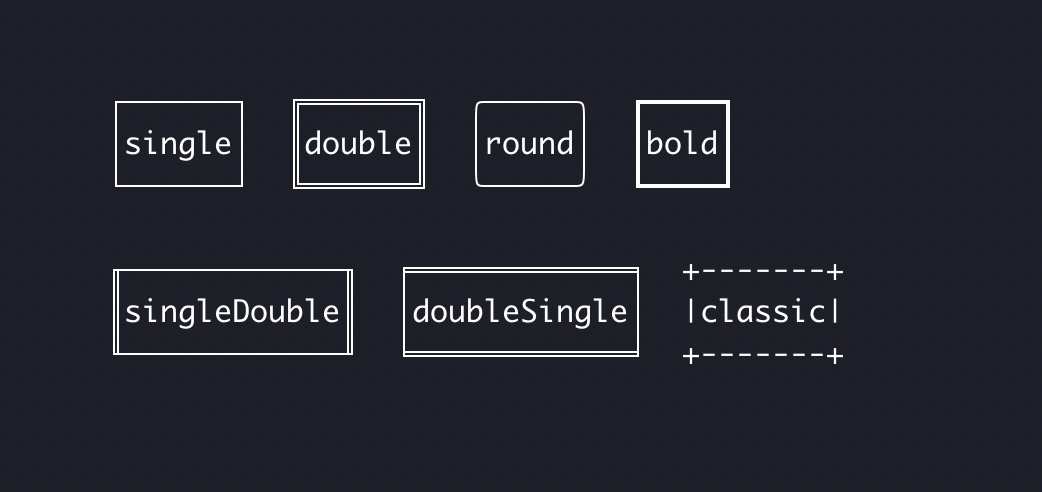
Allowed values: single double round bold singleDouble doubleSingle classic | BoxStyle
Add a border with a specified style.
If borderStyle is undefined (the default), no border will be added.
Ink uses border styles from the cli-boxes module.
<Box flexDirection="column">
	<Box>
		<Box borderStyle="single" marginRight={2}>
			<Text>single</Text>
		</Box>

		<Box borderStyle="double" marginRight={2}>
			<Text>double</Text>
		</Box>

		<Box borderStyle="round" marginRight={2}>
			<Text>round</Text>
		</Box>

		<Box borderStyle="bold">
			<Text>bold</Text>
		</Box>
	</Box>

	<Box marginTop={1}>
		<Box borderStyle="singleDouble" marginRight={2}>
			<Text>singleDouble</Text>
		</Box>

		<Box borderStyle="doubleSingle" marginRight={2}>
			<Text>doubleSingle</Text>
		</Box>

		<Box borderStyle="classic">
			<Text>classic</Text>
		</Box>
	</Box>
</Box>
Alternatively, pass a custom border style like so:
<Box
	borderStyle={{
		topLeft: '↘',
		top: '↓',
		topRight: '↙',
		left: '→',
		bottomLeft: '↗',
		bottom: '↑',
		bottomRight: '↖',
		right: '←'
	}}
>
	<Text>Custom</Text>
</Box>
See example in examples/borders.
borderColor
Type: string
Change border color.
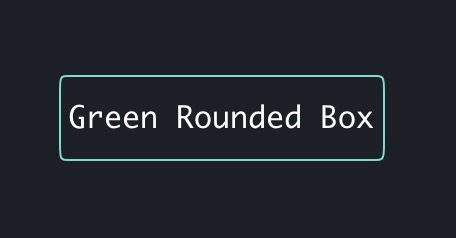
A shorthand for setting borderTopColor, borderRightColor, borderBottomColor, and borderLeftColor.
<Box borderStyle="round" borderColor="green">
	<Text>Green Rounded Box</Text>
</Box>
borderTopColor
Type: string
Change top border color.
Accepts the same values as color in <Text> component.
<Box borderStyle="round" borderTopColor="green">
	<Text>Hello world</Text>
</Box>
borderRightColor
Type: string
Change right border color.
Accepts the same values as color in <Text> component.
<Box borderStyle="round" borderRightColor="green">
	<Text>Hello world</Text>
</Box>
borderBottomColor
Type: string
Change bottom border color.
Accepts the same values as color in <Text> component.
<Box borderStyle="round" borderBottomColor="green">
	<Text>Hello world</Text>
</Box>
borderLeftColor
Type: string
Change left border color.
Accepts the same values as color in <Text> component.
<Box borderStyle="round" borderLeftColor="green">
	<Text>Hello world</Text>
</Box>
borderDimColor
Type: boolean
Default: false
Dim the border color.
A shorthand for setting borderTopDimColor, borderBottomDimColor, borderLeftDimColor, and borderRightDimColor.
<Box borderStyle="round" borderDimColor>
	<Text>Hello world</Text>
</Box>
borderTopDimColor
Type: boolean
Default: false
Dim the top border color.
<Box borderStyle="round" borderTopDimColor>
	<Text>Hello world</Text>
</Box>
borderBottomDimColor
Type: boolean
Default: false
Dim the bottom border color.
<Box borderStyle="round" borderBottomDimColor>
	<Text>Hello world</Text>
</Box>
borderLeftDimColor
Type: boolean
Default: false
Dim the left border color.
<Box borderStyle="round" borderLeftDimColor>
	<Text>Hello world</Text>
</Box>
borderRightDimColor
Type: boolean
Default: false
Dim the right border color.
<Box borderStyle="round" borderRightDimColor>
	<Text>Hello world</Text>
</Box>
borderTop
Type: boolean
Default: true
Determines whether top border is visible.
borderRight
Type: boolean
Default: true
Determines whether right border is visible.
borderBottom
Type: boolean
Default: true
Determines whether bottom border is visible.
borderLeft
Type: boolean
Default: true
Determines whether left border is visible.
Background
backgroundColor
Type: string
Background color for the element.
Accepts the same values as color in the <Text> component.
<Box flexDirection="column">
	<Box backgroundColor="red" width={20} height={5} alignSelf="flex-start">
		<Text>Red background</Text>
	</Box>

	<Box backgroundColor="#FF8800" width={20} height={3} marginTop={1} alignSelf="flex-start">
		<Text>Orange background</Text>
	</Box>

	<Box backgroundColor="rgb(0, 255, 0)" width={20} height={3} marginTop={1} alignSelf="flex-start">
		<Text>Green background</Text>
	</Box>
</Box>
The background color fills the entire <Box> area and is inherited by child <Text> components unless they specify their own backgroundColor.
<Box backgroundColor="blue" alignSelf="flex-start">
	<Text>Blue inherited </Text>
	<Text backgroundColor="yellow">Yellow override </Text>
	<Text>Blue inherited again</Text>
</Box>
Background colors work with borders and padding:
<Box backgroundColor="cyan" borderStyle="round" padding={1} alignSelf="flex-start">
	<Text>Background with border and padding</Text>
</Box>
See example in examples/box-backgrounds.
<Newline>
Adds one or more newline (\n) characters.
Must be used within <Text> components.
count
Type: number
Default: 1
Number of newlines to insert.
import {render, Text, Newline} from 'ink';

const Example = () => (
	<Text>
		<Text color="green">Hello</Text>
		<Newline />
		<Text color="red">World</Text>
	</Text>
);

render(<Example />);
Output:
Hello
World
<Spacer>
A flexible space that expands along the major axis of its containing layout. It's useful as a shortcut for filling all the available space between elements.
For example, using <Spacer> in a <Box> with default flex direction (row) will position "Left" on the left side and will push "Right" to the right side.
import {render, Box, Text, Spacer} from 'ink';

const Example = () => (
	<Box>
		<Text>Left</Text>
		<Spacer />
		<Text>Right</Text>
	</Box>
);

render(<Example />);
In a vertical flex direction (column), it will position "Top" at the top of the container and push "Bottom" to the bottom.
Note that the container needs to be tall enough to see this in effect.
import {render, Box, Text, Spacer} from 'ink';

const Example = () => (
	<Box flexDirection="column" height={10}>
		<Text>Top</Text>
		<Spacer />
		<Text>Bottom</Text>
	</Box>
);

render(<Example />);
<Static>
<Static> component permanently renders its output above everything else.
It's useful for displaying activity like completed tasks or logs - things that
don't change after they're rendered (hence the name "Static").
It's preferred to use <Static> for use cases like these when you can't know
or control the number of items that need to be rendered.
For example, Tap uses <Static> to display
a list of completed tests. Gatsby uses it
to display a list of generated pages while still displaying a live progress bar.
import React, {useState, useEffect} from 'react';
import {render, Static, Box, Text} from 'ink';

const Example = () => {
	const [tests, setTests] = useState([]);

	useEffect(() => {
		let completedTests = 0;
		let timer;

		const run = () => {
			// Fake 10 completed tests
			if (completedTests++ < 10) {
				setTests(previousTests => [
					...previousTests,
					{
						id: previousTests.length,
						title: `Test #${previousTests.length + 1}`
					}
				]);

				timer = setTimeout(run, 100);
			}
		};

		run();

		return () => {
			clearTimeout(timer);
		};
	}, []);

	return (
		<>
			{/* This part will be rendered once to the terminal */}
			<Static items={tests}>
				{test => (
					<Box key={test.id}>
						<Text color="green">✔ {test.title}</Text>
					</Box>
				)}
			</Static>

			{/* This part keeps updating as state changes */}
			<Box marginTop={1}>
				<Text dimColor>Completed tests: {tests.length}</Text>
			</Box>
		</>
	);
};

render(<Example />);
Note: <Static> only renders new items in the items prop and ignores items
that were previously rendered. This means that when you add new items to the items
array, changes you make to previous items will not trigger a rerender.
See examples/static for an example usage of <Static> component.
items
Type: Array
Array of items of any type to render using the function you pass as a component child.
style
Type: object
Styles to apply to a container of child elements.
See <Box> for supported properties.
<Static items={...} style={{padding: 1}}>
	{...}
</Static>
children(item)
Type: Function
Function that is called to render every item in the items array.
The first argument is the item itself, and the second argument is the index of that item in the
items array.
Note that a key must be assigned to the root component.
<Static items={['a', 'b', 'c']}>
	{(item, index) => {
		// This function is called for every item in ['a', 'b', 'c']
		// `item` is 'a', 'b', 'c'
		// `index` is 0, 1, 2
		return (
			<Box key={index}>
				<Text>Item: {item}</Text>
			</Box>
		);
	}}
</Static>
<Transform>
Transform a string representation of React components before they're written to output.
For example, you might want to apply a gradient to text, add a clickable link, or create some text effects.
These use cases can't accept React nodes as input; they expect a string.
That's what the <Transform> component does: it gives you an output string of its child components and lets you transform it in any way.
Note: <Transform> must be applied only to <Text> children components and shouldn't change the dimensions of the output; otherwise, the layout will be incorrect.
import {render, Transform} from 'ink';

const Example = () => (
	<Transform transform={output => output.toUpperCase()}>
		<Text>Hello World</Text>
	</Transform>
);

render(<Example />);
Since the transform function converts all characters to uppercase, the final output rendered to the terminal will be "HELLO WORLD", not "Hello World".
When the output wraps to multiple lines, it can be helpful to know which line is being processed.
For example, to implement a hanging indent component, you can indent all the lines except for the first.
import {render, Transform} from 'ink';

const HangingIndent = ({content, indent = 4, children, ...props}) => (
	<Transform
		transform={(line, index) =>
			index === 0 ? line : ' '.repeat(indent) + line
		}
		{...props}
	>
		{children}
	</Transform>
);

const text =
	'WHEN I WROTE the following pages, or rather the bulk of them, ' +
	'I lived alone, in the woods, a mile from any neighbor, in a ' +
	'house which I had built myself, on the shore of Walden Pond, ' +
	'in Concord, Massachusetts, and earned my living by the labor ' +
	'of my hands only. I lived there two years and two months. At ' +
	'present I am a sojourner in civilized life again.';

// Other text properties are allowed as well
render(
	<HangingIndent bold dimColor indent={4}>
		{text}
	</HangingIndent>
);
transform(outputLine, index)
Type: Function
Function that transforms children output. It accepts children and must return transformed children as well.
children
Type: string
Output of child components.
index
Type: number
The zero-indexed line number of the line that's currently being transformed.
Hooks
useInput(inputHandler, options?)
This hook is used for handling user input.
It's a more convenient alternative to using useStdin and listening for data events.
The callback you pass to useInput is called for each character when the user enters any input.
However, if the user pastes text and it's more than one character, the callback will be called only once, and the whole string will be passed as input.
You can find a full example of using useInput at examples/use-input.
import {useInput} from 'ink';

const UserInput = () => {
	useInput((input, key) => {
		if (input === 'q') {
			// Exit program
		}

		if (key.leftArrow) {
			// Left arrow key pressed
		}
	});

	return …
};
inputHandler(input, key)
Type: Function
The handler function that you pass to useInput receives two arguments:
input
Type: string
The input that the program received.
key
Type: object
Handy information about a key that was pressed.
key.leftArrow
key.rightArrow
key.upArrow
key.downArrow
Type: boolean
Default: false
If an arrow key was pressed, the corresponding property will be true.
For example, if the user presses the left arrow key, key.leftArrow equals true.
key.return
Type: boolean
Default: false
Return (Enter) key was pressed.
key.escape
Type: boolean
Default: false
Escape key was pressed.
key.ctrl
Type: boolean
Default: false
Ctrl key was pressed.
key.shift
Type: boolean
Default: false
Shift key was pressed.
key.tab
Type: boolean
Default: false
Tab key was pressed.
key.backspace
Type: boolean
Default: false
Backspace key was pressed.
key.delete
Type: boolean
Default: false
Delete key was pressed.
key.pageDown
key.pageUp
Type: boolean
Default: false
If the Page Up or Page Down key was pressed, the corresponding property will be true.
For example, if the user presses Page Down, key.pageDown equals true.
key.meta
Type: boolean
Default: false
Meta key was pressed.
options
Type: object
isActive
Type: boolean
Default: true
Enable or disable capturing of user input.
Useful when there are multiple useInput hooks used at once to avoid handling the same input several times.
useApp()
useApp is a React hook that exposes a method to manually exit the app (unmount).
exit(error?)
Type: Function
Exit (unmount) the whole Ink app.
error
Type: Error
Optional error. If passed, waitUntilExit will reject with that error.
import {useApp} from 'ink';

const Example = () => {
	const {exit} = useApp();

	// Exit the app after 5 seconds
	useEffect(() => {
		setTimeout(() => {
			exit();
		}, 5000);
	}, []);

	return …
};
useStdin()
useStdin is a React hook that exposes the stdin stream.
stdin
Type: stream.Readable
Default: process.stdin
The stdin stream passed to render() in options.stdin, or process.stdin by default.
Useful if your app needs to handle user input.
import {useStdin} from 'ink';

const Example = () => {
	const {stdin} = useStdin();

	return …
};
isRawModeSupported
Type: boolean
A boolean flag determining if the current stdin supports setRawMode.
A component using setRawMode might want to use isRawModeSupported to nicely fall back in environments where raw mode is not supported.
import {useStdin} from 'ink';

const Example = () => {
	const {isRawModeSupported} = useStdin();

	return isRawModeSupported ? (
		<MyInputComponent />
	) : (
		<MyComponentThatDoesntUseInput />
	);
};
setRawMode(isRawModeEnabled)
Type: function
isRawModeEnabled
Type: boolean
See setRawMode.
Ink exposes this function to be able to handle Ctrl+C, that's why you should use Ink's setRawMode instead of process.stdin.setRawMode.
Warning: This function will throw unless the current stdin supports setRawMode. Use isRawModeSupported to detect setRawMode support.
import {useStdin} from 'ink';

const Example = () => {
	const {setRawMode} = useStdin();

	useEffect(() => {
		setRawMode(true);

		return () => {
			setRawMode(false);
		};
	});

	return …
};
useStdout()
useStdout is a React hook that exposes the stdout stream where Ink renders your app.
stdout
Type: stream.Writable
Default: process.stdout
import {useStdout} from 'ink';

const Example = () => {
	const {stdout} = useStdout();

	return …
};
write(data)
Write any string to stdout while preserving Ink's output.
It's useful when you want to display external information outside of Ink's rendering and ensure there's no conflict between the two.
It's similar to <Static>, except it can't accept components; it only works with strings.
data
Type: string
Data to write to stdout.
import {useStdout} from 'ink';

const Example = () => {
	const {write} = useStdout();

	useEffect(() => {
		// Write a single message to stdout, above Ink's output
		write('Hello from Ink to stdout\n');
	}, []);

	return …
};
See additional usage example in examples/use-stdout.
useStderr()
useStderr is a React hook that exposes the stderr stream.
stderr
Type: stream.Writable
Default: process.stderr
Stderr stream.
import {useStderr} from 'ink';

const Example = () => {
	const {stderr} = useStderr();

	return …
};
write(data)
Write any string to stderr while preserving Ink's output.
It's useful when you want to display external information outside of Ink's rendering and ensure there's no conflict between the two.
It's similar to <Static>, except it can't accept components; it only works with strings.
data
Type: string
Data to write to stderr.
import {useStderr} from 'ink';

const Example = () => {
	const {write} = useStderr();

	useEffect(() => {
		// Write a single message to stderr, above Ink's output
		write('Hello from Ink to stderr\n');
	}, []);

	return …
};
useFocus(options?)
A component that uses the useFocus hook becomes "focusable" to Ink, so when the user presses Tab, Ink will switch focus to this component.
If there are multiple components that execute the useFocus hook, focus will be given to them in the order in which these components are rendered.
This hook returns an object with an isFocused boolean property, which determines whether this component is focused.
options
autoFocus
Type: boolean
Default: false
Auto-focus this component if there's no active (focused) component right now.
isActive
Type: boolean
Default: true
Enable or disable this component's focus, while still maintaining its position in the list of focusable components. This is useful for inputs that are temporarily disabled.
id
Type: string
Required: false
Set a component's focus ID, which can be used to programmatically focus the component. This is useful for large interfaces with many focusable elements to avoid having to cycle through all of them.
import {render, useFocus, Text} from 'ink';

const Example = () => {
	const {isFocused} = useFocus();

	return <Text>{isFocused ? 'I am focused' : 'I am not focused'}</Text>;
};

render(<Example />);
See example in examples/use-focus and examples/use-focus-with-id.
useFocusManager()
This hook exposes methods to enable or disable focus management for all components or manually switch focus to next or previous components.
enableFocus()
Enable focus management for all components.
Note: You don't need to call this method manually unless you've disabled focus management. Focus management is enabled by default.
import {useFocusManager} from 'ink';

const Example = () => {
	const {enableFocus} = useFocusManager();

	useEffect(() => {
		enableFocus();
	}, []);

	return …
};
disableFocus()
Disable focus management for all components. The currently active component (if there's one) will lose its focus.
import {useFocusManager} from 'ink';

const Example = () => {
	const {disableFocus} = useFocusManager();

	useEffect(() => {
		disableFocus();
	}, []);

	return …
};
focusNext()
Switch focus to the next focusable component. If there's no active component right now, focus will be given to the first focusable component. If the active component is the last in the list of focusable components, focus will be switched to the first focusable component.
Note: Ink calls this method when user presses Tab.
import {useFocusManager} from 'ink';

const Example = () => {
	const {focusNext} = useFocusManager();

	useEffect(() => {
		focusNext();
	}, []);

	return …
};
focusPrevious()
Switch focus to the previous focusable component. If there's no active component right now, focus will be given to the first focusable component. If the active component is the first in the list of focusable components, focus will be switched to the last focusable component.
Note: Ink calls this method when user presses Shift+Tab.
import {useFocusManager} from 'ink';

const Example = () => {
	const {focusPrevious} = useFocusManager();

	useEffect(() => {
		focusPrevious();
	}, []);

	return …
};
focus(id)
id
Type: string
Switch focus to the component with the given id.
If there's no component with that ID, focus will be given to the next focusable component.
import {useFocusManager, useInput} from 'ink';

const Example = () => {
	const {focus} = useFocusManager();

	useInput(input => {
		if (input === 's') {
			// Focus the component with focus ID 'someId'
			focus('someId');
		}
	});

	return …
};
useIsScreenReaderEnabled()
Returns whether a screen reader is enabled. This is useful when you want to render different output for screen readers.
import {useIsScreenReaderEnabled, Text} from 'ink';

const Example = () => {
	const isScreenReaderEnabled = useIsScreenReaderEnabled();

	return (
		<Text>
			{isScreenReaderEnabled
				? 'Screen reader is enabled'
				: 'Screen reader is disabled'}
		</Text>
	);
};
API
render(tree, options?)
Returns: Instance
Mount a component and render the output.
tree
Type: ReactElement
options
Type: object
stdout
Type: stream.Writable
Default: process.stdout
Output stream where app will be rendered.
stdin
Type: stream.Readable
Default: process.stdin
Input stream where app will listen for input.
exitOnCtrlC
Type: boolean
Default: true
Configure whether Ink should listen for Ctrl+C keyboard input and exit the app.
This is needed in case process.stdin is in raw mode, because then Ctrl+C is ignored by default and the process is expected to handle it manually.
patchConsole
Type: boolean
Default: true
Patch console methods to ensure console output doesn't mix with Ink's output.
When any of the console.* methods are called (like console.log()), Ink intercepts their output, clears the main output, renders output from the console method, and then rerenders the main output again.
That way, both are visible and don't overlap each other.
This functionality is powered by patch-console, so if you need to disable Ink's interception of output but want to build something custom, you can use that.
debug
Type: boolean
Default: false
If true, each update will be rendered as separate output, without replacing the previous one.
maxFps
Type: number
Default: 30
Maximum frames per second for render updates. This controls how frequently the UI can update to prevent excessive re-rendering. Higher values allow more frequent updates but may impact performance. Setting it to a lower value may be useful for components that update very frequently, to reduce CPU usage.
Instance
This is the object that render() returns.
rerender(tree)
Replace the previous root node with a new one or update props of the current root node.
tree
Type: ReactElement
// Update props of the root node
const {rerender} = render(<Counter count={1} />);
rerender(<Counter count={2} />);

// Replace root node
const {rerender} = render(<OldCounter />);
rerender(<NewCounter />);
unmount()
Manually unmount the whole Ink app.
const {unmount} = render(<MyApp />);
unmount();
waitUntilExit()
Returns a promise that resolves when the app is unmounted.
const {unmount, waitUntilExit} = render(<MyApp />);

setTimeout(unmount, 1000);

await waitUntilExit(); // resolves after `unmount()` is called
clear()
Clear output.
const {clear} = render(<MyApp />);
clear();
measureElement(ref)
Measure the dimensions of a particular <Box> element.
Returns an object with width and height properties.
This function is useful when your component needs to know the amount of available space it has. You can use it when you need to change the layout based on the length of its content.
Note: measureElement() returns correct results only after the initial render, when the layout has been calculated. Until then, width and height equal zero. It's recommended to call measureElement() in a useEffect hook, which fires after the component has rendered.
ref
Type: MutableRef
A reference to a <Box> element captured with the ref property.
See Refs for more information on how to capture references.
import {render, measureElement, Box, Text} from 'ink';

const Example = () => {
	const ref = useRef();

	useEffect(() => {
		const {width, height} = measureElement(ref.current);
		// width = 100, height = 1
	}, []);

	return (
		<Box width={100}>
			<Box ref={ref}>
				<Text>This box will stretch to 100 width</Text>
			</Box>
		</Box>
	);
};

render(<Example />);
Testing
Ink components are simple to test with ink-testing-library. Here's a simple example that checks how component is rendered:
import React from 'react';
import {Text} from 'ink';
import {render} from 'ink-testing-library';

const Test = () => <Text>Hello World</Text>;
const {lastFrame} = render(<Test />);

lastFrame() === 'Hello World'; //=> true
Check out ink-testing-library for more examples and full documentation.
Using React Devtools
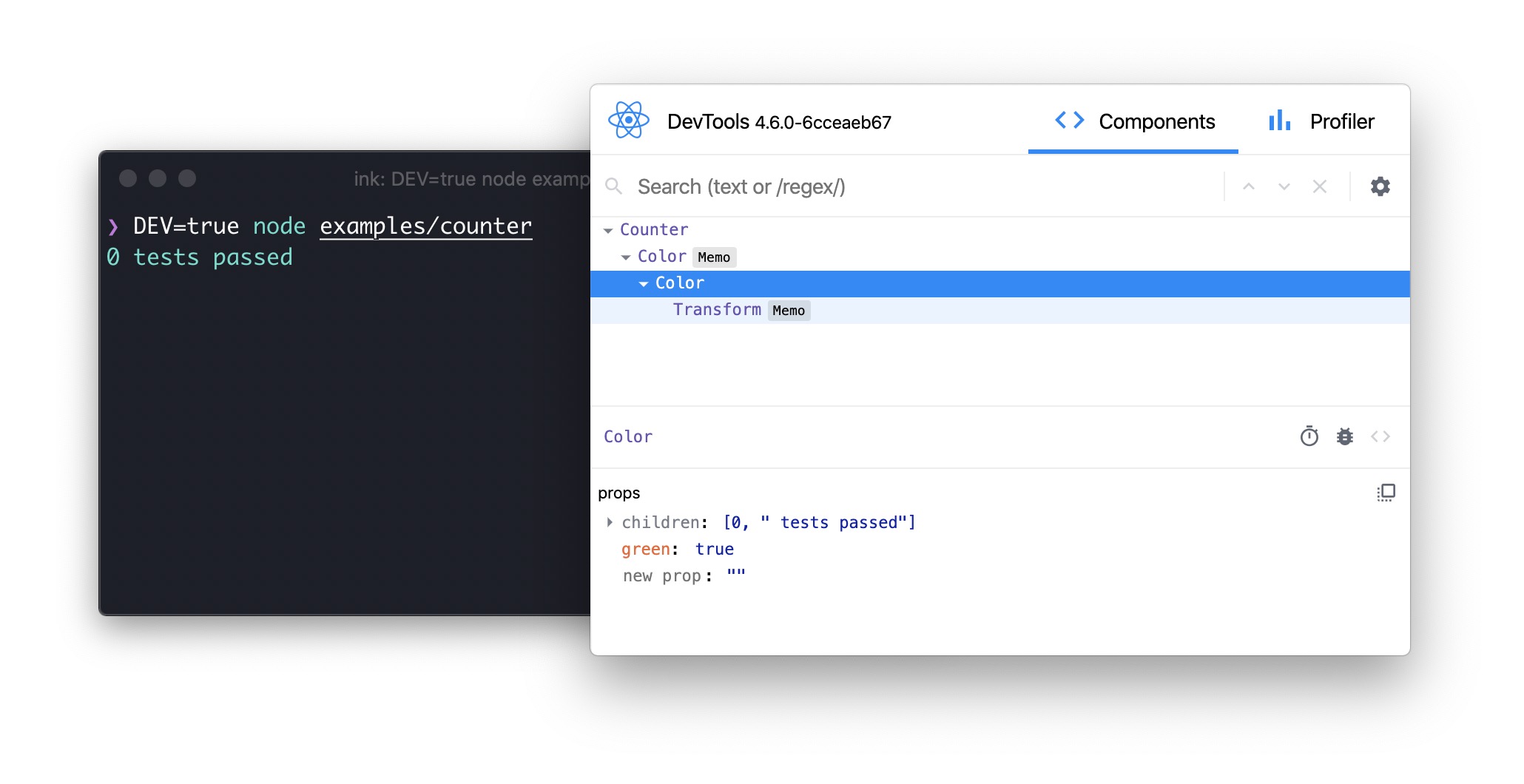
Ink supports React Devtools out of the box. To enable integration with React Devtools in your Ink-based CLI, first ensure you have installed the optional react-devtools-core dependency, and then run your app with the DEV=true environment variable:
DEV=true my-cli
Then, start React Devtools itself:
npx react-devtools
After it starts, you should see the component tree of your CLI. You can even inspect and change the props of components, and see the results immediately in the CLI, without restarting it.
Note: You must manually quit your CLI via Ctrl+C after you're done testing.
Screen Reader Support
Ink has basic support for screen readers.
To enable it, you can either pass the isScreenReaderEnabled option to the render function or set the INK_SCREEN_READER environment variable to true.
Ink implements a small subset of functionality from the ARIA specification.
render(<MyApp />, {isScreenReaderEnabled: true});
When screen reader support is enabled, Ink will try its best to generate a screen-reader-friendly output.
For example, for this code:
<Box aria-role="checkbox" aria-state={{checked: true}}>
	Accept terms and conditions
</Box>
Ink will generate the following output for screen readers:
(checked) checkbox: Accept terms and conditions
You can also provide a custom label for screen readers if you want to render something different for them.
For example, if you are building a progress bar, you can use aria-label to provide a more descriptive label for screen readers.
<Box>
	<Box width="50%" height={1} backgroundColor="green" />
	<Text aria-label="Progress: 50%">50%</Text>
</Box>
In the example above, the screen reader will read "Progress: 50%" instead of "50%".
aria-label
Type: string
A label for the element for screen readers.
aria-hidden
Type: boolean
Default: false
Hide the element from screen readers.
aria-role
Type: string
The role of the element.
Supported values:
buttoncheckboxradioradiogrouplistlistitemmenumenuitemprogressbartabtablisttimertoolbartable
aria-state
Type: object
The state of the element.
Supported values:
checked(boolean)disabled(boolean)expanded(boolean)selected(boolean)
Creating Components
When building custom components, it's important to keep accessibility in mind. While Ink provides the building blocks, ensuring your components are accessible will make your CLIs usable by a wider audience.
General Principles
- Provide screen reader-friendly output: Use the
useIsScreenReaderEnabledhook to detect if a screen reader is active. You can then render more descriptive output for screen reader users. - Leverage ARIA props: For components that have a specific role (e.g., a checkbox or button), use the
aria-role,aria-state, andaria-labelprops on<Box>and<Text>to provide semantic meaning to screen readers.
For a practical example of building an accessible component, see the ARIA example.
Useful Components
- ink-text-input - Text input.
- ink-spinner - Spinner.
- ink-select-input - Select (dropdown) input.
- ink-link - Link.
- ink-gradient - Gradient color.
- ink-big-text - Awesome text.
- ink-picture - Display images.
- ink-tab - Tab.
- ink-color-pipe - Create color text with simpler style strings.
- ink-multi-select - Select one or more values from a list
- ink-divider - A divider.
- ink-progress-bar - Progress bar.
- ink-table - Table.
- ink-ascii - Awesome text component with more font choices, based on Figlet.
- ink-markdown - Render syntax highlighted Markdown.
- ink-quicksearch-input - Select component with fast, quicksearch-like navigation.
- ink-confirm-input - Yes/No confirmation input.
- ink-syntax-highlight - Code syntax highlighting.
- ink-form - Form.
- ink-task-list - Task list.
- ink-spawn - Spawn child processes.
- ink-titled-box - Box with a title.
- ink-chart - Sparkline and bar chart.
Useful Hooks
- ink-use-stdout-dimensions - Subscribe to stdout dimensions.
Examples
The examples directory contains a set of real examples. You can run them with:
npm run example examples/[example name]
# e.g. npm run example examples/borders
- Jest - Implementation of basic Jest UI.
- Counter - A simple counter that increments every 100ms.
- Form with validation - Manage form state using Final Form.
- Borders - Add borders to the
<Box>component. - Suspense - Use React Suspense.
- Table - Renders a table with multiple columns and rows.
- Focus management - Use the
useFocushook to manage focus between components. - User input - Listen for user input.
- Write to stdout - Write to stdout, bypassing main Ink output.
- Write to stderr - Write to stderr, bypassing main Ink output.
- Static - Use the
<Static>component to render permanent output. - Child process - Renders output from a child process.
Maintainers
Discover Repositories
Search across tracked repositories by name or description