
sipeed/picoclaw
Tiny, Fast, and Deployable anywhere — automate the mundane, unleash your creativity
Build with Backblaze B2
SDKs, agent skills, IDE extensions, and reference pipelines from Backblaze Labs. All open source.
Loading star history...
Use Cases & Benefits
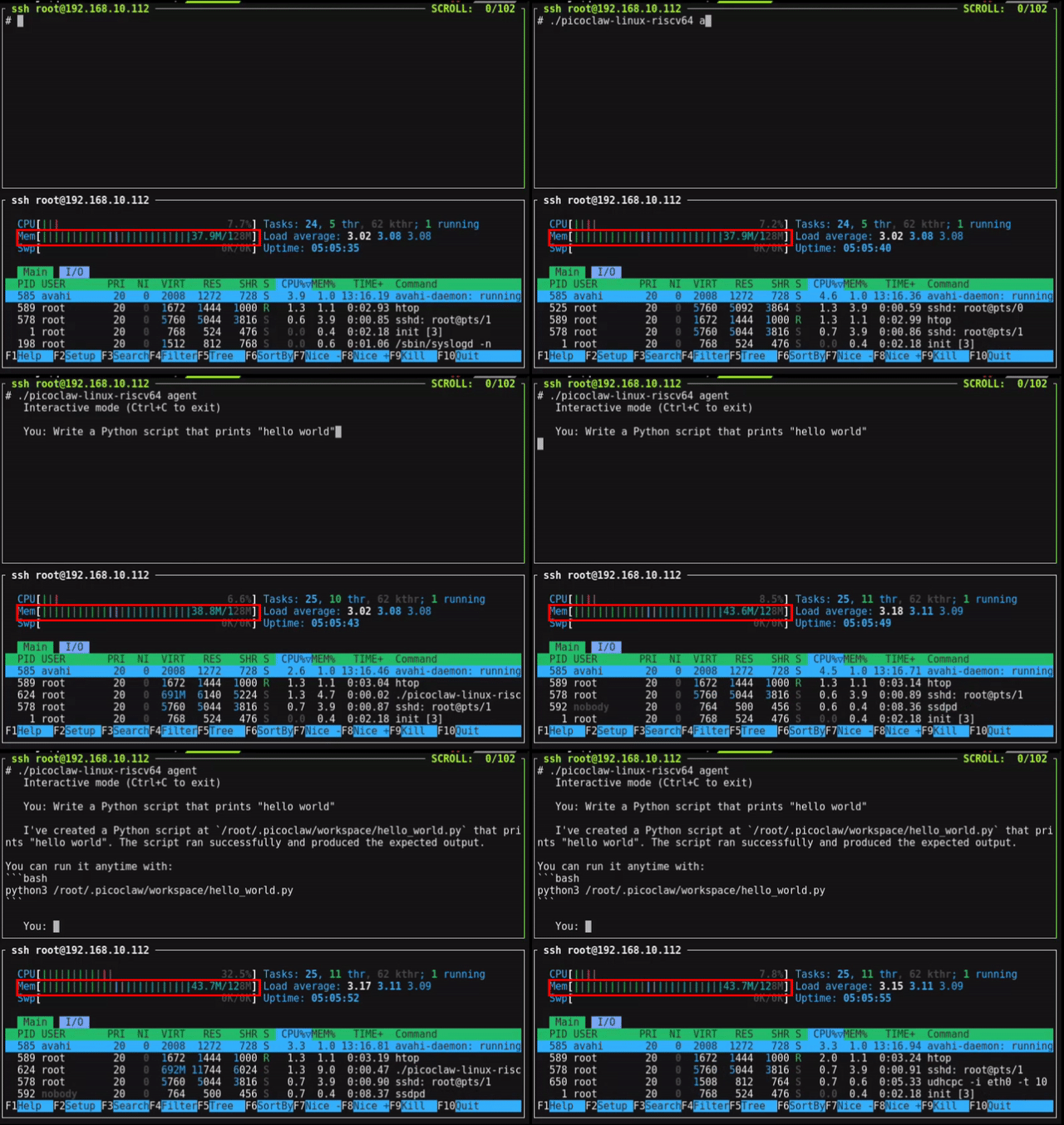
- Provides an ultra-lightweight, fast AI assistant written in Go that runs on minimal hardware with under 10MB RAM and boots in under one second.
- Delivers extreme efficiency and portability by supporting multiple CPU architectures with a single binary and running on $10 hardware, drastically reducing cost and resource usage.
- Use for deploying personal AI assistants on low-cost, resource-constrained devices like Raspberry Pi or RISC-V boards for home automation or lightweight AI tasks.
- Use for integrating AI capabilities into chat platforms such as Telegram, Discord, WhatsApp, and WeChat via native support for 18+ messaging channels.
- Use for developers needing a modular AI agent framework with native Model Context Protocol support to extend AI functionality with external tools and data sources.
About picoclaw

PicoClaw: Ultra-Efficient AI Assistant in Go
$10 Hardware · 10MB RAM · ms Boot · Let's Go, PicoClaw!






-SipeedIO-black?style=flat&logo=x&logoColor=white)


中文 | 日本語 | Português | Tiếng Việt | Français | Italiano | Bahasa Indonesia | Malay | English
PicoClaw is an independent open-source project initiated by Sipeed, written entirely in Go from scratch — not a fork of OpenClaw, NanoBot, or any other project.
PicoClaw is an ultra-lightweight personal AI assistant inspired by NanoBot. It was rebuilt from the ground up in Go through a "self-bootstrapping" process — the AI Agent itself drove the architecture migration and code optimization.
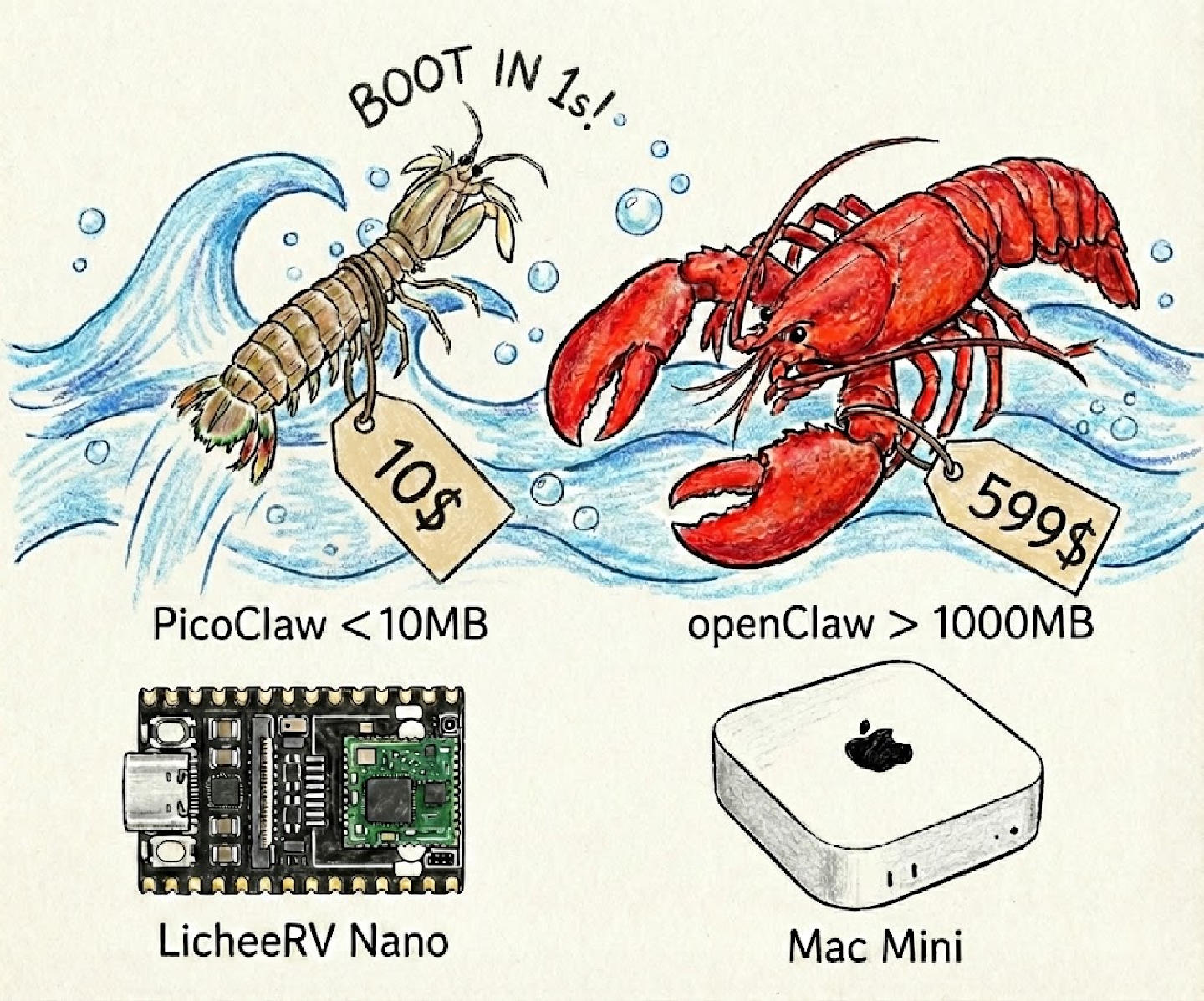
Runs on $10 hardware with <10MB RAM — that's 99% less memory than OpenClaw and 98% cheaper than a Mac mini!
|
|
|
[!CAUTION] Security Notice
- NO CRYPTO: PicoClaw has not issued any official tokens or cryptocurrency. All claims on
pump.funor other trading platforms are scams.- OFFICIAL DOMAIN: The ONLY official website is picoclaw.io, and company website is sipeed.com
- BEWARE: Many
.ai/.org/.com/.net/...domains have been registered by third parties. Do not trust them.- NOTE: PicoClaw is in early rapid development. There may be unresolved security issues. Do not deploy to production before v1.0.
- NOTE: PicoClaw has recently merged many PRs. Recent builds may use 10-20MB RAM. Resource optimization is planned after feature stabilization.
📢 News
2026-03-31 📱 Android Support! PicoClaw now runs on Android! Download the APK at picoclaw.io
2026-03-25 🚀 v0.2.4 Released! Agent architecture overhaul (SubTurn, Hooks, Steering, EventBus), WeChat/WeCom integration, security hardening (.security.yml, sensitive data filtering), new providers (AWS Bedrock, Azure, Xiaomi MiMo), and 35 bug fixes. PicoClaw has reached 26K Stars!
2026-03-17 🚀 v0.2.3 Released! System tray UI (Windows & Linux), sub-agent status query (spawn_status), experimental Gateway hot-reload, Cron security gating, and 2 security fixes. PicoClaw has reached 25K Stars!
2026-03-09 🎉 v0.2.1 — Biggest update yet! MCP protocol support, 4 new channels (Matrix/IRC/WeCom/Discord Proxy), 3 new providers (Kimi/Minimax/Avian), vision pipeline, JSONL memory store, model routing.
2026-02-28 📦 v0.2.0 released with Docker Compose and Web UI Launcher support.
Earlier news...
2026-02-26 🎉 PicoClaw hits 20K Stars in just 17 days! Channel auto-orchestration and capability interfaces are live.
2026-02-16 🎉 PicoClaw breaks 12K Stars in one week! Community maintainer roles and Roadmap officially launched.
2026-02-13 🎉 PicoClaw breaks 5000 Stars in 4 days! Project roadmap and developer groups in progress.
2026-02-09 🎉 PicoClaw Released! Built in 1 day to bring AI Agents to $10 hardware with <10MB RAM. Let's Go, PicoClaw!
✨ Features
🪶 Ultra-lightweight: Core memory footprint <10MB — 99% smaller than OpenClaw.*
💰 Minimal cost: Efficient enough to run on $10 hardware — 98% cheaper than a Mac mini.
⚡️ Lightning-fast boot: 400x faster startup. Boots in <1s even on a 0.6GHz single-core processor.
🌍 Truly portable: Single binary across RISC-V, ARM, MIPS, and x86 architectures. One binary, runs everywhere!
🤖 AI-bootstrapped: Pure Go native implementation — 95% of core code was generated by an Agent and fine-tuned through human-in-the-loop review.
🔌 MCP support: Native Model Context Protocol integration — connect any MCP server to extend Agent capabilities.
👁️ Vision pipeline: Send images and files directly to the Agent — automatic base64 encoding for multimodal LLMs.
🧠 Smart routing: Rule-based model routing — simple queries go to lightweight models, saving API costs.
*Recent builds may use 10-20MB due to rapid PR merges. Resource optimization is planned. Boot speed comparison based on 0.8GHz single-core benchmarks (see table below).
| OpenClaw | NanoBot | PicoClaw | |
|---|---|---|---|
| Language | TypeScript | Python | Go |
| RAM | >1GB | >100MB | < 10MB* |
| Boot time (0.8GHz core) | >500s | >30s | <1s |
| Cost | Mac Mini $599 | Most Linux boards ~$50 | Any Linux board from $10 |
Hardware Compatibility List — See all tested boards, from $5 RISC-V to Raspberry Pi to Android phones. Your board not listed? Submit a PR!
🦾 Demonstration
🛠️ Standard Assistant Workflows
Full-Stack Engineer Mode | Logging & Planning | Web Search & Learning |
|---|---|---|
|
|
|
| Develop · Deploy · Scale | Schedule · Automate · Remember | Discover · Insights · Trends |
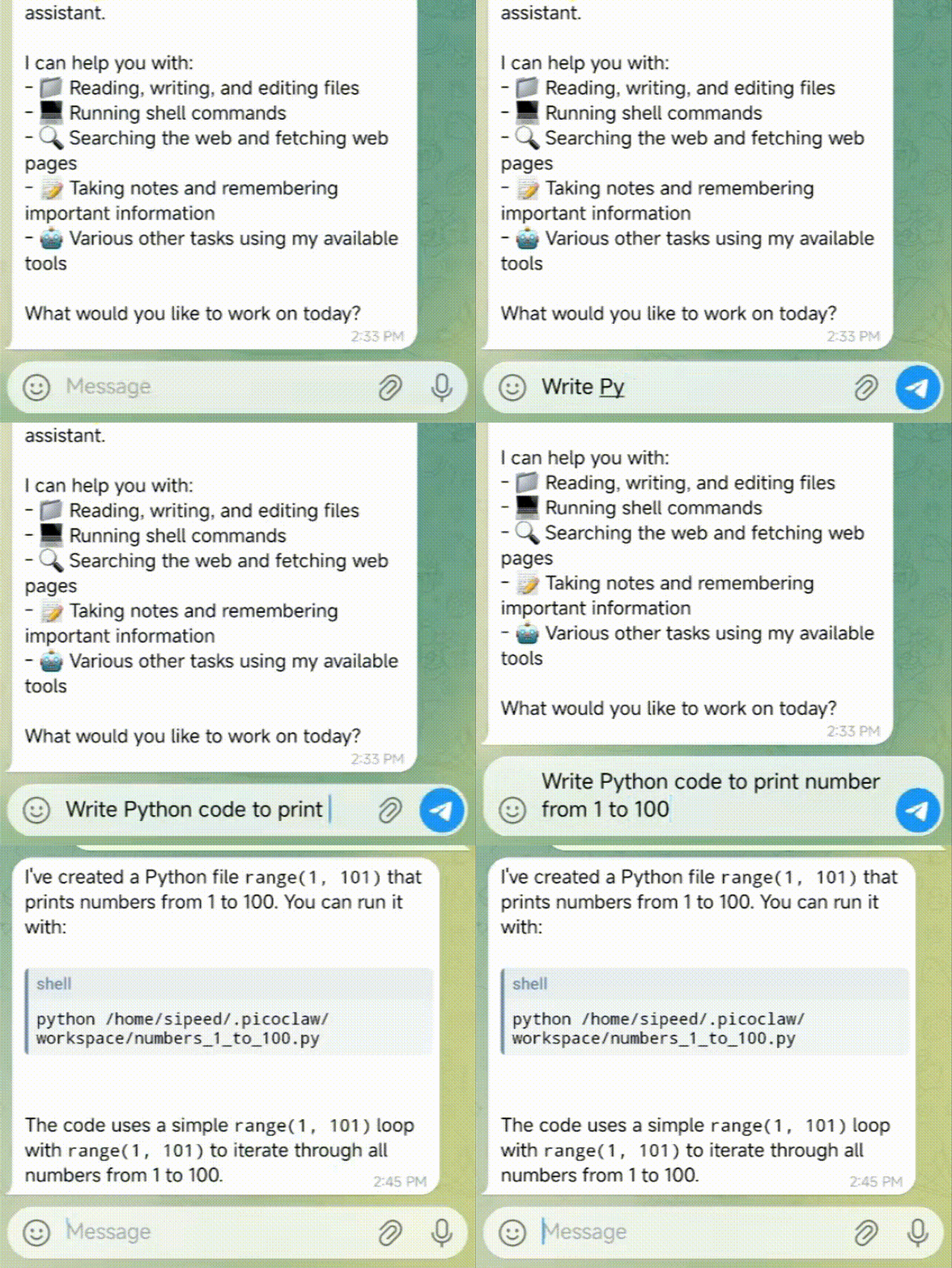
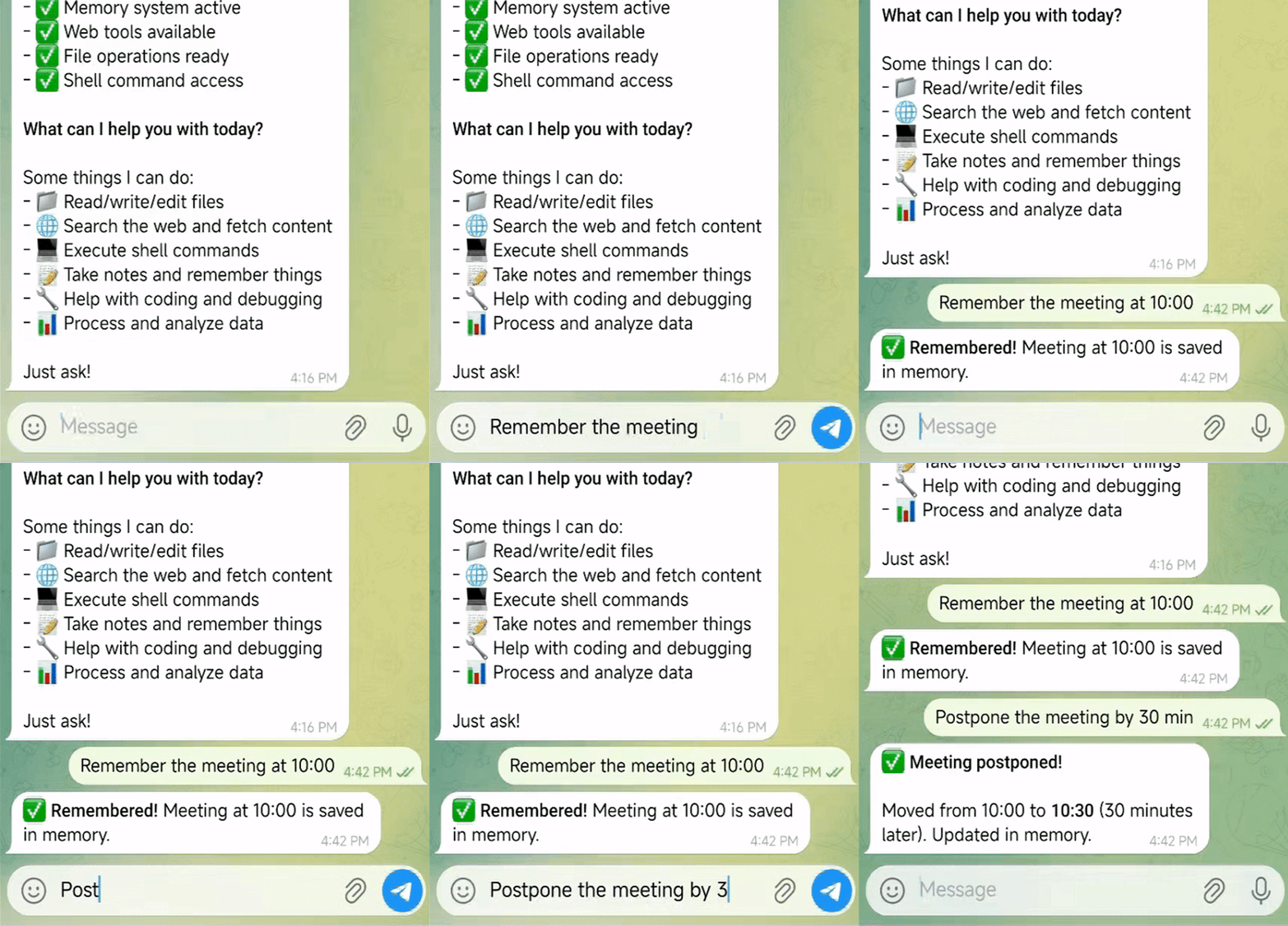
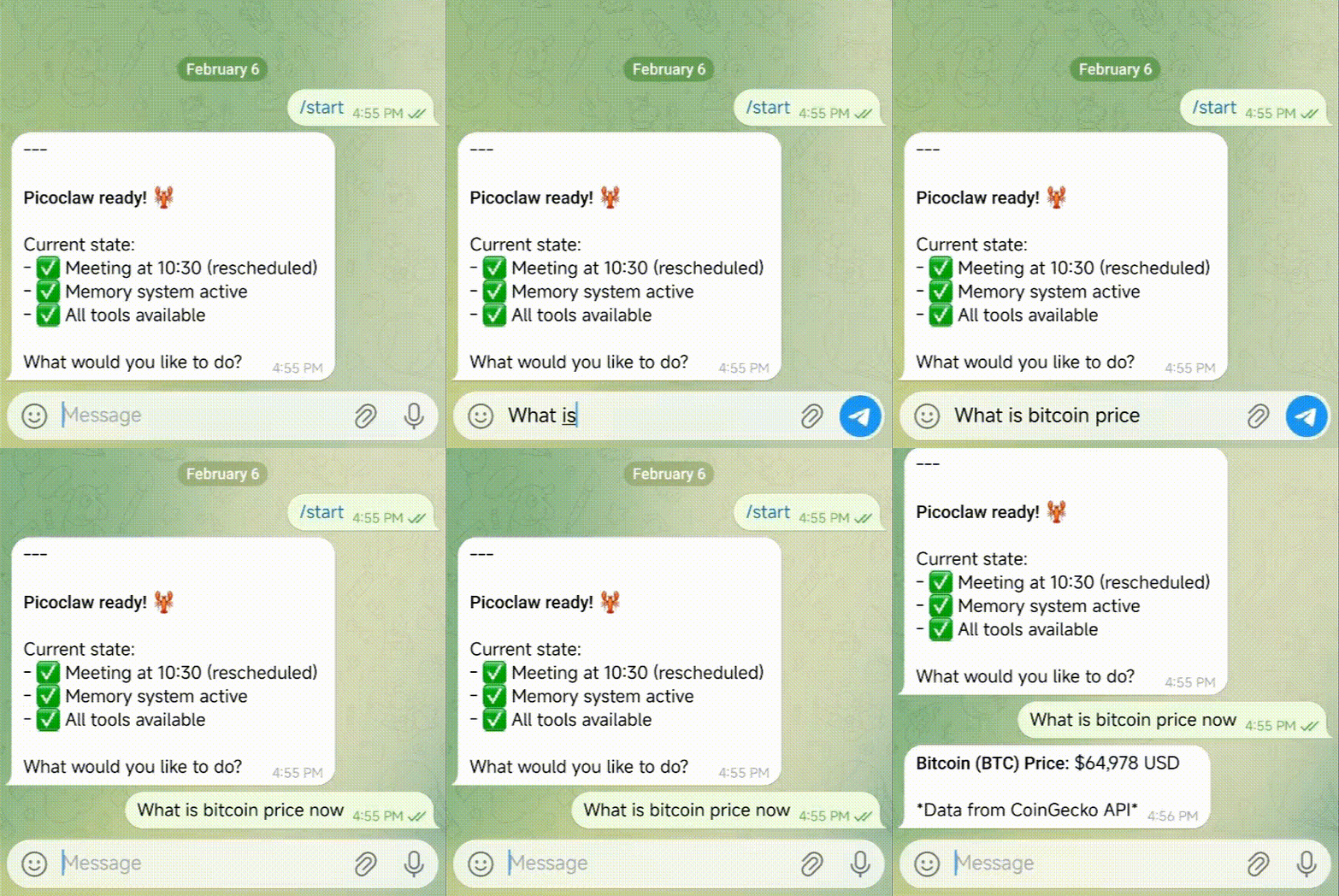
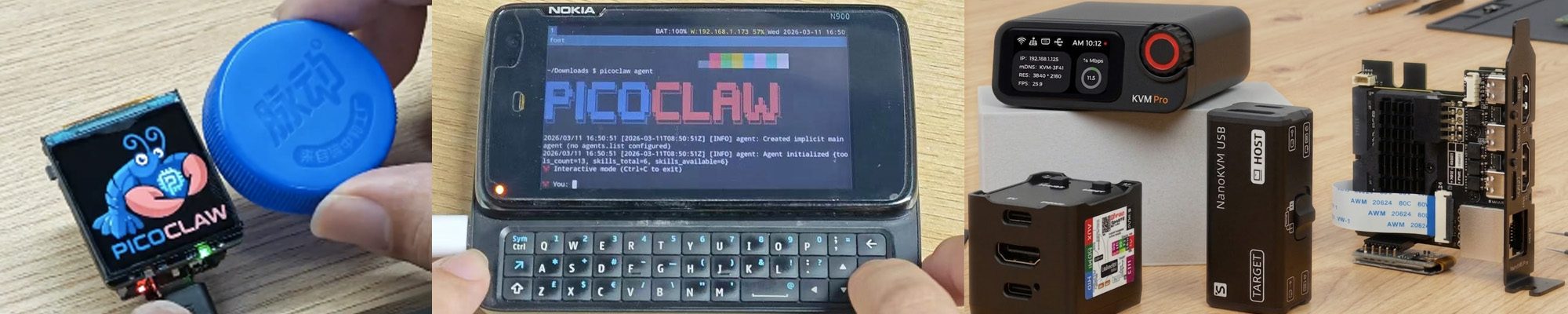
🐜 Innovative Low-Footprint Deployment
PicoClaw can be deployed on virtually any Linux device!
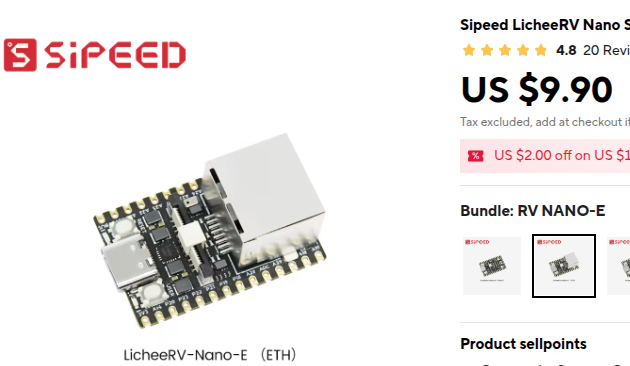
- $9.9 LicheeRV-Nano E(Ethernet) or W(WiFi6) edition, for a minimal home assistant
- $30~50 NanoKVM, or $100 NanoKVM-Pro, for automated server operations
- $50 MaixCAM or $100 MaixCAM2, for smart surveillance
🌟 More Deployment Cases Await!
📦 Install
Download from picoclaw.io (Recommended)
Visit picoclaw.io — the official website auto-detects your platform and provides one-click download. No need to manually pick an architecture.
Download precompiled binary
Alternatively, download the binary for your platform from the GitHub Releases page.
Build from source (for development)
git clone https://github.com/sipeed/picoclaw.git

cd picoclaw
make deps

# Build core binary
make build

# Build Web UI Launcher (required for WebUI mode)
make build-launcher

# Build for multiple platforms
make build-all

# Build for Raspberry Pi Zero 2 W (32-bit: make build-linux-arm; 64-bit: make build-linux-arm64)
make build-pi-zero

# Build and install
make install
Raspberry Pi Zero 2 W: Use the binary that matches your OS: 32-bit Raspberry Pi OS -> make build-linux-arm; 64-bit -> make build-linux-arm64. Or run make build-pi-zero to build both.
🚀 Quick Start Guide
🌐 WebUI Launcher (Recommended for Desktop)
The WebUI Launcher provides a browser-based interface for configuration and chat. This is the easiest way to get started — no command-line knowledge required.
Option 1: Double-click (Desktop)
After downloading from picoclaw.io, double-click picoclaw-launcher (or picoclaw-launcher.exe on Windows). Your browser will open automatically at http://localhost:18800.
Option 2: Command line
picoclaw-launcher
# Open http://localhost:18800 in your browser
[!TIP] Remote access / Docker / VM: Add the
-publicflag to listen on all interfaces:picoclaw-launcher -public
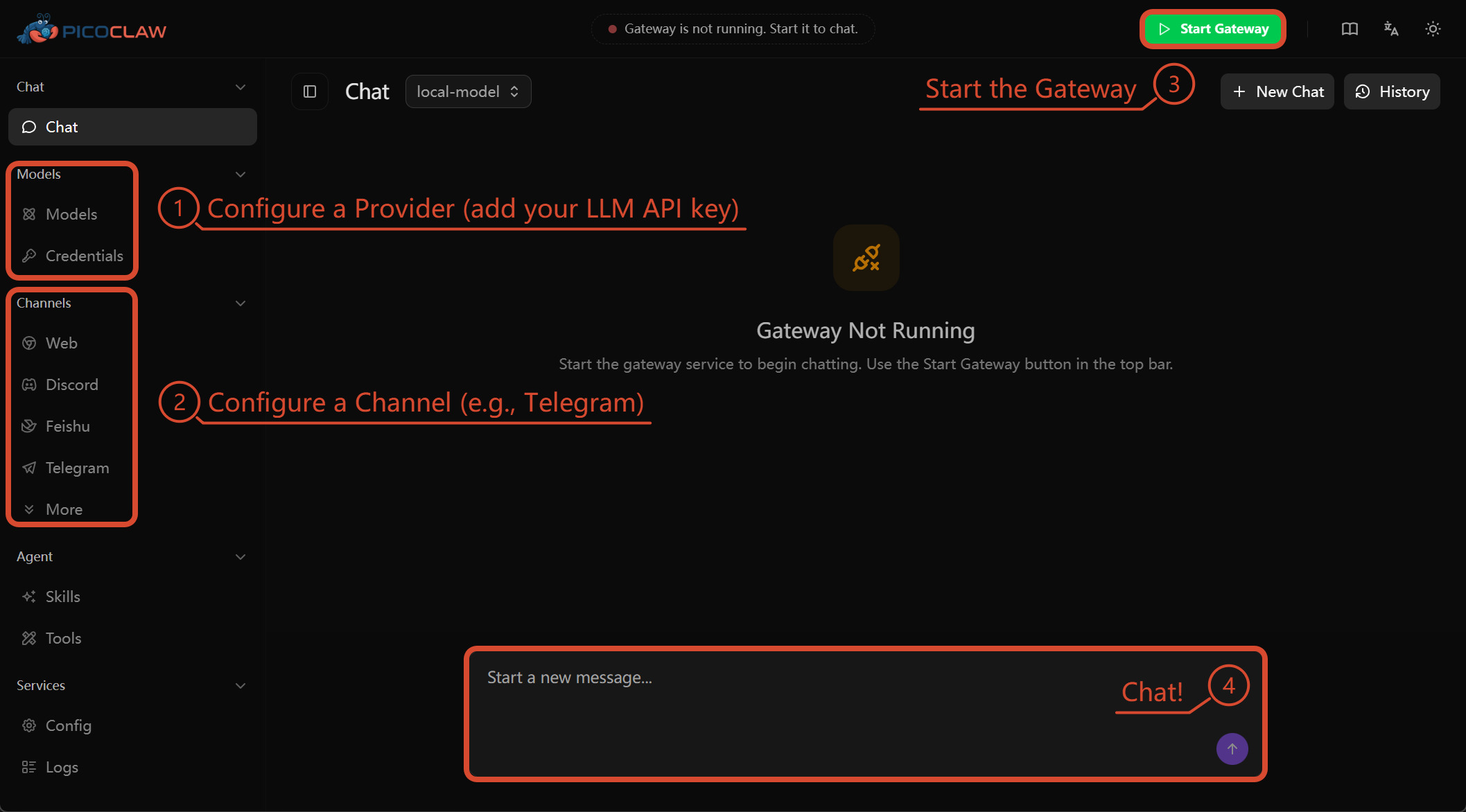
Getting started:
Open the WebUI, then: 1) Configure a Provider (add your LLM API key) -> 2) Configure a Channel (e.g., Telegram) -> 3) Start the Gateway -> 4) Chat!
For detailed WebUI documentation, see docs.picoclaw.io.
Docker (alternative)
# 1. Clone this repo
git clone https://github.com/sipeed/picoclaw.git
cd picoclaw

# 2. First run — auto-generates docker/data/config.json then exits
#    (only triggers when both config.json and workspace/ are missing)
docker compose -f docker/docker-compose.yml --profile launcher up
# The container prints "First-run setup complete." and stops.

# 3. Set your API keys
vim docker/data/config.json

# 4. Start
docker compose -f docker/docker-compose.yml --profile launcher up -d
# Open http://localhost:18800
Docker / VM users: The Gateway listens on
127.0.0.1by default. SetPICOCLAW_GATEWAY_HOST=0.0.0.0or use the-publicflag to make it accessible from the host.
# Check logs
docker compose -f docker/docker-compose.yml logs -f

# Stop
docker compose -f docker/docker-compose.yml --profile launcher down

# Update
docker compose -f docker/docker-compose.yml pull
docker compose -f docker/docker-compose.yml --profile launcher up -d
macOS — First Launch Security Warning
macOS may block picoclaw-launcher on first launch because it is downloaded from the internet and not notarized through the Mac App Store.
Step 1: Double-click picoclaw-launcher. You will see a security warning:
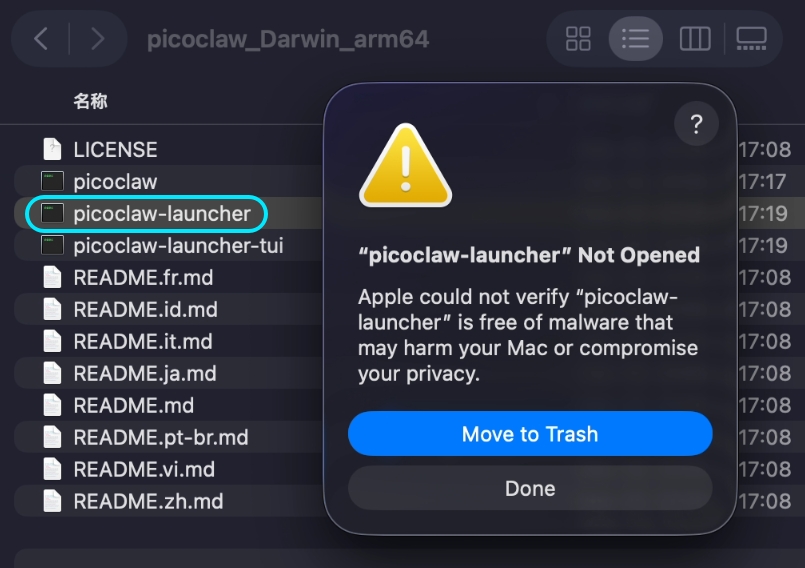
"picoclaw-launcher" Not Opened — Apple could not verify "picoclaw-launcher" is free of malware that may harm your Mac or compromise your privacy.
Step 2: Open System Settings → Privacy & Security → scroll down to the Security section → click Open Anyway → confirm by clicking Open Anyway in the dialog.
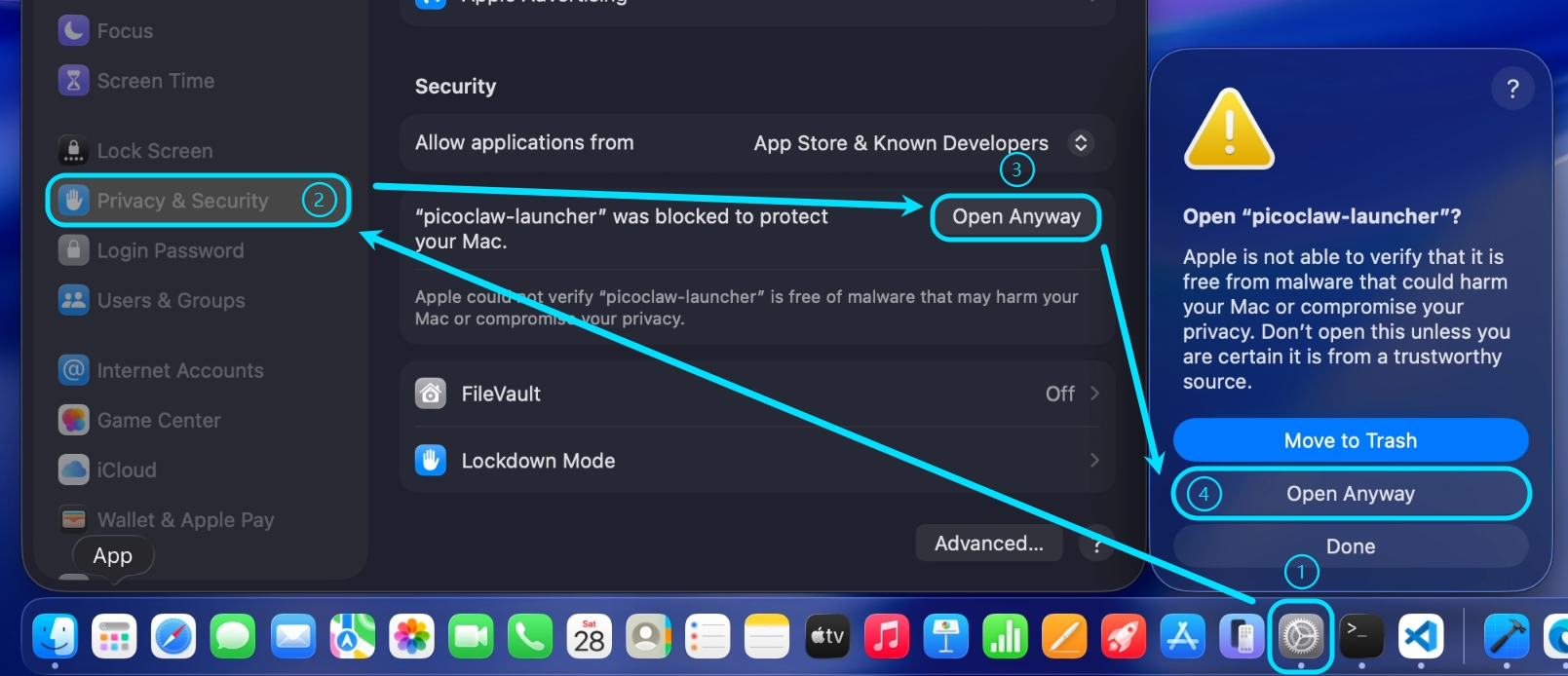
After this one-time step, picoclaw-launcher will open normally on subsequent launches.
💻 TUI Launcher (Recommended for Headless / SSH)
The TUI (Terminal UI) Launcher provides a full-featured terminal interface for configuration and management. Ideal for servers, Raspberry Pi, and other headless environments.
picoclaw-launcher-tui
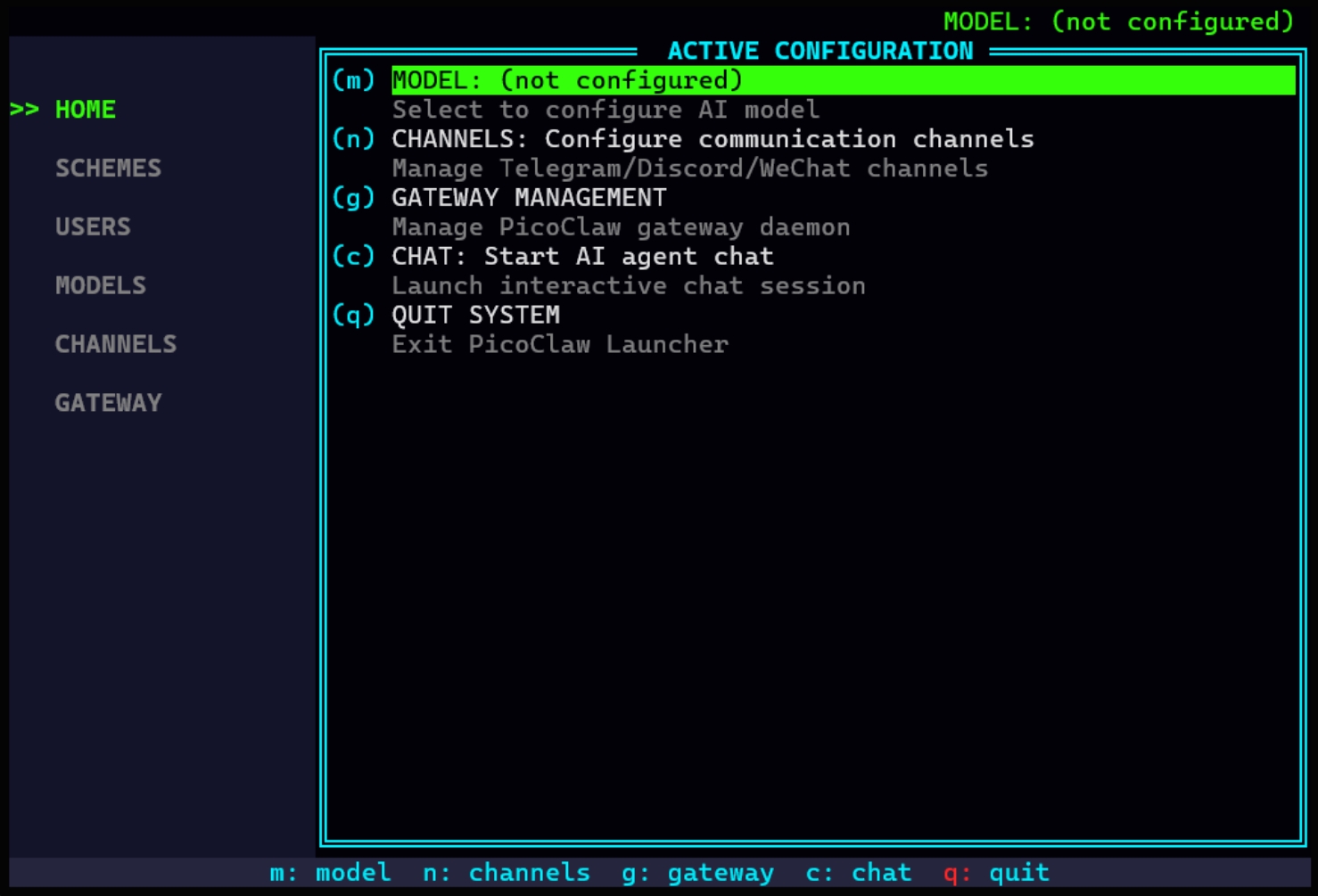
Getting started:
Use the TUI menus to: 1) Configure a Provider -> 2) Configure a Channel -> 3) Start the Gateway -> 4) Chat!
For detailed TUI documentation, see docs.picoclaw.io.
📱 Android
Give your decade-old phone a second life! Turn it into a smart AI Assistant with PicoClaw.
Option 1: APK Install
Preview:
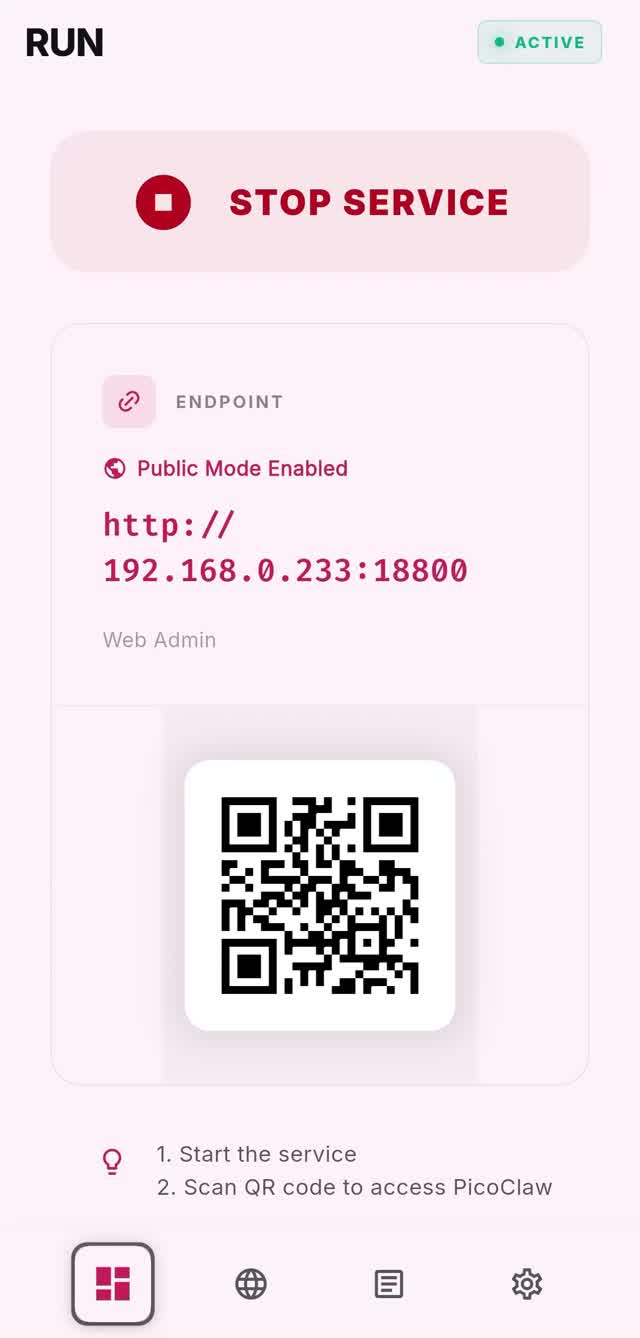 | 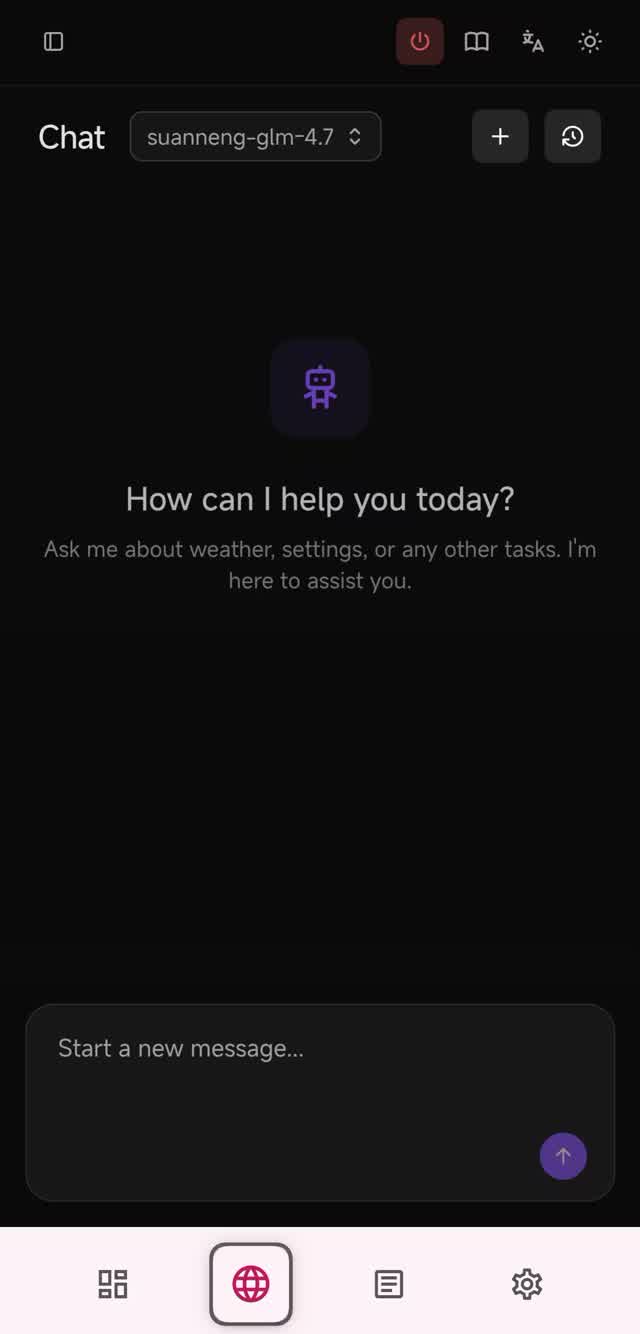 | 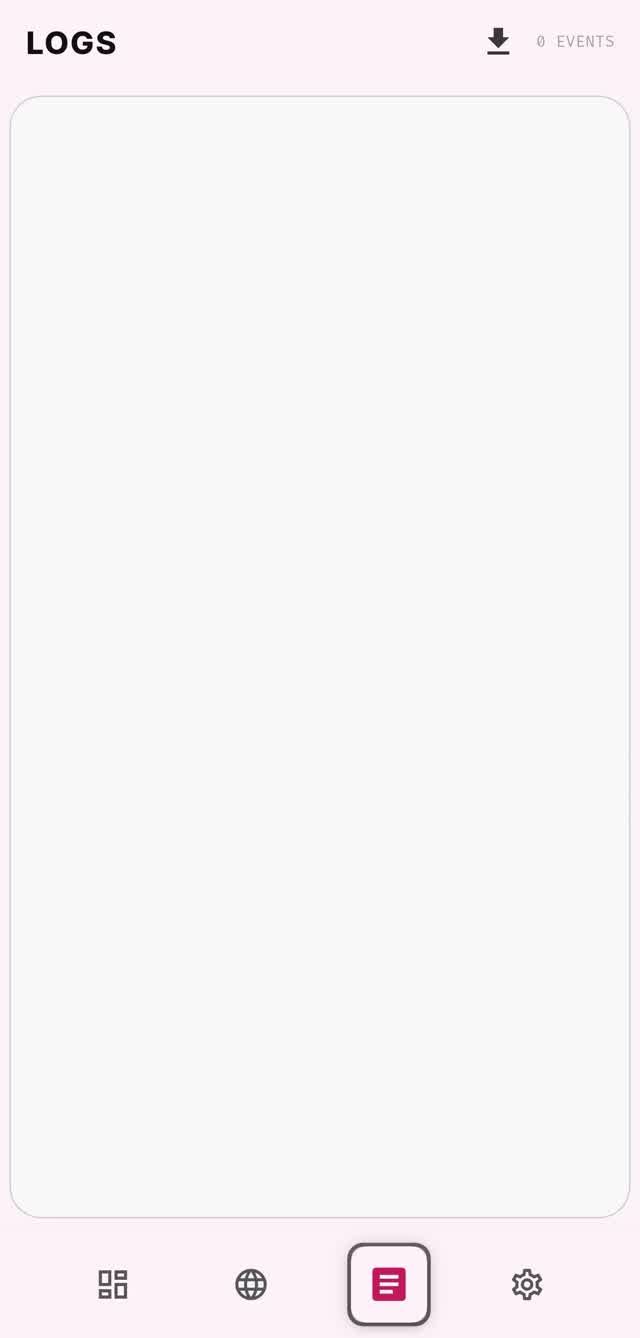 | 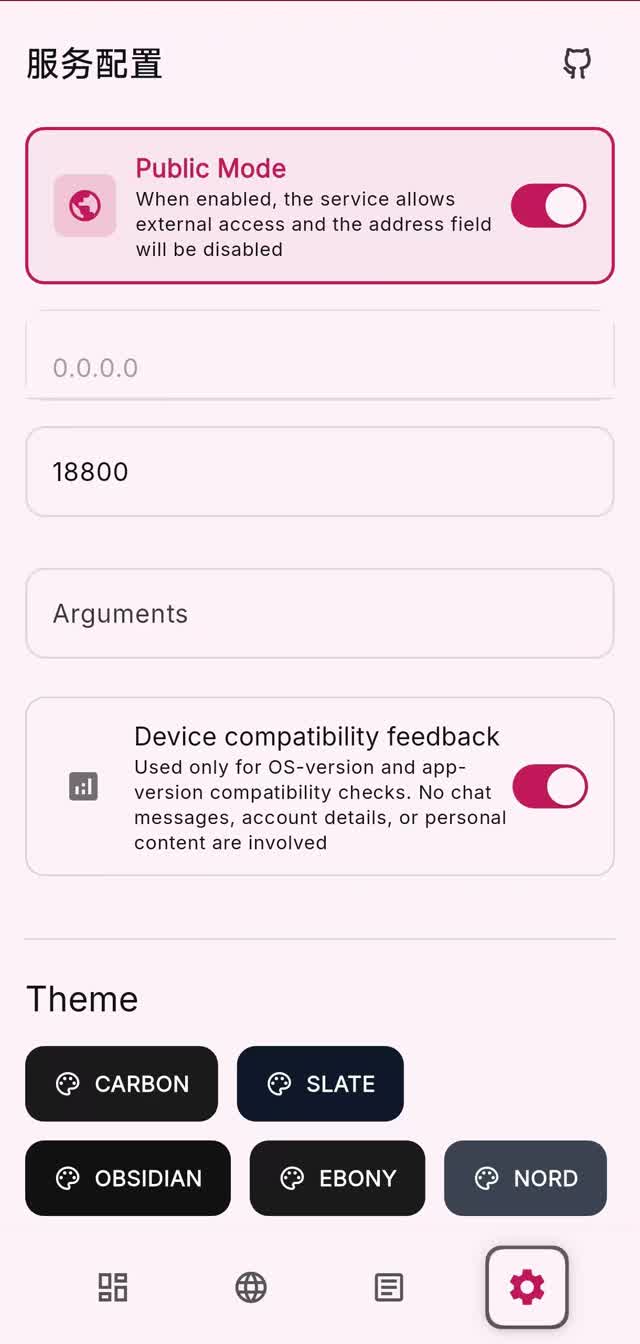 |
Download the APK from picoclaw.io and install directly. No Termux required!
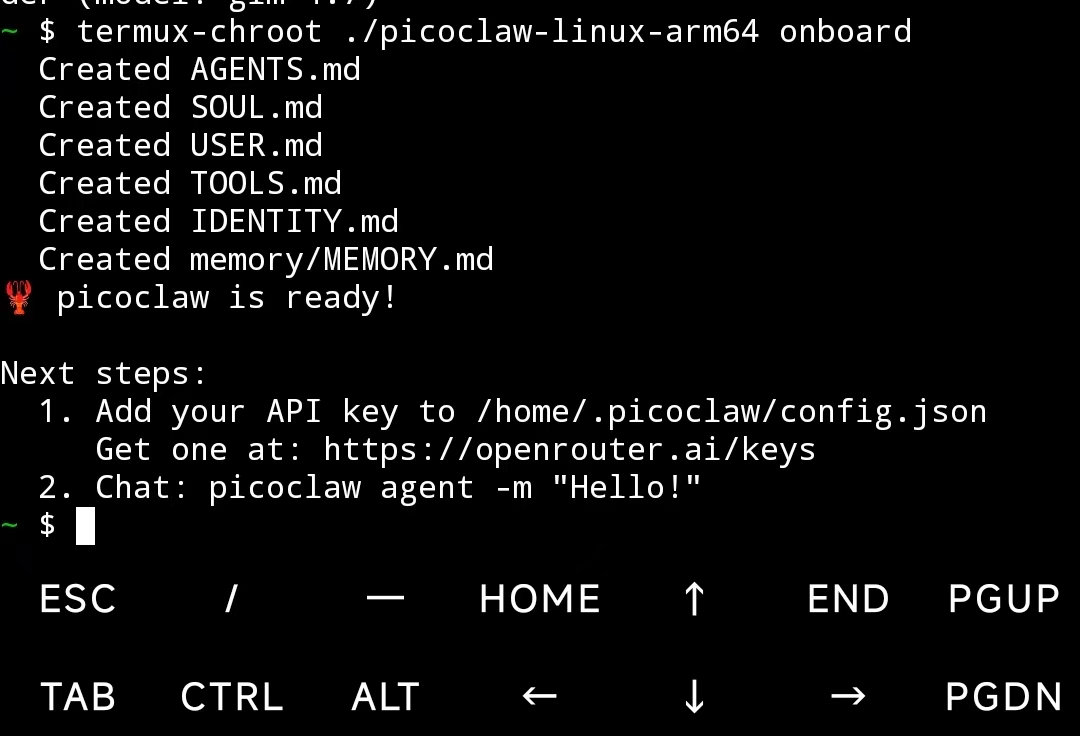
Option 2: Termux
Terminal Launcher (for resource-constrained environments)
- Install Termux (download from GitHub Releases, or search in F-Droid / Google Play)
- Run the following commands:
# Download the latest release
wget https://github.com/sipeed/picoclaw/releases/latest/download/picoclaw_Linux_arm64.tar.gz
tar xzf picoclaw_Linux_arm64.tar.gz
pkg install proot
termux-chroot ./picoclaw onboard   # chroot provides a standard Linux filesystem layout
Then follow the Terminal Launcher section below to complete configuration.
For minimal environments where only the picoclaw core binary is available (no Launcher UI), you can configure everything via the command line and a JSON config file.
1. Initialize
picoclaw onboard
This creates ~/.picoclaw/config.json and the workspace directory.
2. Configure (~/.picoclaw/config.json)
{
  "agents": {
    "defaults": {
      "model_name": "gpt-5.4"
    }
  },
  "model_list": [
    {
      "model_name": "gpt-5.4",
      "model": "openai/gpt-5.4"
      // api_key is now loaded from .security.yml
    }
  ]
}
See
config/config.example.jsonin the repo for a complete configuration template with all available options.Please note: config.example.json format is version 0, with sensitive codes in it, and will be auto migrated to version 1+, then, the config.json will only store insensitive data, the sensitive codes will be stored in .security.yml, if you need manually modify the codes, please see
docs/security_configuration.mdfor more details.
3. Chat
# One-shot question
picoclaw agent -m "What is 2+2?"

# Interactive mode
picoclaw agent

# Start gateway for chat app integration
picoclaw gateway
🔌 Providers (LLM)
PicoClaw supports 30+ LLM providers through the model_list configuration. Use the protocol/model format:
| Provider | Protocol | API Key | Notes |
|---|---|---|---|
| OpenAI | openai/ | Required | GPT-5.4, GPT-4o, o3, etc. |
| Anthropic | anthropic/ | Required | Claude Opus 4.6, Sonnet 4.6, etc. |
| Google Gemini | gemini/ | Required | Gemini 3 Flash, 2.5 Pro, etc. |
| OpenRouter | openrouter/ | Required | 200+ models, unified API |
| Zhipu (GLM) | zhipu/ | Required | GLM-4.7, GLM-5, etc. |
| DeepSeek | deepseek/ | Required | DeepSeek-V3, DeepSeek-R1 |
| Volcengine | volcengine/ | Required | Doubao, Ark models |
| Qwen | qwen/ | Required | Qwen3, Qwen-Max, etc. |
| Groq | groq/ | Required | Fast inference (Llama, Mixtral) |
| Moonshot (Kimi) | moonshot/ | Required | Kimi models |
| Minimax | minimax/ | Required | MiniMax models |
| Mistral | mistral/ | Required | Mistral Large, Codestral |
| NVIDIA NIM | nvidia/ | Required | NVIDIA hosted models |
| Cerebras | cerebras/ | Required | Fast inference |
| Novita AI | novita/ | Required | Various open models |
| Xiaomi MiMo | mimo/ | Required | MiMo models |
| Ollama | ollama/ | Not needed | Local models, self-hosted |
| vLLM | vllm/ | Not needed | Local deployment, OpenAI-compatible |
| LiteLLM | litellm/ | Varies | Proxy for 100+ providers |
| Azure OpenAI | azure/ | Required | Enterprise Azure deployment |
| GitHub Copilot | github-copilot/ | OAuth | Device code login |
| Antigravity | antigravity/ | OAuth | Google Cloud AI |
| AWS Bedrock* | bedrock/ | AWS credentials | Claude, Llama, Mistral on AWS |
* AWS Bedrock requires build tag:
go build -tags bedrock. Setapi_baseto a region name (e.g.,us-east-1) for automatic endpoint resolution across all AWS partitions (aws, aws-cn, aws-us-gov). When using a full endpoint URL instead, you must also configureAWS_REGIONvia environment variable or AWS config/profile.
Local deployment (Ollama, vLLM, etc.)
Ollama:
{
  "model_list": [
    {
      "model_name": "local-llama",
      "model": "ollama/llama3.1:8b",
      "api_base": "http://localhost:11434/v1"
    }
  ]
}
vLLM:
{
  "model_list": [
    {
      "model_name": "local-vllm",
      "model": "vllm/your-model",
      "api_base": "http://localhost:8000/v1"
    }
  ]
}
For full provider configuration details, see Providers & Models.
💬 Channels (Chat Apps)
Talk to your PicoClaw through 18+ messaging platforms:
| Channel | Setup | Protocol | Docs |
|---|---|---|---|
| Telegram | Easy (bot token) | Long polling | Guide |
| Discord | Easy (bot token + intents) | WebSocket | Guide |
| Easy (QR scan or bridge URL) | Native / Bridge | Guide | |
| Weixin | Easy (Native QR scan) | iLink API | Guide |
| Easy (AppID + AppSecret) | WebSocket | Guide | |
| Slack | Easy (bot + app token) | Socket Mode | Guide |
| Matrix | Medium (homeserver + token) | Sync API | Guide |
| DingTalk | Medium (client credentials) | Stream | Guide |
| Feishu / Lark | Medium (App ID + Secret) | WebSocket/SDK | Guide |
| LINE | Medium (credentials + webhook) | Webhook | Guide |
| WeCom | Easy (QR login or manual) | WebSocket | Guide |
| VK | Easy (group token) | Long Poll | Guide |
| IRC | Medium (server + nick) | IRC protocol | Guide |
| OneBot | Medium (WebSocket URL) | OneBot v11 | Guide |
| MaixCam | Easy (enable) | TCP socket | Guide |
| Pico | Easy (enable) | Native protocol | Built-in |
| Pico Client | Easy (WebSocket URL) | WebSocket | Built-in |
All webhook-based channels share a single Gateway HTTP server (
gateway.host:gateway.port, default127.0.0.1:18790). Feishu uses WebSocket/SDK mode and does not use the shared HTTP server.
Log verbosity is controlled by
gateway.log_level(default:warn). Supported values:debug,info,warn,error,fatal. Can also be set viaPICOCLAW_LOG_LEVEL. See Configuration for details.
For detailed channel setup instructions, see Chat Apps Configuration.
🔧 Tools
🔍 Web Search
PicoClaw can search the web to provide up-to-date information. Configure in tools.web:
| Search Engine | API Key | Free Tier | Link |
|---|---|---|---|
| DuckDuckGo | Not needed | Unlimited | Built-in fallback |
| Baidu Search | Required | 1000 queries/day | AI-powered, China-optimized |
| Tavily | Required | 1000 queries/month | Optimized for AI Agents |
| Brave Search | Required | 2000 queries/month | Fast and private |
| Perplexity | Required | Paid | AI-powered search |
| SearXNG | Not needed | Self-hosted | Free metasearch engine |
| GLM Search | Required | Varies | Zhipu web search |
⚙️ Other Tools
PicoClaw includes built-in tools for file operations, code execution, scheduling, and more. See Tools Configuration for details.
🎯 Skills
Skills are modular capabilities that extend your Agent. They are loaded from SKILL.md files in your workspace.
Install skills from ClawHub:
picoclaw skills search "web scraping"
picoclaw skills install <skill-name>
Configure ClawHub token (optional, for higher rate limits):
Add to your config.json:
{
  "tools": {
    "skills": {
      "registries": {
        "clawhub": {
          "auth_token": "your-clawhub-token"
        }
      }
    }
  }
}
For more details, see Tools Configuration - Skills.
🔗 MCP (Model Context Protocol)
PicoClaw natively supports MCP — connect any MCP server to extend your Agent's capabilities with external tools and data sources.
{
  "tools": {
    "mcp": {
      "enabled": true,
      "servers": {
        "filesystem": {
          "enabled": true,
          "command": "npx",
          "args": ["-y", "@modelcontextprotocol/server-filesystem", "/tmp"]
        }
      }
    }
  }
}
For full MCP configuration (stdio, SSE, HTTP transports, Tool Discovery), see Tools Configuration - MCP.
 Join the Agent Social Network
Connect PicoClaw to the Agent Social Network simply by sending a single message via the CLI or any integrated Chat App.
Read https://clawdchat.ai/skill.md and follow the instructions to join ClawdChat.ai
🖥️ CLI Reference
| Command | Description |
|---|---|
picoclaw onboard | Initialize config & workspace |
picoclaw auth weixin | Connect WeChat account via QR |
picoclaw agent -m "..." | Chat with the agent |
picoclaw agent | Interactive chat mode |
picoclaw gateway | Start the gateway |
picoclaw status | Show status |
picoclaw version | Show version info |
picoclaw model | View or switch the default model |
picoclaw cron list | List all scheduled jobs |
picoclaw cron add ... | Add a scheduled job |
picoclaw cron disable | Disable a scheduled job |
picoclaw cron remove | Remove a scheduled job |
picoclaw skills list | List installed skills |
picoclaw skills install | Install a skill |
picoclaw migrate | Migrate data from older versions |
picoclaw auth login | Authenticate with providers |
⏰ Scheduled Tasks / Reminders
PicoClaw supports scheduled reminders and recurring tasks through the cron tool:
- One-time reminders: "Remind me in 10 minutes" -> triggers once after 10min
- Recurring tasks: "Remind me every 2 hours" -> triggers every 2 hours
- Cron expressions: "Remind me at 9am daily" -> uses cron expression
See docs/cron.md for current schedule types, execution modes, command-job gates, and persistence details.
📚 Documentation
For detailed guides beyond this README:
| Topic | Description |
|---|---|
| Docker & Quick Start | Docker Compose setup, Launcher/Agent modes |
| Chat Apps | All 17+ channel setup guides |
| Configuration | Environment variables, workspace layout, security sandbox |
| Scheduled Tasks and Cron Jobs | Cron schedule types, deliver modes, command gates, job storage |
| Providers & Models | 30+ LLM providers, model routing, model_list configuration |
| Spawn & Async Tasks | Quick tasks, long tasks with spawn, async sub-agent orchestration |
| Hooks | Event-driven hook system: observers, interceptors, approval hooks |
| Steering | Inject messages into a running agent loop between tool calls |
| SubTurn | Subagent coordination, concurrency control, lifecycle |
| Troubleshooting | Common issues and solutions |
| Tools Configuration | Per-tool enable/disable, exec policies, MCP, Skills |
| Hardware Compatibility | Tested boards, minimum requirements |
🤝 Contribute & Roadmap
PRs welcome! The codebase is intentionally small and readable.
See our Community Roadmap and CONTRIBUTING.md for guidelines.
Developer group building, join after your first merged PR!
User Groups:
Discord: https://discord.gg/V4sAZ9XWpN
WeChat:
Discover Repositories
Search across tracked repositories by name or description