
sgl-project/sglang
SGLang is a high-performance serving framework for large language models and multimodal models.
Build with Backblaze B2
SDKs, agent skills, IDE extensions, and reference pipelines from Backblaze Labs. All open source.
Loading star history...
Use Cases & Benefits
- Provides a high-performance serving framework for large language and multimodal models with optimized backend runtime and flexible frontend language.
- Delivers significantly faster inference and efficient resource utilization through innovations like RadixAttention, zero-overhead scheduling, and multi-parallelism support.
- Use for deploying large-scale LLM inference pipelines requiring high throughput and low latency on GPU clusters.
- Use for building advanced LLM applications with complex prompting, multi-modal inputs, and parallel generation workflows.
- Use for integrating and serving diverse generative, embedding, and reward models with extensible support for new architectures.
About sglang







| Blog | Documentation | Join Slack | Join Bi-Weekly Development Meeting | Roadmap | Slides |
News
- [2025/08] 🔔 SGLang x AMD SF Meetup on 8/22: Hands-on GPU workshop, tech talks by AMD/xAI/SGLang, and networking (Roadmap, Large-scale EP, Highlights, AITER/MoRI, Wave).
- [2025/08] 🔥 SGLang provides day-0 support for OpenAI gpt-oss model (instructions)
- [2025/06] 🔥 SGLang, the high-performance serving infrastructure powering trillions of tokens daily, has been awarded the third batch of the Open Source AI Grant by a16z (a16z blog).
- [2025/06] 🔥 Deploying DeepSeek on GB200 NVL72 with PD and Large Scale EP (Part I): 2.7x Higher Decoding Throughput (blog).
- [2025/05] 🔥 Deploying DeepSeek with PD Disaggregation and Large-scale Expert Parallelism on 96 H100 GPUs (blog).
- [2025/03] Supercharge DeepSeek-R1 Inference on AMD Instinct MI300X (AMD blog)
- [2025/03] SGLang Joins PyTorch Ecosystem: Efficient LLM Serving Engine (PyTorch blog)
- [2024/12] v0.4 Release: Zero-Overhead Batch Scheduler, Cache-Aware Load Balancer, Faster Structured Outputs (blog).
More
- [2025/02] Unlock DeepSeek-R1 Inference Performance on AMD Instinct™ MI300X GPU (AMD blog)
- [2025/01] SGLang provides day one support for DeepSeek V3/R1 models on NVIDIA and AMD GPUs with DeepSeek-specific optimizations. (instructions, AMD blog, 10+ other companies)
- [2024/10] The First SGLang Online Meetup (slides).
- [2024/09] v0.3 Release: 7x Faster DeepSeek MLA, 1.5x Faster torch.compile, Multi-Image/Video LLaVA-OneVision (blog).
- [2024/07] v0.2 Release: Faster Llama3 Serving with SGLang Runtime (vs. TensorRT-LLM, vLLM) (blog).
- [2024/02] SGLang enables 3x faster JSON decoding with compressed finite state machine (blog).
- [2024/01] SGLang provides up to 5x faster inference with RadixAttention (blog).
- [2024/01] SGLang powers the serving of the official LLaVA v1.6 release demo (usage).
About
SGLang is a fast serving framework for large language models and vision language models. It makes your interaction with models faster and more controllable by co-designing the backend runtime and frontend language. The core features include:
- Fast Backend Runtime: Provides efficient serving with RadixAttention for prefix caching, zero-overhead CPU scheduler, prefill-decode disaggregation, speculative decoding, continuous batching, paged attention, tensor/pipeline/expert/data parallelism, structured outputs, chunked prefill, quantization (FP4/FP8/INT4/AWQ/GPTQ), and multi-lora batching.
- Flexible Frontend Language: Offers an intuitive interface for programming LLM applications, including chained generation calls, advanced prompting, control flow, multi-modal inputs, parallelism, and external interactions.
- Extensive Model Support: Supports a wide range of generative models (Llama, Qwen, DeepSeek, Kimi, GPT, Gemma, Mistral, etc.), embedding models (e5-mistral, gte, mcdse) and reward models (Skywork), with easy extensibility for integrating new models.
- Active Community: SGLang is open-source and backed by an active community with wide industry adoption.
Getting Started
Benchmark and Performance
Learn more in the release blogs: v0.2 blog, v0.3 blog, v0.4 blog, Large-scale expert parallelism.
Roadmap
Adoption and Sponsorship
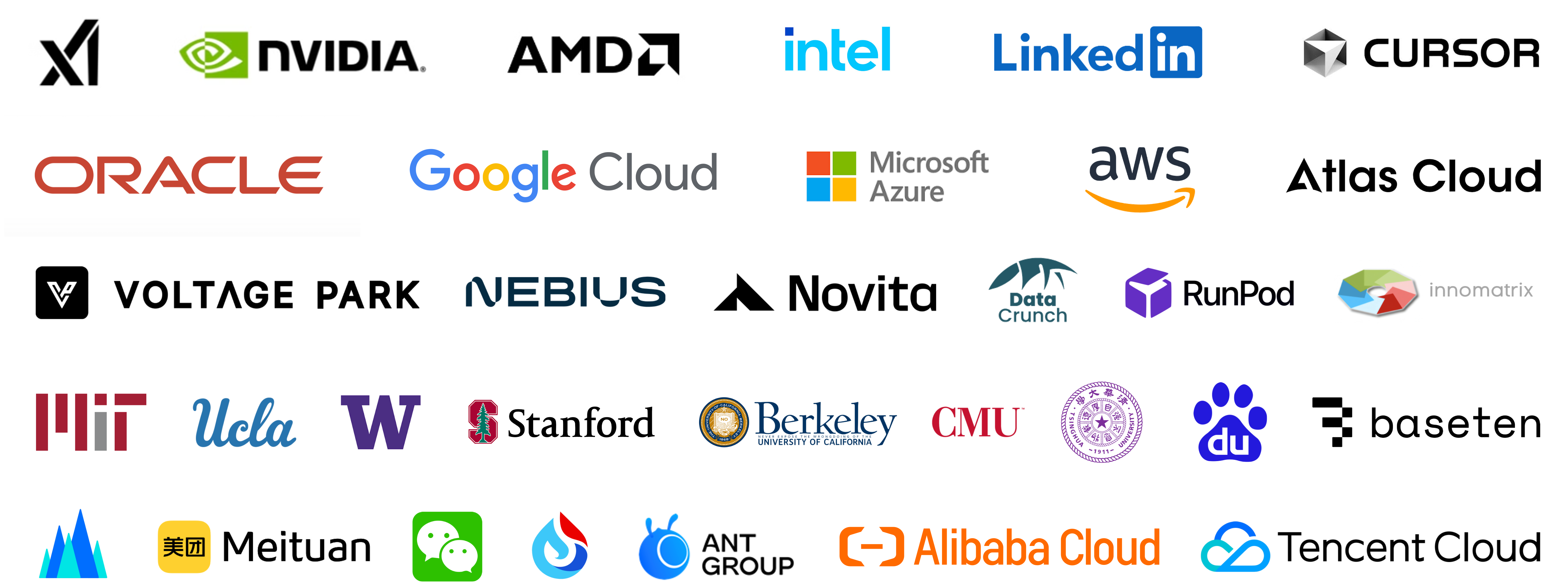
SGLang has been deployed at large scale, generating trillions of tokens in production each day. It is trusted and adopted by a wide range of leading enterprises and institutions, including xAI, AMD, NVIDIA, Intel, LinkedIn, Cursor, Oracle Cloud, Google Cloud, Microsoft Azure, AWS, Atlas Cloud, Voltage Park, Nebius, DataCrunch, Novita, InnoMatrix, MIT, UCLA, the University of Washington, Stanford, UC Berkeley, Tsinghua University, Jam & Tea Studios, Baseten, and other major technology organizations across North America and Asia. As an open-source LLM inference engine, SGLang has become the de facto industry standard, with deployments running on over 1,000,000 GPUs worldwide.
Contact Us
For enterprises interested in adopting or deploying SGLang at scale, including technical consulting, sponsorship opportunities, or partnership inquiries, please contact us at [email protected].
Acknowledgment
We learned the design and reused code from the following projects: Guidance, vLLM, LightLLM, FlashInfer, Outlines, and LMQL.
Discover Repositories
Search across tracked repositories by name or description