
microsoft/presidio
An open-source framework for detecting, redacting, masking, and anonymizing sensitive data (PII) across text, images, and structured data. Supports NLP, pattern matching, and customizable pipelines.
Genblaze — open-source SDK for generative multimedia pipelines
Orchestrate AI video, audio & image providers in Python with provenance built into every output.
 Learn more
Loading star history...
Health Score
75
Weekly Growth
+0
+0.0% this week
Contributors
166
Total contributors
Open Issues
66
Use Cases & Benefits
About presidio
Presidio - Data Protection and De-identification SDK
Context aware, pluggable and customizable PII de-identification service for text and images.




| Component | Downloads | Coverage |
|---|---|---|
| Presidio Analyzer |  |  |
| Presidio Anonymizer |  |  |
| Presidio Image-Redactor |  |  |
| Presidio Structured |  |  |
What is Presidio
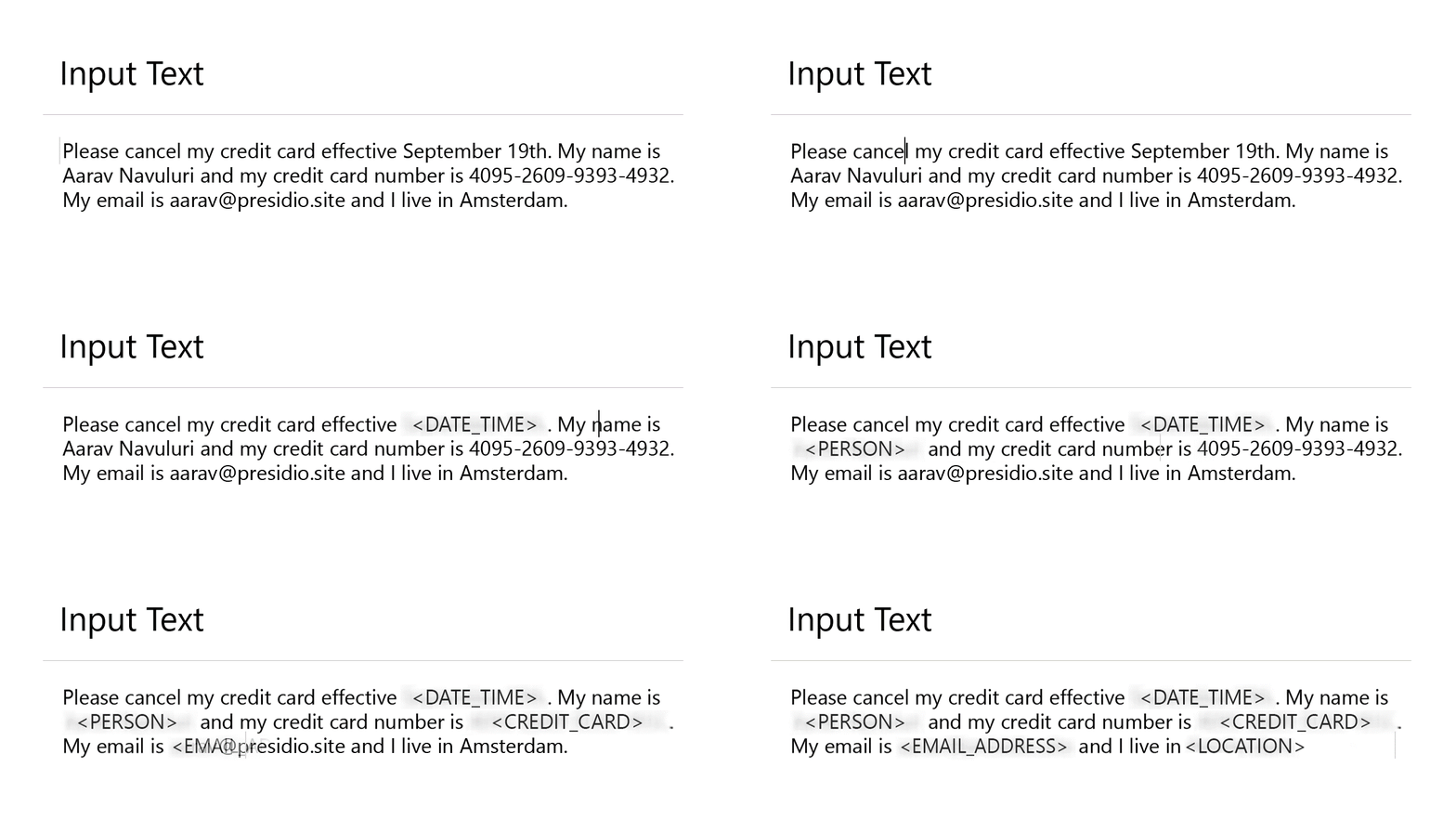
Presidio (Origin from Latin praesidium ‘protection, garrison’) helps to ensure sensitive data is properly managed and governed. It provides fast identification and anonymization modules for private entities in text such as credit card numbers, names, locations, social security numbers, bitcoin wallets, US phone numbers, financial data and more.
:blue_book: Full documentation
:question: Frequently Asked Questions
:thought_balloon: Demo
:flight_departure: Examples
Are you using Presidio? We'd love to know how
Please help us improve by taking this short anonymous survey.
Goals
- Allow organizations to preserve privacy in a simpler way by democratizing de-identification technologies and introducing transparency in decisions.
- Embrace extensibility and customizability to a specific business need.
- Facilitate both fully automated and semi-automated PII de-identification flows on multiple platforms.
Main features
- Predefined or custom PII recognizers leveraging Named Entity Recognition, regular expressions, rule based logic and checksum with relevant context in multiple languages.
- Options for connecting to external PII detection models.
- Multiple usage options, from Python or PySpark workloads through Docker to Kubernetes.
- Customizability in PII identification and de-identification.
- Module for redacting PII text in images (standard image types and DICOM medical images).
:warning: Presidio can help identify sensitive/PII data in un/structured text. However, because it is using automated detection mechanisms, there is no guarantee that Presidio will find all sensitive information. Consequently, additional systems and protections should be employed.
Installing Presidio
Running Presidio
- Getting started
- Setting up a development environment
- PII de-identification in text
- PII de-identification in images
- Usage samples and example deployments
Support
- Before you submit an issue, please go over the documentation.
- For general discussions, please use the GitHub repo's discussion board.
- If you have a usage question, found a bug or have a suggestion for improvement, please file a GitHub issue.
- For other matters, please email [email protected].
Contributing
For details on contributing to this repository, see the contributing guide.
This project welcomes contributions and suggestions. Most contributions require you to agree to a Contributor License Agreement (CLA) declaring that you have the right to, and actually do, grant us the rights to use your contribution. For details, visit https://cla.microsoft.com.
When you submit a pull request, a CLA-bot will automatically determine whether you need to provide a CLA and decorate the PR appropriately (e.g., label, comment). Simply follow the instructions provided by the bot. You will only need to do this once across all repos using our CLA.
This project has adopted the Microsoft Open Source Code of Conduct. For more information see the Code of Conduct FAQ or contact [email protected] with any additional questions or comments.
Contributors
Discover Repositories
Search across tracked repositories by name or description