
gofiber/fiber
⚡️ Express inspired web framework written in Go
Build with Backblaze B2
SDKs, agent skills, IDE extensions, and reference pipelines from Backblaze Labs. All open source.
Loading star history...
Use Cases & Benefits
- Provides a fast, Express-inspired web framework for building web applications and APIs in Go.
- Combines Express-like ease of use with Go's high performance and zero memory allocation for rapid development.
- Use for building high-performance RESTful APIs with minimal memory overhead in Go.
- Use for serving static files and implementing middleware in scalable web servers.
- Use for real-time applications with WebSocket and Server-Sent Events support in Go.
About fiber








Fiber is an Express inspired web framework built on top of Fasthttp, the fastest HTTP engine for Go. Designed to ease things up for fast development with zero memory allocation and performance in mind.
⚠️ Attention
Fiber v3 is currently in beta and under active development. While it offers exciting new features, please note that it may not be stable for production use. We recommend sticking to the latest stable release (v2.x) for mission-critical applications. If you choose to use v3, be prepared for potential bugs and breaking changes. Always check the official documentation and release notes for updates and proceed with caution. Happy coding! 🚀
⚙️ Installation
Fiber requires Go version 1.24 or higher to run. If you need to install or upgrade Go, visit the official Go download page. To start setting up your project, create a new directory for your project and navigate into it. Then, initialize your project with Go modules by executing the following command in your terminal:
go mod init github.com/your/repo
To learn more about Go modules and how they work, you can check out the Using Go Modules blog post.
After setting up your project, you can install Fiber with the go get command:
go get -u github.com/gofiber/fiber/v3
This command fetches the Fiber package and adds it to your project's dependencies, allowing you to start building your web applications with Fiber.
⚡️ Quickstart
Getting started with Fiber is easy. Here's a basic example to create a simple web server that responds with "Hello, World 👋!" on the root path. This example demonstrates initializing a new Fiber app, setting up a route, and starting the server.
package main

import (
    "log"

    "github.com/gofiber/fiber/v3"
)

func main() {
    // Initialize a new Fiber app
    app := fiber.New()

    // Define a route for the GET method on the root path '/'
    app.Get("/", func(c fiber.Ctx) error {
        // Send a string response to the client
        return c.SendString("Hello, World 👋!")
    })

    // Start the server on port 3000
    log.Fatal(app.Listen(":3000"))
}
This simple server is easy to set up and run. It introduces the core concepts of Fiber: app initialization, route definition, and starting the server. Just run this Go program, and visit http://localhost:3000 in your browser to see the message.
Zero Allocation
Fiber is optimized for high-performance, meaning values returned from fiber.Ctx are not immutable by default and will be re-used across requests. As a rule of thumb, you must only use context values within the handler and must not keep any references. Once you return from the handler, any values obtained from the context will be re-used in future requests. Visit our documentation to learn more.
🤖 Benchmarks
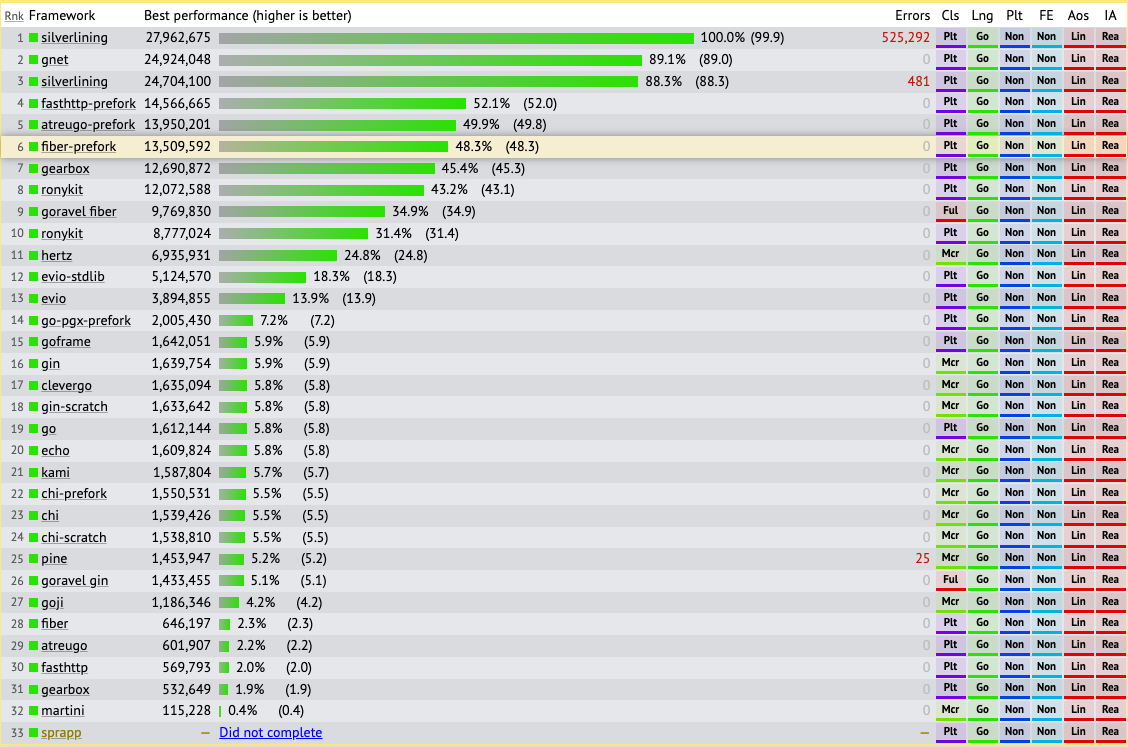
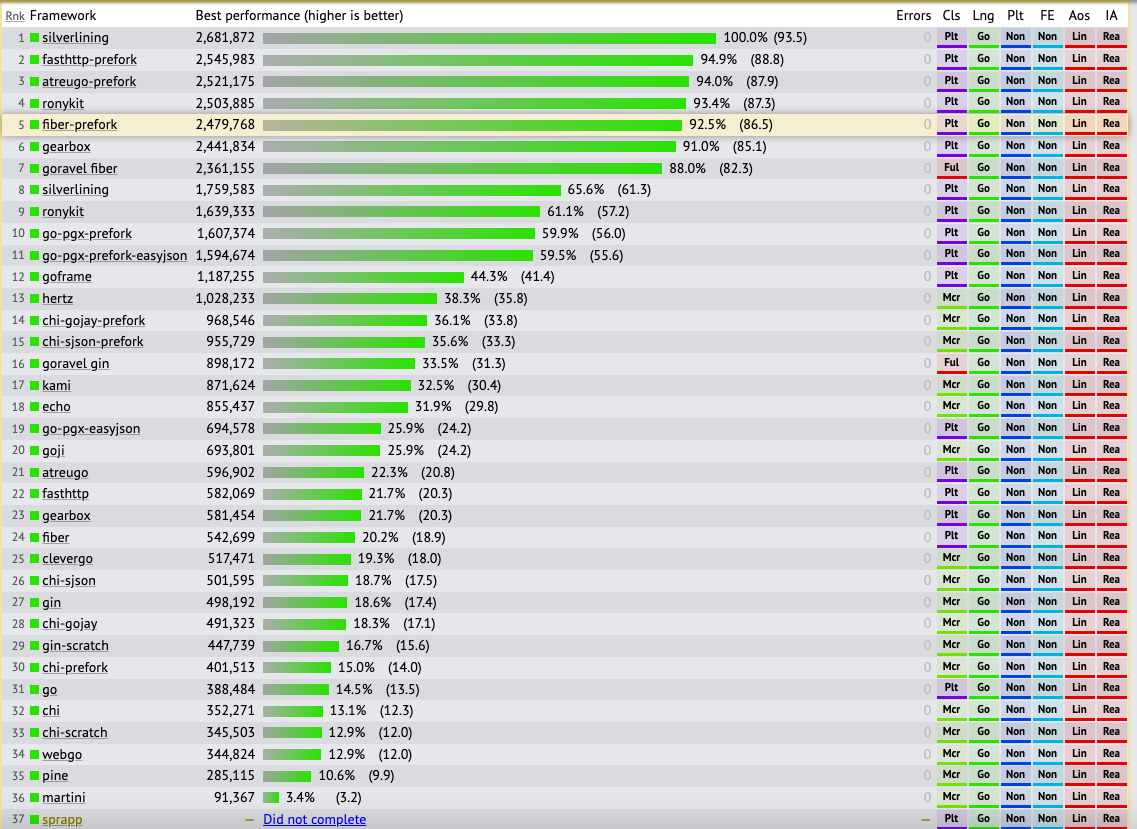
These tests are performed by TechEmpower. If you want to see all the results, please visit our Wiki.
🎯 Features
- Robust Routing
- Serve Static Files
- Extreme Performance
- Low Memory footprint
- API Endpoints
- Middleware & Next support
- Rapid server-side programming
- Template Engines
- WebSocket Support
- Socket.io Support
- Server-Sent Events
- Rate Limiter
- And much more, explore Fiber
💡 Philosophy
New gophers that make the switch from Node.js to Go are dealing with a learning curve before they can start building their web applications or microservices. Fiber, as a web framework, was created with the idea of minimalism and follows the UNIX way, so that new gophers can quickly enter the world of Go with a warm and trusted welcome.
Fiber is inspired by Express, the most popular web framework on the Internet. We combined the ease of Express and raw performance of Go. If you have ever implemented a web application in Node.js (using Express or similar), then many methods and principles will seem very common to you.
We listen to our users in issues, Discord channel and all over the Internet to create a fast, flexible and friendly Go web framework for any task, deadline and developer skill! Just like Express does in the JavaScript world.
⚠️ Limitations
- Due to Fiber's usage of unsafe, the library may not always be compatible with the latest Go version. Fiber v3 has been tested with Go version 1.24 or higher.
- Fiber does not natively expose the
net/httpinterfaces. When you need to integrate with that ecosystem, use the adaptor middleware to bridge handlers and middlewares between Fiber andnet/http.
net/http compatibility
Fiber can run side by side with the standard library by using the adaptor middleware. It converts handlers and middlewares in both directions and even lets you mount a Fiber app in a net/http server.
👀 Examples
Listed below are some of the common examples. If you want to see more code examples, please visit our Recipes repository or visit our hosted API documentation.
📖 Basic Routing
package main

import (
    "fmt"
    "log"

    "github.com/gofiber/fiber/v3"
)

func main() {
    app := fiber.New()

    // GET /api/register
    app.Get("/api/*", func(c fiber.Ctx) error {
        msg := fmt.Sprintf("✋ %s", c.Params("*"))
        return c.SendString(msg) // => ✋ register
    })

    // GET /flights/LAX-SFO
    app.Get("/flights/:from-:to", func(c fiber.Ctx) error {
        msg := fmt.Sprintf("💸 From: %s, To: %s", c.Params("from"), c.Params("to"))
        return c.SendString(msg) // => 💸 From: LAX, To: SFO
    })

    // GET /dictionary.txt
    app.Get("/:file.:ext", func(c fiber.Ctx) error {
        msg := fmt.Sprintf("📃 %s.%s", c.Params("file"), c.Params("ext"))
        return c.SendString(msg) // => 📃 dictionary.txt
    })

    // GET /john/75
    app.Get("/:name/:age/:gender?", func(c fiber.Ctx) error {
        msg := fmt.Sprintf("👴 %s is %s years old", c.Params("name"), c.Params("age"))
        return c.SendString(msg) // => 👴 john is 75 years old
    })

    // GET /john
    app.Get("/:name", func(c fiber.Ctx) error {
        msg := fmt.Sprintf("Hello, %s 👋!", c.Params("name"))
        return c.SendString(msg) // => Hello john 👋!
    })

    log.Fatal(app.Listen(":3000"))
}
📖 Route Naming
package main

import (
    "encoding/json"
    "fmt"
    "log"

    "github.com/gofiber/fiber/v3"
)

func main() {
    app := fiber.New()

    app.Get("/api/*", func(c fiber.Ctx) error {
        msg := fmt.Sprintf("✋ %s", c.Params("*"))
        return c.SendString(msg) // => ✋ register
    }).Name("api")

    route := app.GetRoute("api")

    data, _ := json.MarshalIndent(route, "", "  ")
    fmt.Println(string(data))
    // Prints:
    // {
    //    "method": "GET",
    //    "name": "api",
    //    "path": "/api/*",
    //    "params": [
    //      "*1"
    //    ]
    // }

    log.Fatal(app.Listen(":3000"))
}
📖 Serving Static Files
package main

import (
    "log"

    "github.com/gofiber/fiber/v3"
    "github.com/gofiber/fiber/v3/middleware/static"
)

func main() {
    app := fiber.New()

    // Serve static files from the "./public" directory
    app.Get("/*", static.New("./public"))
    // => http://localhost:3000/js/script.js
    // => http://localhost:3000/css/style.css

    app.Get("/prefix*", static.New("./public"))
    // => http://localhost:3000/prefix/js/script.js
    // => http://localhost:3000/prefix/css/style.css

    // Serve a single file for any unmatched routes
    app.Get("*", static.New("./public/index.html"))
    // => http://localhost:3000/any/path/shows/index.html

    log.Fatal(app.Listen(":3000"))
}
📖 Middleware & Next
package main

import (
    "fmt"
    "log"

    "github.com/gofiber/fiber/v3"
)

func main() {
    app := fiber.New()

    // Middleware that matches any route
    app.Use(func(c fiber.Ctx) error {
        fmt.Println("🥇 First handler")
        return c.Next()
    })

    // Middleware that matches all routes starting with /api
    app.Use("/api", func(c fiber.Ctx) error {
        fmt.Println("🥈 Second handler")
        return c.Next()
    })

    // GET /api/list
    app.Get("/api/list", func(c fiber.Ctx) error {
        fmt.Println("🥉 Last handler")
        return c.SendString("Hello, World 👋!")
    })

    log.Fatal(app.Listen(":3000"))
}
📚 Show more code examples
Views Engines
Fiber defaults to the html/template when no view engine is set.
If you want to execute partials or use a different engine like amber, handlebars, mustache, or pug, etc., check out our Template package that supports multiple view engines.
package main

import (
    "log"

    "github.com/gofiber/fiber/v3"
    "github.com/gofiber/template/pug"
)

func main() {
    // Initialize a new Fiber app with Pug template engine
    app := fiber.New(fiber.Config{
        Views: pug.New("./views", ".pug"),
    })

    // Define a route that renders the "home.pug" template
    app.Get("/", func(c fiber.Ctx) error {
        return c.Render("home", fiber.Map{
            "title": "Homepage",
            "year":  1999,
        })
    })

    log.Fatal(app.Listen(":3000"))
}
Grouping Routes into Chains
📖 Group
package main

import (
    "log"

    "github.com/gofiber/fiber/v3"
)

func middleware(c fiber.Ctx) error {
    log.Println("Middleware executed")
    return c.Next()
}

func handler(c fiber.Ctx) error {
    return c.SendString("Handler response")
}

func main() {
    app := fiber.New()

    // Root API group with middleware
    api := app.Group("/api", middleware) // /api

    // API v1 routes
    v1 := api.Group("/v1", middleware) // /api/v1
    v1.Get("/list", handler)           // /api/v1/list
    v1.Get("/user", handler)           // /api/v1/user

    // API v2 routes
    v2 := api.Group("/v2", middleware) // /api/v2
    v2.Get("/list", handler)           // /api/v2/list
    v2.Get("/user", handler)           // /api/v2/user

    log.Fatal(app.Listen(":3000"))
}
Middleware Logger
📖 Logger
package main

import (
    "log"

    "github.com/gofiber/fiber/v3"
    "github.com/gofiber/fiber/v3/middleware/logger"
)

func main() {
    app := fiber.New()

    // Use Logger middleware
    app.Use(logger.New())

    // Define routes
    app.Get("/", func(c fiber.Ctx) error {
        return c.SendString("Hello, Logger!")
    })

    log.Fatal(app.Listen(":3000"))
}
Cross-Origin Resource Sharing (CORS)
📖 CORS
package main

import (
    "log"

    "github.com/gofiber/fiber/v3"
    "github.com/gofiber/fiber/v3/middleware/cors"
)

func main() {
    app := fiber.New()

    // Use CORS middleware with default settings
    app.Use(cors.New())

    // Define routes
    app.Get("/", func(c fiber.Ctx) error {
        return c.SendString("CORS enabled!")
    })

    log.Fatal(app.Listen(":3000"))
}
Check CORS by passing any domain in Origin header:
curl -H "Origin: http://example.com" --verbose http://localhost:3000
Custom 404 Response
package main

import (
    "log"

    "github.com/gofiber/fiber/v3"
)

func main() {
    app := fiber.New()

    // Define routes
    app.Get("/", static.New("./public"))

    app.Get("/demo", func(c fiber.Ctx) error {
        return c.SendString("This is a demo page!")
    })

    app.Post("/register", func(c fiber.Ctx) error {
        return c.SendString("Registration successful!")
    })

    // Middleware to handle 404 Not Found
    app.Use(func(c fiber.Ctx) error {
        return c.SendStatus(fiber.StatusNotFound) // => 404 "Not Found"
    })

    log.Fatal(app.Listen(":3000"))
}
JSON Response
📖 JSON
package main

import (
    "log"

    "github.com/gofiber/fiber/v3"
)

type User struct {
    Name string `json:"name"`
    Age  int    `json:"age"`
}

func main() {
    app := fiber.New()

    // Route that returns a JSON object
    app.Get("/user", func(c fiber.Ctx) error {
        return c.JSON(&User{"John", 20})
        // => {"name":"John", "age":20}
    })

    // Route that returns a JSON map
    app.Get("/json", func(c fiber.Ctx) error {
        return c.JSON(fiber.Map{
            "success": true,
            "message": "Hi John!",
        })
        // => {"success":true, "message":"Hi John!"}
    })

    log.Fatal(app.Listen(":3000"))
}
WebSocket Upgrade
package main

import (
    "log"

    "github.com/gofiber/fiber/v3"
    "github.com/gofiber/fiber/v3/middleware/websocket"
)

func main() {
    app := fiber.New()

    // WebSocket route
    app.Get("/ws", websocket.New(func(c *websocket.Conn) {
        defer c.Close()
        for {
            // Read message from client
            mt, msg, err := c.ReadMessage()
            if err != nil {
                log.Println("read:", err)
                break
            }
            log.Printf("recv: %s", msg)

            // Write message back to client
            err = c.WriteMessage(mt, msg)
            if err != nil {
                log.Println("write:", err)
                break
            }
        }
    }))

    log.Fatal(app.Listen(":3000"))
    // Connect via WebSocket at ws://localhost:3000/ws
}
Server-Sent Events
package main

import (
    "bufio"
    "fmt"
    "log"
    "time"

    "github.com/gofiber/fiber/v3"
    "github.com/valyala/fasthttp"
)

func main() {
    app := fiber.New()

    // Server-Sent Events route
    app.Get("/sse", func(c fiber.Ctx) error {
        c.Set("Content-Type", "text/event-stream")
        c.Set("Cache-Control", "no-cache")
        c.Set("Connection", "keep-alive")
        c.Set("Transfer-Encoding", "chunked")

        c.Context().SetBodyStreamWriter(func(w *bufio.Writer) {
            var i int
            for {
                i++
                msg := fmt.Sprintf("%d - the time is %v", i, time.Now())
                fmt.Fprintf(w, "data: Message: %s\n\n", msg)
                fmt.Println(msg)

                w.Flush()
                time.Sleep(5 * time.Second)
            }
        })

        return nil
    })

    log.Fatal(app.Listen(":3000"))
}
Recover Middleware
📖 Recover
package main

import (
    "log"

    "github.com/gofiber/fiber/v3"
    "github.com/gofiber/fiber/v3/middleware/recover"
)

func main() {
    app := fiber.New()

    // Use Recover middleware to handle panics gracefully
    app.Use(recover.New())

    // Route that intentionally panics
    app.Get("/", func(c fiber.Ctx) error {
        panic("normally this would crash your app")
    })

    log.Fatal(app.Listen(":3000"))
}
Using Trusted Proxy
📖 Config
package main

import (
    "log"

    "github.com/gofiber/fiber/v3"
)

func main() {
    app := fiber.New(fiber.Config{
        // Configure trusted proxies - WARNING: Only trust proxies you control
        // Using TrustProxy: true with unrestricted IPs can lead to IP spoofing
        TrustProxy: true,
        TrustProxyConfig: fiber.TrustProxyConfig{
            Proxies: []string{"10.0.0.0/8", "172.16.0.0/12"}, // Example: Internal network ranges only
        },
        ProxyHeader: fiber.HeaderXForwardedFor,
    })

    // Define routes
    app.Get("/", func(c fiber.Ctx) error {
        return c.SendString("Trusted Proxy Configured!")
    })

    log.Fatal(app.Listen(":3000"))
}
🧬 Internal Middleware
Here is a list of middleware that are included within the Fiber framework.
| Middleware | Description |
|---|---|
| adaptor | Converter for net/http handlers to/from Fiber request handlers. |
| basicauth | Provides HTTP basic authentication. It calls the next handler for valid credentials and 401 Unauthorized for missing or invalid credentials. |
| cache | Intercept and cache HTTP responses. |
| compress | Compression middleware for Fiber, with support for deflate, gzip, brotli and zstd. |
| cors | Enable cross-origin resource sharing (CORS) with various options. |
| csrf | Protect from CSRF exploits. |
| earlydata | Adds support for TLS 1.3's early data ("0-RTT") feature. |
| encryptcookie | Encrypt middleware which encrypts cookie values. |
| envvar | Expose environment variables with providing an optional config. |
| etag | Allows for caches to be more efficient and save bandwidth, as a web server does not need to resend a full response if the content has not changed. |
| expvar | Serves via its HTTP server runtime exposed variables in the JSON format. |
| favicon | Ignore favicon from logs or serve from memory if a file path is provided. |
| healthcheck | Liveness and Readiness probes for Fiber. |
| helmet | Helps secure your apps by setting various HTTP headers. |
| idempotency | Allows for fault-tolerant APIs where duplicate requests do not erroneously cause the same action performed multiple times on the server-side. |
| keyauth | Adds support for key based authentication. |
| limiter | Adds Rate-limiting support to Fiber. Use to limit repeated requests to public APIs and/or endpoints such as password reset. |
| logger | HTTP request/response logger. |
| pprof | Serves runtime profiling data in pprof format. |
| proxy | Allows you to proxy requests to multiple servers. |
| recover | Recovers from panics anywhere in the stack chain and handles the control to the centralized ErrorHandler. |
| redirect | Redirect middleware. |
| requestid | Adds a request ID to every request. |
| rewrite | Rewrites the URL path based on provided rules. It can be helpful for backward compatibility or just creating cleaner and more descriptive links. |
| session | Session middleware. NOTE: This middleware uses our Storage package. |
| skip | Skip middleware that skips a wrapped handler if a predicate is true. |
| static | Static middleware for Fiber that serves static files such as images, CSS, and JavaScript. |
| timeout | Adds a max time for a request and forwards to ErrorHandler if it is exceeded. |
🧬 External Middleware
List of externally hosted middleware modules and maintained by the Fiber team.
| Middleware | Description |
|---|---|
| contrib | Third-party middlewares |
| storage | Premade storage drivers that implement the Storage interface, designed to be used with various Fiber middlewares. |
| template | This package contains 9 template engines that can be used with Fiber. |
🕶️ Awesome List
For more articles, middlewares, examples, or tools, check our awesome list.
👍 Contribute
If you want to say Thank You and/or support the active development of Fiber:
- Add a GitHub Star to the project.
- Tweet about the project on your 𝕏 (Twitter).
- Write a review or tutorial on Medium, Dev.to or your personal blog.
- Support the project by donating a cup of coffee.
💻 Development
To ensure your contributions are ready for a Pull Request, please use the following Makefile commands. These tools help maintain code quality and consistency.
- make help: Display available commands.
- make audit: Conduct quality checks.
- make benchmark: Benchmark code performance.
- make coverage: Generate test coverage report.
- make format: Automatically format code.
- make lint: Run lint checks.
- make test: Execute all tests.
- make tidy: Tidy dependencies.
Run these commands to ensure your code adheres to project standards and best practices.
☕ Supporters
Fiber is an open-source project that runs on donations to pay the bills, e.g., our domain name, GitBook, Netlify, and serverless hosting. If you want to support Fiber, you can ☕ buy a coffee here.
| User | Donation | |
|---|---|---|
 | @destari | ☕ x 10 |
 | @dembygenesis | ☕ x 5 |
 | @thomasvvugt | ☕ x 5 |
 | @hendratommy | ☕ x 5 |
 | @ekaputra07 | ☕ x 5 |
 | @jorgefuertes | ☕ x 5 |
 | @candidosales | ☕ x 5 |
 | @l0nax | ☕ x 3 |
 | @bihe | ☕ x 3 |
 | @justdave | ☕ x 3 |
 | @koddr | ☕ x 1 |
 | @lapolinar | ☕ x 1 |
 | @diegowifi | ☕ x 1 |
 | @ssimk0 | ☕ x 1 |
 | @raymayemir | ☕ x 1 |
 | @melkorm | ☕ x 1 |
 | @marvinjwendt | ☕ x 1 |
 | @toishy | ☕ x 1 |
💻 Code Contributors
⭐️ Stargazers
🧾 License
Copyright (c) 2019-present Fenny and Contributors. Fiber is free and open-source software licensed under the MIT License. Official logo was created by Vic Shóstak and distributed under Creative Commons license (CC BY-SA 4.0 International).
Discover Repositories
Search across tracked repositories by name or description