
Orange-OpenSource/hurl
Hurl, run and test HTTP requests with plain text.
Backblaze Generative Media Hackathon
Build the next generation of AI media apps with Genblaze, stored on Backblaze B2. $10,000 in prizes.
Loading star history...
Use Cases & Benefits
- Runs and tests HTTP requests defined in a simple plain text format via a fast CLI tool.
- Combines curl's power with an easy-to-read text format for chaining requests, capturing values, and asserting responses.
- Use for automating API integration tests with JSON, XML, SOAP, or GraphQL payloads in CI/CD pipelines.
- Use for validating HTML content and HTTP headers in web application testing workflows.
- Use for performance testing HTTP endpoints by asserting response times and content integrity.
About hurl




What's Hurl?
Hurl is a command line tool that runs HTTP requests defined in a simple plain text format.
It can chain requests, capture values and evaluate queries on headers and body response. Hurl is very versatile: it can be used for both fetching data and testing HTTP sessions.
Hurl makes it easy to work with HTML content, REST / SOAP / GraphQL APIs, or any other XML / JSON based APIs.
# Go home and capture token
GET https://example.org
HTTP 200
[Captures]
csrf_token: xpath "string(//meta[@name='_csrf_token']/@content)"


# Do login!
POST https://example.org/login
X-CSRF-TOKEN: {{csrf_token}}
[Form]
user: toto
password: 1234
HTTP 302
Chaining multiple requests is easy:
GET https://example.org/api/health
GET https://example.org/api/step1
GET https://example.org/api/step2
GET https://example.org/api/step3
Also an HTTP Test Tool
Hurl can run HTTP requests but can also be used to test HTTP responses. Different types of queries and predicates are supported, from XPath and JSONPath on body response, to assert on status code and response headers.
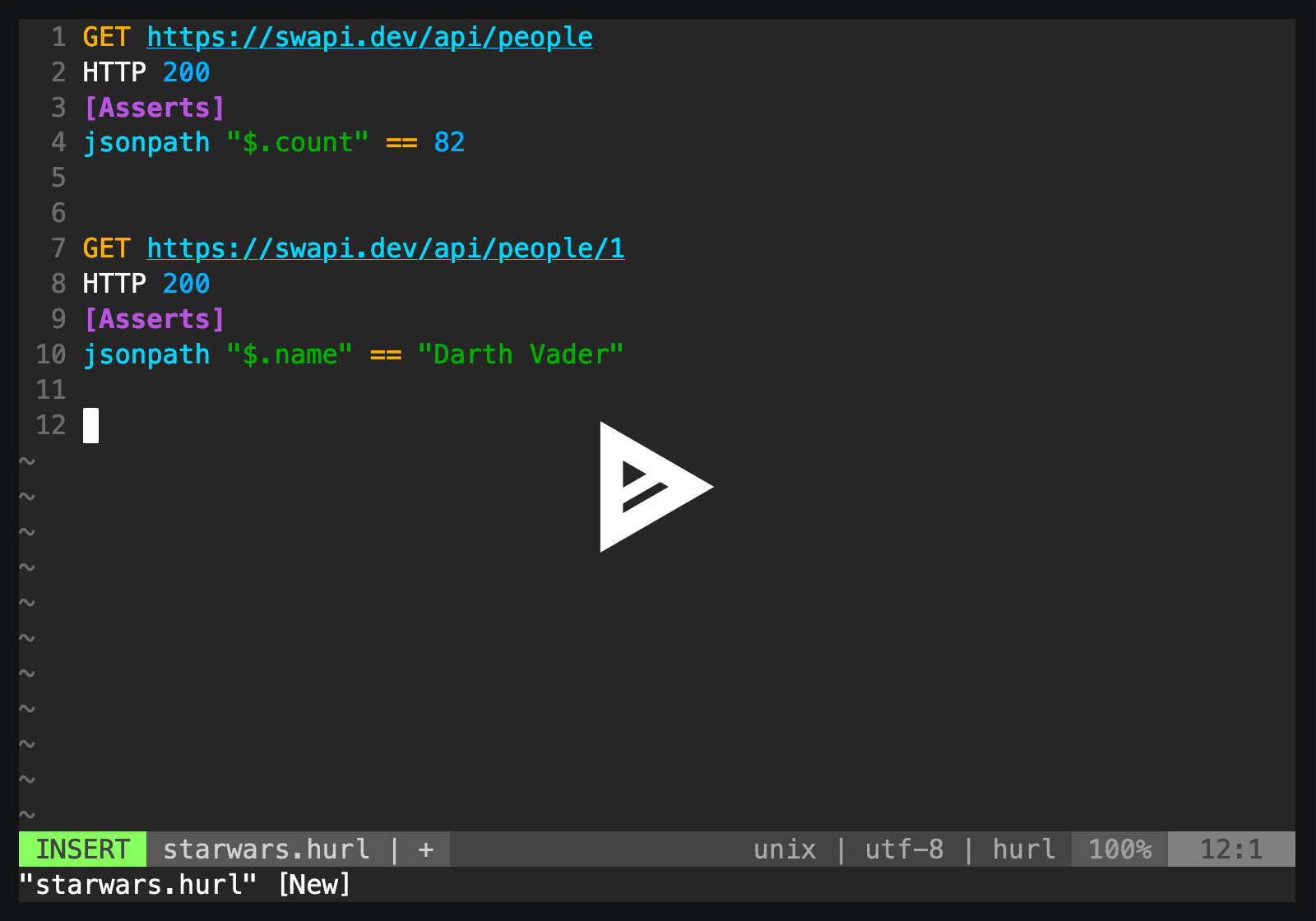
It is well adapted for REST / JSON APIs
POST https://example.org/api/tests
{
    "id": "4568",
    "evaluate": true
}
HTTP 200
[Asserts]
header "X-Frame-Options" == "SAMEORIGIN"
jsonpath "$.status" == "RUNNING"    # Check the status code
jsonpath "$.tests" count == 25      # Check the number of items
jsonpath "$.id" matches /\d{4}/     # Check the format of the id
HTML content
GET https://example.org
HTTP 200
[Asserts]
xpath "normalize-space(//head/title)" == "Hello world!"
GraphQL
POST https://example.org/graphql
```graphql
{
  human(id: "1000") {
    name
    height(unit: FOOT)
  }
}
```
HTTP 200
and even SOAP APIs
POST https://example.org/InStock
Content-Type: application/soap+xml; charset=utf-8
SOAPAction: "http://www.w3.org/2003/05/soap-envelope"
<?xml version="1.0" encoding="UTF-8"?>
<soap:Envelope xmlns:soap="http://www.w3.org/2003/05/soap-envelope" xmlns:m="https://example.org">
  <soap:Header></soap:Header>
  <soap:Body>
    <m:GetStockPrice>
      <m:StockName>GOOG</m:StockName>
    </m:GetStockPrice>
  </soap:Body>
</soap:Envelope>
HTTP 200
Hurl can also be used to test the performance of HTTP endpoints
GET https://example.org/api/v1/pets
HTTP 200
[Asserts]
duration < 1000  # Duration in ms
And check response bytes
GET https://example.org/data.tar.gz
HTTP 200
[Asserts]
sha256 == hex,039058c6f2c0cb492c533b0a4d14ef77cc0f78abccced5287d84a1a2011cfb81;
Finally, Hurl is easy to integrate in CI/CD, with text, JUnit, TAP and HTML reports

Why Hurl?
- Text Format: for both devops and developers
- Fast CLI: a command line for local dev and continuous integration
- Single Binary: easy to install, with no runtime required
Powered by curl
Hurl is a lightweight binary written in Rust. Under the hood, Hurl HTTP engine is powered by libcurl, one of the most powerful and reliable file transfer libraries. With its text file format, Hurl adds syntactic sugar to run and test HTTP requests, but it's still the curl that we love: fast, efficient and IPv6 / HTTP/3 ready.
Feedbacks
To support its development, star Hurl on GitHub!
Feedback, suggestion, bugs or improvements are welcome.
POST https://hurl.dev/api/feedback
{
  "name": "John Doe",
  "feedback": "Hurl is awesome!"
}
HTTP 200
Resources
Documentation (download HTML, PDF, Markdown)
Table of Contents
- Samples
- Manual
- Installation
Samples
To run a sample, edit a file with the sample content, and run Hurl:
$ vi sample.hurl

GET https://example.org

$ hurl sample.hurl
By default, Hurl behaves like curl and outputs the last HTTP response's entry. To have a test
oriented output, you can use --test option:
$ hurl --test sample.hurl
A particular response can be saved with [Options] section:
GET https://example.ord/cats/123
[Options]
output: cat123.txt    # use - to output to stdout
HTTP 200

GET https://example.ord/dogs/567
HTTP 200
Finally, Hurl can take files as input, or directories. In the latter case, Hurl will search files with .hurl extension recursively.
$ hurl --test integration/*.hurl
$ hurl --test .
You can check Hurl tests suite for more samples.
Getting Data
A simple GET:
GET https://example.org
Requests can be chained:
GET https://example.org/a
GET https://example.org/b
HEAD https://example.org/c
GET https://example.org/c
HTTP Headers
A simple GET with headers:
GET https://example.org/news
User-Agent: Mozilla/5.0
Accept: */*
Accept-Language: en-US,en;q=0.5
Accept-Encoding: gzip, deflate, br
Connection: keep-alive
Query Params
GET https://example.org/news
[Query]
order: newest
search: something to search
count: 100
Or:
GET https://example.org/news?order=newest&search=something%20to%20search&count=100
With
[Query]section, params don't need to be URL escaped.
Basic Authentication
GET https://example.org/protected
[BasicAuth]
bob: secret
This is equivalent to construct the request with a Authorization header:
# Authorization header value can be computed with `echo -n 'bob:secret' | base64`
GET https://example.org/protected
Authorization: Basic Ym9iOnNlY3JldA==
Basic authentication section allows per request authentication. If you want to add basic authentication to all the
requests of a Hurl file you could use -u/--user option:
$ hurl --user bob:secret login.hurl
--user option can also be set per request:
GET https://example.org/login
[Options]
user: bob:secret
HTTP 200

GET https://example.org/login
[Options]
user: alice:secret
HTTP 200
Passing Data between Requests
Captures can be used to pass data from one request to another:
POST https://sample.org/orders
HTTP 201
[Captures]
order_id: jsonpath "$.order.id"

GET https://sample.org/orders/{{order_id}}
HTTP 200
Sending Data
Sending HTML Form Data
POST https://example.org/contact
[Form]
default: false
token: {{token}}
email: [email protected]
number: 33611223344
Sending Multipart Form Data
POST https://example.org/upload
[Multipart]
field1: value1
field2: file,example.txt;
# One can specify the file content type:
field3: file,example.zip; application/zip
Multipart forms can also be sent with a multiline string body:
POST https://example.org/upload
Content-Type: multipart/form-data; boundary="boundary"
```
--boundary
Content-Disposition: form-data; name="key1"

value1
--boundary
Content-Disposition: form-data; name="upload1"; filename="data.txt"
Content-Type: text/plain

Hello World!
--boundary
Content-Disposition: form-data; name="upload2"; filename="data.html"
Content-Type: text/html

<div>Hello <b>World</b>!</div>
--boundary--
```
In that case, files have to be inlined in the Hurl file.
Posting a JSON Body
With an inline JSON:
POST https://example.org/api/tests
{
    "id": "456",
    "evaluate": true
}
With a local file:
POST https://example.org/api/tests
Content-Type: application/json
file,data.json;
Templating a JSON Body
PUT https://example.org/api/hits
Content-Type: application/json
{
    "key0": "{{a_string}}",
    "key1": {{a_bool}},
    "key2": {{a_null}},
    "key3": {{a_number}}
}
Variables can be initialized via command line:
$ hurl --variable a_string=apple \
       --variable a_bool=true \
       --variable a_null=null \
       --variable a_number=42 \
       test.hurl
Resulting in a PUT request with the following JSON body:
{
    "key0": "apple",
    "key1": true,
    "key2": null,
    "key3": 42
}
Templating a XML Body
Using templates with XML body is not currently supported in Hurl. You can use templates in XML multiline string body with variables to send a variable XML body:
POST https://example.org/echo/post/xml
```xml
<?xml version="1.0" encoding="utf-8"?>
<Request>
    <Login>{{login}}</Login>
    <Password>{{password}}</Password>
</Request>
```
Using GraphQL Query
A simple GraphQL query:
POST https://example.org/starwars/graphql
```graphql
{
  human(id: "1000") {
    name
    height(unit: FOOT)
  }
}
```
A GraphQL query with variables:
POST https://example.org/starwars/graphql
```graphql
query Hero($episode: Episode, $withFriends: Boolean!) {
  hero(episode: $episode) {
    name
    friends @include(if: $withFriends) {
      name
    }
  }
}

variables {
  "episode": "JEDI",
  "withFriends": false
}
```
GraphQL queries can also use Hurl templates.
Using Dynamic Datas
Functions like newUuid and newDate can be used in templates to create dynamic datas:
A file that creates a dynamic email (i.e [email protected]):
POST https://example.org/api/foo
{
  "name": "foo",
  "email": "{{newUuid}}@test.com"
}
A file that creates a dynamic query parameter (i.e 2024-12-02T10:35:44.461731Z):
GET https://example.org/api/foo
[Query]
date: {{newDate}}
HTTP 200
Testing Response
Responses are optional, everything after HTTP is part of the response asserts.
# A request with (almost) no check:
GET https://foo.com

# A status code check:
GET https://foo.com
HTTP 200

# A test on response body
GET https://foo.com
HTTP 200
[Asserts]
jsonpath "$.state" == "running"
Testing Status Code
GET https://example.org/order/435
HTTP 200
GET https://example.org/order/435
# Testing status code is in a 200-300 range
HTTP *
[Asserts]
status >= 200
status < 300
Testing Response Headers
Use implicit response asserts to test header values:
GET https://example.org/index.html
HTTP 200
Set-Cookie: theme=light
Set-Cookie: sessionToken=abc123; Expires=Wed, 09 Jun 2021 10:18:14 GMT
Or use explicit response asserts with predicates:
GET https://example.org
HTTP 302
[Asserts]
header "Location" contains "www.example.net"
Implicit and explicit asserts can be combined:
GET https://example.org/index.html
HTTP 200
Set-Cookie: theme=light
Set-Cookie: sessionToken=abc123; Expires=Wed, 09 Jun 2021 10:18:14 GMT
[Asserts]
header "Location" contains "www.example.net"
Testing REST APIs
Asserting JSON body response (node values, collection count etc...) with JSONPath:
GET https://example.org/order
screencapability: low
HTTP 200
[Asserts]
jsonpath "$.validated" == true
jsonpath "$.userInfo.firstName" == "Franck"
jsonpath "$.userInfo.lastName" == "Herbert"
jsonpath "$.hasDevice" == false
jsonpath "$.links" count == 12
jsonpath "$.state" != null
jsonpath "$.order" matches "^order-\\d{8}$"
jsonpath "$.order" matches /^order-\d{8}$/  # Alternative syntax with regex literal
jsonpath "$.id" matches /(?i)[a-z]*/        # See syntax for flags <https://docs.rs/regex/latest/regex/#grouping-and-flags>
jsonpath "$.created" isIsoDate
Testing HTML Response
GET https://example.org
HTTP 200
Content-Type: text/html; charset=UTF-8
[Asserts]
xpath "string(/html/head/title)" contains "Example" # Check title
xpath "count(//p)" == 2  # Check the number of p
xpath "//p" count == 2  # Similar assert for p
xpath "boolean(count(//h2))" == false  # Check there is no h2
xpath "//h2" not exists  # Similar assert for h2
xpath "string(//div[1])" matches /Hello.*/
Testing Set-Cookie Attributes
GET https://example.org/home
HTTP 200
[Asserts]
cookie "JSESSIONID" == "8400BAFE2F66443613DC38AE3D9D6239"
cookie "JSESSIONID[Value]" == "8400BAFE2F66443613DC38AE3D9D6239"
cookie "JSESSIONID[Expires]" contains "Wed, 13 Jan 2021"
cookie "JSESSIONID[Secure]" exists
cookie "JSESSIONID[HttpOnly]" exists
cookie "JSESSIONID[SameSite]" == "Lax"
Testing Bytes Content
Check the SHA-256 response body hash:
GET https://example.org/data.tar.gz
HTTP 200
[Asserts]
sha256 == hex,039058c6f2c0cb492c533b0a4d14ef77cc0f78abccced5287d84a1a2011cfb81;
SSL Certificate
Check the properties of a SSL certificate:
GET https://example.org
HTTP 200
[Asserts]
certificate "Subject" == "CN=example.org"
certificate "Issuer" == "C=US, O=Let's Encrypt, CN=R3"
certificate "Expire-Date" daysAfterNow > 15
certificate "Serial-Number" matches /[\da-f]+/
Checking Full Body
Use implicit body to test an exact JSON body match:
GET https://example.org/api/cats/123
HTTP 200
{
  "name" : "Purrsloud",
  "species" : "Cat",
  "favFoods" : ["wet food", "dry food", "<strong>any</strong> food"],
  "birthYear" : 2016,
  "photo" : "https://learnwebcode.github.io/json-example/images/cat-2.jpg"
}
Or an explicit assert file:
GET https://example.org/index.html
HTTP 200
[Asserts]
body == file,cat.json;
Implicit asserts supports XML body:
GET https://example.org/api/catalog
HTTP 200
<?xml version="1.0" encoding="UTF-8"?>
<catalog>
   <book id="bk101">
      <author>Gambardella, Matthew</author>
      <title>XML Developer's Guide</title>
      <genre>Computer</genre>
      <price>44.95</price>
      <publish_date>2000-10-01</publish_date>
      <description>An in-depth look at creating applications with XML.</description>
   </book>
</catalog>
Plain text:
GET https://example.org/models
HTTP 200
```
Year,Make,Model,Description,Price
1997,Ford,E350,"ac, abs, moon",3000.00
1999,Chevy,"Venture ""Extended Edition""","",4900.00
1999,Chevy,"Venture ""Extended Edition, Very Large""",,5000.00
1996,Jeep,Grand Cherokee,"MUST SELL! air, moon roof, loaded",4799.00
```
One line:
POST https://example.org/helloworld
HTTP 200
`Hello world!`
File:
GET https://example.org
HTTP 200
file,data.bin;
Testing Redirections
By default, Hurl doesn't follow redirection so each step of a redirect must be run manually and can be analysed:
GET https://example.org/step1
HTTP 301
[Asserts]
header "Location" == "https://example.org/step2"


GET https://example.org/step2
HTTP 301
[Asserts]
header "Location" == "https://example.org/step3"


GET https://example.org/step3
HTTP 200
Using --location and --location-trusted (either with command line option or per request), Hurl follows
redirection and each step of the redirection can be checked.
GET https://example.org/step1
[Options]
location: true
HTTP 200
[Asserts]
redirects count == 2
redirects nth 0 location == "https://example.org/step2"
redirects nth 1 location == "https://example.org/step3"
GET https://example.org/step1
[Options]
location-trusted: true
HTTP 200
[Asserts]
redirects last location == "https://example.org/step2"
Debug Tips
Verbose Mode
To get more info on a given request/response, use [Options] section:
GET https://example.org
HTTP 200

GET https://example.org/api/cats/123
[Options]
very-verbose: true
HTTP 200
--verbose and --very-verbose can be also used globally as command line options.
Error Format
$ hurl --test --error-format long *.hurl
Output Response Body
Use --output on a specific request to get the response body (- can be used as standard output):
GET https://foo.com/failure
[Options]
# use - to output on standard output, foo.bin to save on disk
output: -
HTTP 200

GET https://foo.com/success
HTTP 200
Export curl Commands
$ hurl ---curl /tmp/curl.txt *.hurl
Using Proxy
Use --proxy on a specific request or globally as command line option:
GET https://foo.com/a
HTTP 200

GET https://foo.com/b
[Options]
proxy: localhost:8888
HTTP 200

GET https://foo.com/c
HTTP 200
Reports
HTML Report
$ hurl --test --report-html build/report/ *.hurl
JSON Report
$ hurl --test --report-json build/report/ *.hurl
JUnit Report
$ hurl --test --report-junit build/report.xml *.hurl
TAP Report
$ hurl --test --report-tap build/report.txt *.hurl
JSON Output
A structured output of running Hurl files can be obtained with --json option. Each file will produce a JSON export of the run.
$ hurl --json *.hurl
Others
HTTP Version
Testing HTTP version (HTTP/1.0, HTTP/1.1, HTTP/2 or HTTP/3) can be done using implicit asserts:
GET https://foo.com
HTTP/3 200

GET https://bar.com
HTTP/2 200
Or explicit:
GET https://foo.com
HTTP 200
[Asserts]
version == "3"

GET https://bar.com
HTTP 200
[Asserts]
version == "2"
version toFloat > 1.1
IP Address
Testing the IP address of the response, as a string. This string may be IPv6 address:
GET https://foo.com
HTTP 200
[Asserts]
ip == "2001:0db8:85a3:0000:0000:8a2e:0370:733"
ip startsWith "2001"
ip isIpv6
Polling and Retry
Retry request on any errors (asserts, captures, status code, runtime etc...):
# Create a new job
POST https://api.example.org/jobs
HTTP 201
[Captures]
job_id: jsonpath "$.id"
[Asserts]
jsonpath "$.state" == "RUNNING"


# Pull job status until it is completed
GET https://api.example.org/jobs/{{job_id}}
[Options]
retry: 10   # maximum number of retry, -1 for unlimited
retry-interval: 500ms
HTTP 200
[Asserts]
jsonpath "$.state" == "COMPLETED"
Delaying Requests
Add delay for every request, or a particular request:
# Delaying this request by 5 seconds (aka sleep)
GET https://example.org/turtle
[Options]
delay: 5s
HTTP 200

# No delay!
GET https://example.org/turtle
HTTP 200
Skipping Requests
# a, c, d are run, b is skipped
GET https://example.org/a

GET https://example.org/b
[Options]
skip: true

GET https://example.org/c

GET https://example.org/d
Testing Endpoint Performance
GET https://sample.org/helloworld
HTTP *
[Asserts]
duration < 1000   # Check that response time is less than one second
Using SOAP APIs
POST https://example.org/InStock
Content-Type: application/soap+xml; charset=utf-8
SOAPAction: "http://www.w3.org/2003/05/soap-envelope"
<?xml version="1.0" encoding="UTF-8"?>
<soap:Envelope xmlns:soap="http://www.w3.org/2003/05/soap-envelope" xmlns:m="https://example.org">
  <soap:Header></soap:Header>
  <soap:Body>
    <m:GetStockPrice>
      <m:StockName>GOOG</m:StockName>
    </m:GetStockPrice>
  </soap:Body>
</soap:Envelope>
HTTP 200
Capturing and Using a CSRF Token
GET https://example.org
HTTP 200
[Captures]
csrf_token: xpath "string(//meta[@name='_csrf_token']/@content)"


POST https://example.org/login?user=toto&password=1234
X-CSRF-TOKEN: {{csrf_token}}
HTTP 302
Redacting Secrets
Using command-line for known values:
$ hurl --secret token=1234 file.hurl
POST https://example.org
X-Token: {{token}}
{
  "name": "Alice",
  "value": 100
}
HTTP 200
Using redact for dynamic values:
# Get an authorization token:
GET https://example.org/token
HTTP 200
[Captures]
token: header "X-Token" redact

# Send an authorized request:
POST https://example.org
X-Token: {{token}}
{
  "name": "Alice",
  "value": 100
}
HTTP 200
Checking Byte Order Mark (BOM) in Response Body
GET https://example.org/data.bin
HTTP 200
[Asserts]
bytes startsWith hex,efbbbf;
AWS Signature Version 4 Requests
Generate signed API requests with AWS Signature Version 4, as used by several cloud providers.
POST https://sts.eu-central-1.amazonaws.com/
[Options]
aws-sigv4: aws:amz:eu-central-1:sts
[Form]
Action: GetCallerIdentity
Version: 2011-06-15
The Access Key is given per --user, either with command line option or within the [Options] section:
POST https://sts.eu-central-1.amazonaws.com/
[Options]
aws-sigv4: aws:amz:eu-central-1:sts
user: bob=secret
[Form]
Action: GetCallerIdentity
Version: 2011-06-15
Using curl Options
curl options (for instance --resolve or --connect-to) can be used as CLI argument. In this case, they're applicable
to each request of an Hurl file.
$ hurl --resolve foo.com:8000:127.0.0.1 foo.hurl
Use [Options] section to configure a specific request:
GET http://bar.com
HTTP 200


GET http://foo.com:8000/resolve
[Options]
resolve: foo.com:8000:127.0.0.1
HTTP 200
`Hello World!`
Manual
Name
hurl - run and test HTTP requests.
Synopsis
hurl [options] [FILE...]
Description
Hurl is a command line tool that runs HTTP requests defined in a simple plain text format.
It can chain requests, capture values and evaluate queries on headers and body response. Hurl is very versatile, it can be used for fetching data and testing HTTP sessions: HTML content, REST / SOAP / GraphQL APIs, or any other XML / JSON based APIs.
$ hurl session.hurl
If no input files are specified, input is read from stdin.
$ echo GET http://httpbin.org/get | hurl
    {
      "args": {},
      "headers": {
        "Accept": "*/*",
        "Accept-Encoding": "gzip",
        "Content-Length": "0",
        "Host": "httpbin.org",
        "User-Agent": "hurl/0.99.10",
        "X-Amzn-Trace-Id": "Root=1-5eedf4c7-520814d64e2f9249ea44e0"
      },
      "origin": "1.2.3.4",
      "url": "http://httpbin.org/get"
    }
Hurl can take files as input, or directories. In the latter case, Hurl will search files with .hurl extension recursively.
Output goes to stdout by default. To have output go to a file, use the -o, --output option:
$ hurl -o output input.hurl
By default, Hurl executes all HTTP requests and outputs the response body of the last HTTP call.
To have a test oriented output, you can use --test option:
$ hurl --test *.hurl
Hurl File Format
The Hurl file format is fully documented in https://hurl.dev/docs/hurl-file.html
It consists of one or several HTTP requests
GET http://example.org/endpoint1
GET http://example.org/endpoint2
Capturing values
A value from an HTTP response can be-reused for successive HTTP requests.
A typical example occurs with CSRF tokens.
GET https://example.org
HTTP 200
# Capture the CSRF token value from html body.
[Captures]
csrf_token: xpath "normalize-space(//meta[@name='_csrf_token']/@content)"

# Do the login !
POST https://example.org/login?user=toto&password=1234
X-CSRF-TOKEN: {{csrf_token}}
More information on captures can be found here https://hurl.dev/docs/capturing-response.html
Asserts
The HTTP response defined in the Hurl file are used to make asserts. Responses are optional.
At the minimum, response includes assert on the HTTP status code.
GET http://example.org
HTTP 301
It can also include asserts on the response headers
GET http://example.org
HTTP 301
Location: http://www.example.org
Explicit asserts can be included by combining a query and a predicate
GET http://example.org
HTTP 301
[Asserts]
xpath "string(//title)" == "301 Moved"
With the addition of asserts, Hurl can be used as a testing tool to run scenarios.
More information on asserts can be found here https://hurl.dev/docs/asserting-response.html
Options
Options that exist in curl have exactly the same semantics.
Options specified on the command line are defined for every Hurl file's entry, except if they are tagged as cli-only (can not be defined in the Hurl request [Options] entry)
For instance:
$ hurl --location foo.hurl
will follow redirection for each entry in foo.hurl. You can also define an option only for a particular entry with an [Options] section. For instance, this Hurl file:
GET https://example.org
HTTP 301

GET https://example.org
[Options]
location: true
HTTP 200
will follow a redirection only for the second entry.
| Option | Description |
|---|---|
--aws-sigv4 <PROVIDER1[:PROVIDER2[:REGION[:SERVICE]]]> | Generate an Authorization header with an AWS SigV4 signature.Use -u, --user to specify Access Key Id (username) and Secret Key (password).To use temporary session credentials (e.g. for an AWS IAM Role), add the X-Amz-Security-Token header containing the session token. |
--cacert <FILE> | Specifies the certificate file for peer verification. The file may contain multiple CA certificates and must be in PEM format. Normally Hurl is built to use a default file for this, so this option is typically used to alter that default file. |
-E, --cert <CERTIFICATE[:PASSWORD]> | Client certificate file and password. See also --key. |
--color | Colorize debug output (the HTTP response output is not colorized). This is a cli-only option. |
--compressed | Request a compressed response using one of the algorithms br, gzip, deflate and automatically decompress the content. |
--connect-timeout <SECONDS> | Maximum time in seconds that you allow Hurl's connection to take. You can specify time units in the connect timeout expression. Set Hurl to use a connect timeout of 20 seconds with --connect-timeout 20s or set it to 35,000 milliseconds with --connect-timeout 35000ms. No spaces allowed.See also -m, --max-time. |
--connect-to <HOST1:PORT1:HOST2:PORT2> | For a request to the given HOST1:PORT1 pair, connect to HOST2:PORT2 instead. This option can be used several times in a command line. See also --resolve. |
--continue-on-error | Continue executing requests to the end of the Hurl file even when an assert error occurs. By default, Hurl exits after an assert error in the HTTP response. Note that this option does not affect the behavior with multiple input Hurl files. All the input files are executed independently. The result of one file does not affect the execution of the other Hurl files. This is a cli-only option. |
-b, --cookie <FILE> | Read cookies from FILE (using the Netscape cookie file format). Combined with -c, --cookie-jar, you can simulate a cookie storage between successive Hurl runs.This is a cli-only option. |
-c, --cookie-jar <FILE> | Write cookies to FILE after running the session. The file will be written using the Netscape cookie file format. Combined with -b, --cookie, you can simulate a cookie storage between successive Hurl runs.This is a cli-only option. |
--curl <FILE> | Export each request to a list of curl commands. This is a cli-only option. |
--delay <MILLISECONDS> | Sets delay before each request (aka sleep). The delay is not applied to requests that have been retried because of --retry. See --retry-interval to space retried requests.You can specify time units in the delay expression. Set Hurl to use a delay of 2 seconds with --delay 2s or set it to 500 milliseconds with --delay 500ms. No spaces allowed. |
--error-format <FORMAT> | Control the format of error message (short by default or long) This is a cli-only option. |
--file-root <DIR> | Set root directory to import files in Hurl. This is used for files in multipart form data, request body and response output. When it is not explicitly defined, files are relative to the Hurl file's directory. This is a cli-only option. |
--from-entry <ENTRY_NUMBER> | Execute Hurl file from ENTRY_NUMBER (starting at 1). This is a cli-only option. |
--glob <GLOB> | Specify input files that match the given glob pattern. Multiple glob flags may be used. This flag supports common Unix glob patterns like *, ? and []. However, to avoid your shell accidentally expanding glob patterns before Hurl handles them, you must use single quotes or double quotes around each pattern. This is a cli-only option. |
-H, --header <HEADER> | Add an extra header to include in information sent. Can be used several times in a command Do not add newlines or carriage returns |
-0, --http1.0 | Tells Hurl to use HTTP version 1.0 instead of using its internally preferred HTTP version. |
--http1.1 | Tells Hurl to use HTTP version 1.1. |
--http2 | Tells Hurl to use HTTP version 2. For HTTPS, this means Hurl negotiates HTTP/2 in the TLS handshake. Hurl does this by default. For HTTP, this means Hurl attempts to upgrade the request to HTTP/2 using the Upgrade: request header. |
--http3 | Tells Hurl to try HTTP/3 to the host in the URL, but fallback to earlier HTTP versions if the HTTP/3 connection establishment fails. HTTP/3 is only available for HTTPS and not for HTTP URLs. |
--ignore-asserts | Ignore all asserts defined in the Hurl file. This is a cli-only option. |
-i, --include | Include the HTTP headers in the output This is a cli-only option. |
-k, --insecure | This option explicitly allows Hurl to perform "insecure" SSL connections and transfers. |
-4, --ipv4 | This option tells Hurl to use IPv4 addresses only when resolving host names, and not for example try IPv6. |
-6, --ipv6 | This option tells Hurl to use IPv6 addresses only when resolving host names, and not for example try IPv4. |
--jobs <NUM> | Maximum number of parallel jobs in parallel mode. Default value corresponds (in most cases) to the current amount of CPUs. See also --parallel.This is a cli-only option. |
--json | Output each Hurl file result to JSON. The format is very closed to HAR format. This is a cli-only option. |
--key <KEY> | Private key file name. |
--limit-rate <SPEED> | Specify the maximum transfer rate you want Hurl to use, for both downloads and uploads. This feature is useful if you have a limited pipe and you would like your transfer not to use your entire bandwidth. To make it slower than it otherwise would be. The given speed is measured in bytes/second. |
-L, --location | Follow redirect. To limit the amount of redirects to follow use the --max-redirs option |
--location-trusted | Like -L, --location, but allows sending the name + password to all hosts that the site may redirect to.This may or may not introduce a security breach if the site redirects you to a site to which you send your authentication info (which is plaintext in the case of HTTP Basic authentication). |
--max-filesize <BYTES> | Specify the maximum size in bytes of a file to download. If the file requested is larger than this value, the transfer does not start. This is a cli-only option. |
--max-redirs <NUM> | Set maximum number of redirection-followings allowed By default, the limit is set to 50 redirections. Set this option to -1 to make it unlimited. |
-m, --max-time <SECONDS> | Maximum time in seconds that you allow a request/response to take. This is the standard timeout. You can specify time units in the maximum time expression. Set Hurl to use a maximum time of 20 seconds with --max-time 20s or set it to 35,000 milliseconds with --max-time 35000ms. No spaces allowed.See also --connect-timeout. |
--negotiate | Tell Hurl to use Negotiate (SPNEGO) authentication. |
-n, --netrc | Scan the .netrc file in the user's home directory for the username and password. See also --netrc-file and --netrc-optional. |
--netrc-file <FILE> | Like --netrc, but provide the path to the netrc file.See also --netrc-optional. |
--netrc-optional | Similar to --netrc, but make the .netrc usage optional.See also --netrc-file. |
--no-color | Do not colorize output. This is a cli-only option. |
--no-output | Suppress output. By default, Hurl outputs the body of the last response. This is a cli-only option. |
--no-pretty | Do not prettify response output for supported content type (JSON only for the moment). By default, output is prettified if standard output is a terminal. This is a cli-only option. |
--noproxy <HOST(S)> | Comma-separated list of hosts which do not use a proxy. Override value from Environment variable no_proxy. |
--ntlm | Tell Hurl to use NTLM authentication |
-o, --output <FILE> | Write output to FILE instead of stdout. Use '-' for stdout in [Options] sections. |
--parallel | Run files in parallel. Each Hurl file is executed in its own worker thread, without sharing anything with the other workers. The default run mode is sequential. Parallel execution is by default in --test mode.See also --jobs.This is a cli-only option. |
--path-as-is | Tell Hurl to not handle sequences of /../ or /./ in the given URL path. Normally Hurl will squash or merge them according to standards but with this option set you tell it not to do that. |
--pinnedpubkey <HASHES> | When negotiating a TLS or SSL connection, the server sends a certificate indicating its identity. A public key is extracted from this certificate and if it does not exactly match the public key provided to this option, Hurl aborts the connection before sending or receiving any data. |
--pretty | Prettify response output for supported content type (JSON only for the moment). By default, JSON response is prettified if standard output is a terminal, and colorized, see--no-color to format without color.This is a cli-only option. |
--progress-bar | Display a progress bar in test mode. The progress bar is displayed only in interactive TTYs. This option forces the progress bar to be displayed even in non-interactive TTYs. This is a cli-only option. |
-x, --proxy <[PROTOCOL://]HOST[:PORT]> | Use the specified proxy. |
--repeat <NUM> | Repeat the input files sequence NUM times, -1 for infinite loop. Given a.hurl, b.hurl, c.hurl as input, repeat two times will run a.hurl, b.hurl, c.hurl, a.hurl, b.hurl, c.hurl. |
--report-html <DIR> | Generate HTML report in DIR. If the HTML report already exists, it will be updated with the new test results. This is a cli-only option. |
--report-json <DIR> | Generate JSON report in DIR. If the JSON report already exists, it will be updated with the new test results. This is a cli-only option. |
--report-junit <FILE> | Generate JUnit File. If the FILE report already exists, it will be updated with the new test results. This is a cli-only option. |
--report-tap <FILE> | Generate TAP report. If the FILE report already exists, it will be updated with the new test results. This is a cli-only option. |
--resolve <HOST:PORT:ADDR> | Provide a custom address for a specific host and port pair. Using this, you can make the Hurl requests(s) use a specified address and prevent the otherwise normally resolved address to be used. Consider it a sort of /etc/hosts alternative provided on the command line. |
--retry <NUM> | Maximum number of retries, 0 for no retries, -1 for unlimited retries. Retry happens if any error occurs (asserts, captures, runtimes etc...). |
--retry-interval <MILLISECONDS> | Duration in milliseconds between each retry. Default is 1000 ms. You can specify time units in the retry interval expression. Set Hurl to use a retry interval of 2 seconds with --retry-interval 2s or set it to 500 milliseconds with --retry-interval 500ms. No spaces allowed. |
--secret <NAME=VALUE> | Define secret value to be redacted from logs and report. When defined, secrets can be used as variable everywhere variables are used. This is a cli-only option. |
--secrets-file <FILE> | Define a secrets file in which you define your secrets Each secret is defined as name=value exactly as with --secret option.Note that defining a secret twice produces an error. This is a cli-only option. |
--ssl-no-revoke | (Windows) This option tells Hurl to disable certificate revocation checks. WARNING: this option loosens the SSL security, and by using this flag you ask for exactly that. This is a cli-only option. |
--test | Activate test mode: with this, the HTTP response is not outputted anymore, progress is reported for each Hurl file tested, and a text summary is displayed when all files have been run. In test mode, files are executed in parallel. To run test in a sequential way use --job 1.See also --jobs.This is a cli-only option. |
--to-entry <ENTRY_NUMBER> | Execute Hurl file to ENTRY_NUMBER (starting at 1). Ignore the remaining of the file. It is useful for debugging a session. This is a cli-only option. |
--unix-socket <PATH> | (HTTP) Connect through this Unix domain socket, instead of using the network. |
-u, --user <USER:PASSWORD> | Add basic Authentication header to each request. |
-A, --user-agent <NAME> | Specify the User-Agent string to send to the HTTP server. This is a cli-only option. |
--variable <NAME=VALUE> | Define variable (name/value) to be used in Hurl templates. |
--variables-file <FILE> | Set properties file in which your define your variables. Each variable is defined as name=value exactly as with --variable option.Note that defining a variable twice produces an error. This is a cli-only option. |
-v, --verbose | Turn on verbose output on standard error stream. Useful for debugging. A line starting with '>' means data sent by Hurl. A line staring with '<' means data received by Hurl. A line starting with '*' means additional info provided by Hurl. If you only want HTTP headers in the output, -i, --include might be the option you're looking for. |
--very-verbose | Turn on more verbose output on standard error stream. In contrast to --verbose option, this option outputs the full HTTP body request and response on standard error. In addition, lines starting with '**' are libcurl debug logs. |
-h, --help | Usage help. This lists all current command line options with a short description. |
-V, --version | Prints version information |
Environment
Environment variables can only be specified in lowercase.
Using an environment variable to set the proxy has the same effect as using the -x, --proxy option.
| Variable | Description |
|---|---|
http_proxy [PROTOCOL://]<HOST>[:PORT] | Sets the proxy server to use for HTTP. |
https_proxy [PROTOCOL://]<HOST>[:PORT] | Sets the proxy server to use for HTTPS. |
all_proxy [PROTOCOL://]<HOST>[:PORT] | Sets the proxy server to use if no protocol-specific proxy is set. |
no_proxy <comma-separated list of hosts> | List of host names that shouldn't go through any proxy. |
HURL_name value | Define variable (name/value) to be used in Hurl templates. This is similar than --variable and --variables-file options. |
NO_COLOR | When set to a non-empty string, do not colorize output (see --no-color option). |
Exit Codes
| Value | Description |
|---|---|
0 | Success. |
1 | Failed to parse command-line options. |
2 | Input File Parsing Error. |
3 | Runtime error (such as failure to connect to host). |
4 | Assert Error. |
WWW
See Also
curl(1) hurlfmt(1)
Installation
Binaries Installation
Linux
Precompiled binary (depending on libc >=2.35) is available at Hurl latest GitHub release:
$ INSTALL_DIR=/tmp
$ VERSION=7.0.0
$ curl --silent --location https://github.com/Orange-OpenSource/hurl/releases/download/$VERSION/hurl-$VERSION-x86_64-unknown-linux-gnu.tar.gz | tar xvz -C $INSTALL_DIR
$ export PATH=$INSTALL_DIR/hurl-$VERSION-x86_64-unknown-linux-gnu/bin:$PATH
Debian / Ubuntu
For Debian >=12 / Ubuntu >=22.04, Hurl can be installed using a binary .deb file provided in each Hurl release.
$ VERSION=7.0.0
$ curl --location --remote-name https://github.com/Orange-OpenSource/hurl/releases/download/$VERSION/hurl_${VERSION}_amd64.deb
$ sudo apt update && sudo apt install ./hurl_${VERSION}_amd64.deb
For Ubuntu >=18.04, Hurl can be installed from ppa:lepapareil/hurl
$ VERSION=7.0.0
$ sudo apt-add-repository -y ppa:lepapareil/hurl
$ sudo apt install hurl="${VERSION}"*
Alpine
Hurl is available on testing channel.
$ apk add --repository http://dl-cdn.alpinelinux.org/alpine/edge/testing hurl
Arch Linux / Manjaro
Hurl is available on extra channel.
$ pacman -Sy hurl
NixOS / Nix
NixOS / Nix package is available on stable channel.
macOS
Precompiled binaries for Intel and ARM CPUs are available at Hurl latest GitHub release.
Homebrew
$ brew install hurl
MacPorts
$ sudo port install hurl
FreeBSD
$ sudo pkg install hurl
Windows
Windows requires the Visual C++ Redistributable Package to be installed manually, as this is not included in the installer.
Zip File
Hurl can be installed from a standalone zip file at Hurl latest GitHub release. You will need to update your PATH variable.
Installer
An executable installer is also available at Hurl latest GitHub release.
Chocolatey
$ choco install hurl
Scoop
$ scoop install hurl
Windows Package Manager
$ winget install hurl
Cargo
If you're a Rust programmer, Hurl can be installed with cargo.
$ cargo install --locked hurl
conda-forge
$ conda install -c conda-forge hurl
Hurl can also be installed with conda-forge powered package manager like pixi.
Docker
$ docker pull ghcr.io/orange-opensource/hurl:latest
npm
$ npm install --save-dev @orangeopensource/hurl
Building From Sources
Hurl sources are available in GitHub.
Build on Linux
Hurl depends on libssl, libcurl and libxml2 native libraries. You will need their development files in your platform.
Debian based distributions
$ apt install -y build-essential pkg-config libssl-dev libcurl4-openssl-dev libxml2-dev libclang-dev
Fedora based distributions
$ dnf install -y pkgconf-pkg-config gcc openssl-devel libxml2-devel clang-devel
Red Hat based distributions
$ yum install -y pkg-config gcc openssl-devel libxml2-devel clang-devel
Arch based distributions
$ pacman -S --noconfirm pkgconf gcc glibc openssl libxml2 clang
Alpine based distributions
$ apk add curl-dev gcc libxml2-dev musl-dev openssl-dev clang-dev
Build on macOS
$ xcode-select --install
$ brew install pkg-config
Hurl is written in Rust. You should install the latest stable release.
$ curl https://sh.rustup.rs -sSf | sh -s -- -y
$ source $HOME/.cargo/env
$ rustc --version
$ cargo --version
Then build hurl:
$ git clone https://github.com/Orange-OpenSource/hurl
$ cd hurl
$ cargo build --release
$ ./target/release/hurl --version
Build on Windows
Please follow the contrib on Windows section.
Discover Repositories
Search across tracked repositories by name or description