
FoundationAgents/MetaGPT
🌟 The Multi-Agent Framework: First AI Software Company, Towards Natural Language Programming
Build with Backblaze B2
SDKs, agent skills, IDE extensions, and reference pipelines from Backblaze Labs. All open source.
Loading star history...
Use Cases & Benefits
- Enables natural language programming by orchestrating multiple AI agents with distinct roles to collaboratively complete complex software development tasks.
- Provides a comprehensive multi-agent framework that simulates a full software company workflow, improving task decomposition and collaboration among AI roles.
- Use for automating end-to-end software project generation from a single natural language requirement, including user stories, APIs, and documentation.
- Use for building AI-powered multi-agent systems that assign specialized roles like product managers and engineers to streamline software development processes.
- Use for integrating data interpretation and retrieval-augmented generation to enhance AI-driven data analysis and code generation workflows.
About MetaGPT
MetaGPT: The Multi-Agent Framework

[ En | 中 | Fr | 日 ] Assign different roles to GPTs to form a collaborative entity for complex tasks.



News
🚀 Mar. 10, 2025: 🎉 mgx.dev is the #1 Product of the Week on @ProductHunt! 🏆
🚀 Mar. 4, 2025: 🎉 mgx.dev is the #1 Product of the Day on @ProductHunt! 🏆
🚀 Feb. 19, 2025: Today we are officially launching our natural language programming product: MGX (MetaGPT X) - the world's first AI agent development team. More details on Twitter.
🚀 Feb. 17, 2025: We introduced two papers: SPO and AOT, check the code!
🚀 Jan. 22, 2025: Our paper AFlow: Automating Agentic Workflow Generation accepted for oral presentation (top 1.8%) at ICLR 2025, ranking #2 in the LLM-based Agent category.
👉👉 Earlier news
Software Company as Multi-Agent System
- MetaGPT takes a one line requirement as input and outputs user stories / competitive analysis / requirements / data structures / APIs / documents, etc.
- Internally, MetaGPT includes product managers / architects / project managers / engineers. It provides the entire process of a software company along with carefully orchestrated SOPs.
Code = SOP(Team)is the core philosophy. We materialize SOP and apply it to teams composed of LLMs.
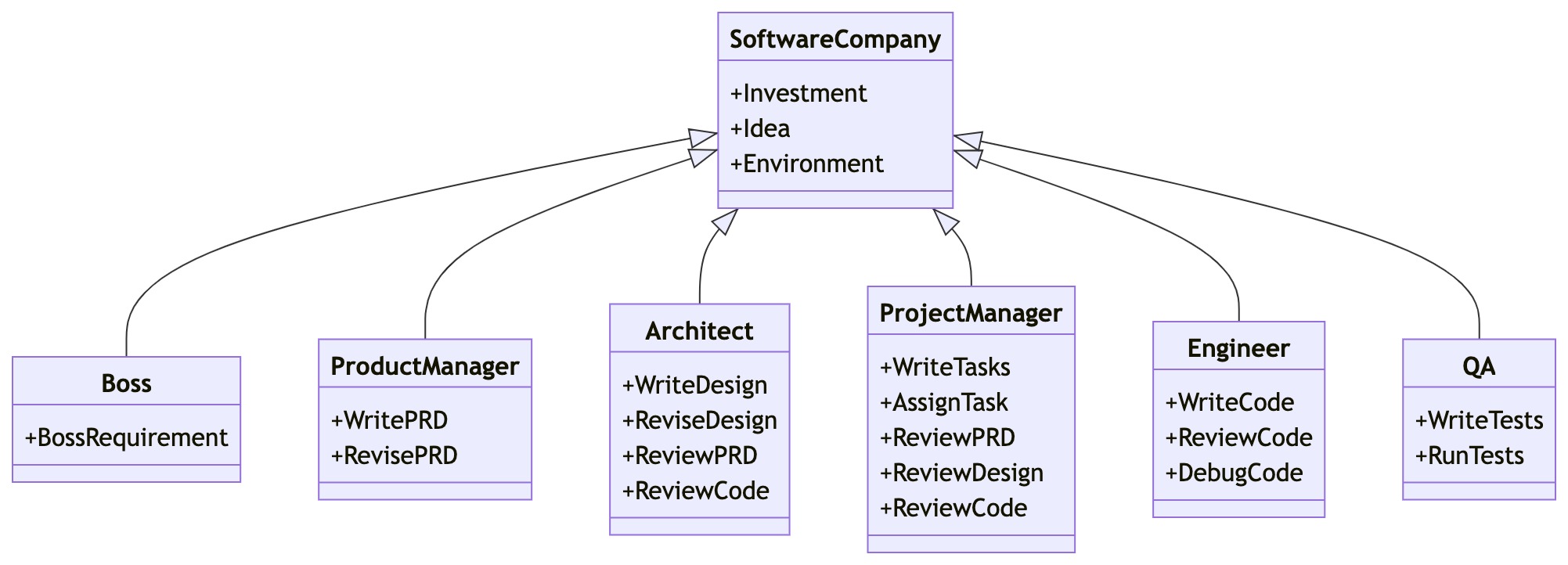
Software Company Multi-Agent Schematic (Gradually Implementing)
Get Started
Installation
Ensure that Python 3.9 or later, but less than 3.12, is installed on your system. You can check this by using:
python --version.
You can use conda like this:conda create -n metagpt python=3.9 && conda activate metagpt
pip install --upgrade metagpt
# or `pip install --upgrade git+https://github.com/geekan/MetaGPT.git`
# or `git clone https://github.com/geekan/MetaGPT && cd MetaGPT && pip install --upgrade -e .`
Install node and pnpm before actual use.
For detailed installation guidance, please refer to cli_install or docker_install
Configuration
You can init the config of MetaGPT by running the following command, or manually create ~/.metagpt/config2.yaml file:
# Check https://docs.deepwisdom.ai/main/en/guide/get_started/configuration.html for more details
metagpt --init-config  # it will create ~/.metagpt/config2.yaml, just modify it to your needs
You can configure ~/.metagpt/config2.yaml according to the example and doc:
llm:
  api_type: "openai"  # or azure / ollama / groq etc. Check LLMType for more options
  model: "gpt-4-turbo"  # or gpt-3.5-turbo
  base_url: "https://api.openai.com/v1"  # or forward url / other llm url
  api_key: "YOUR_API_KEY"
Usage
After installation, you can use MetaGPT at CLI
metagpt "Create a 2048 game" # this will create a repo in ./workspace
or use it as library
from metagpt.software_company import generate_repo
from metagpt.utils.project_repo import ProjectRepo

repo: ProjectRepo = generate_repo("Create a 2048 game")  # or ProjectRepo("<path>")
print(repo)  # it will print the repo structure with files
You can also use Data Interpreter to write code:
import asyncio
from metagpt.roles.di.data_interpreter import DataInterpreter

async def main():
    di = DataInterpreter()
    await di.run("Run data analysis on sklearn Iris dataset, include a plot")

asyncio.run(main())  # or await main() in a jupyter notebook setting
QuickStart & Demo Video
- Try it on MetaGPT Huggingface Space
- Matthew Berman: How To Install MetaGPT - Build A Startup With One Prompt!!
- Official Demo Video
https://github.com/user-attachments/assets/888cb169-78c3-4a42-9d62-9d90ed3928c9
Tutorial
- 🗒 Online Document
- 💻 Usage
- 🔎 What can MetaGPT do?
- 🛠 How to build your own agents?
- 🧑💻 Contribution
- 🔖 Use Cases
- ❓ FAQs
Support
Discord Join US
📢 Join Our Discord Channel! Looking forward to seeing you there! 🎉
Contributor form
📝 Fill out the form to become a contributor. We are looking forward to your participation!
Contact Information
If you have any questions or feedback about this project, please feel free to contact us. We highly appreciate your suggestions!
- Email: [email protected]
- GitHub Issues: For more technical inquiries, you can also create a new issue in our GitHub repository.
We will respond to all questions within 2-3 business days.
Citation
To stay updated with the latest research and development, follow @MetaGPT_ on Twitter.
To cite MetaGPT in publications, please use the following BibTeX entries.
@inproceedings{hong2024metagpt,
      title={Meta{GPT}: Meta Programming for A Multi-Agent Collaborative Framework},
      author={Sirui Hong and Mingchen Zhuge and Jonathan Chen and Xiawu Zheng and Yuheng Cheng and Jinlin Wang and Ceyao Zhang and Zili Wang and Steven Ka Shing Yau and Zijuan Lin and Liyang Zhou and Chenyu Ran and Lingfeng Xiao and Chenglin Wu and J{\"u}rgen Schmidhuber},
      booktitle={The Twelfth International Conference on Learning Representations},
      year={2024},
      url={https://openreview.net/forum?id=VtmBAGCN7o}
}
For more work, please refer to Academic Work.
Discover Repositories
Search across tracked repositories by name or description