
DeusData/codebase-memory-mcp
High-performance code intelligence MCP server. Indexes codebases into a persistent knowledge graph — average repo in milliseconds. 158 languages, sub-ms queries, 99% fewer tokens. Single static binary, zero dependencies.
Build with Backblaze B2
SDKs, agent skills, IDE extensions, and reference pipelines from Backblaze Labs. All open source.
Loading star history...
Use Cases & Benefits
- Indexes codebases into a persistent knowledge graph enabling ultra-fast structural code queries across 158 programming languages.
- Delivers sub-millisecond query responses and extreme indexing speed with a single static binary requiring zero dependencies.
- Use for rapid codebase exploration and call graph tracing in large-scale repositories like the Linux kernel.
- Use for integrating with AI coding agents to provide efficient, token-saving code intelligence and semantic search.
- Use for visualizing and analyzing cross-repository architecture and infrastructure-as-code with built-in 3D graph UI.
About codebase-memory-mcp
codebase-memory-mcp











The fastest and most efficient code intelligence engine for AI coding agents. Full-indexes an average repository in milliseconds, the Linux kernel (28M LOC, 75K files) in 3 minutes. Answers structural queries in under 1ms. Ships as a single static binary for macOS, Linux, and Windows — download, run install, done.
High-quality parsing through tree-sitter AST analysis across all 158 languages, enhanced with Hybrid LSP semantic type resolution for Python, TypeScript / JavaScript / JSX / TSX, PHP, C#, Go, C, C++, Java, Kotlin, and Rust — producing a persistent knowledge graph of functions, classes, call chains, HTTP routes, and cross-service links. 14 MCP tools. Zero dependencies. Plug and play across 11 coding agents.
Research — The design and benchmarks behind this project are described in the preprint Codebase-Memory: Tree-Sitter-Based Knowledge Graphs for LLM Code Exploration via MCP (arXiv:2603.27277). Evaluated across 31 real-world repositories: 83% answer quality, 10× fewer tokens, 2.1× fewer tool calls vs. file-by-file exploration.
Security & Trust — This tool reads your codebase and writes to your agent configuration files. That is what it is designed to do. If you prefer to audit before running, the full source is here — every release binary is signed, checksummed, and scanned by 70+ antivirus engines. All processing happens 100% locally; your code never leaves your machine. Found a security issue? We want to know — see SECURITY.md. Security is Priority #1 for us.
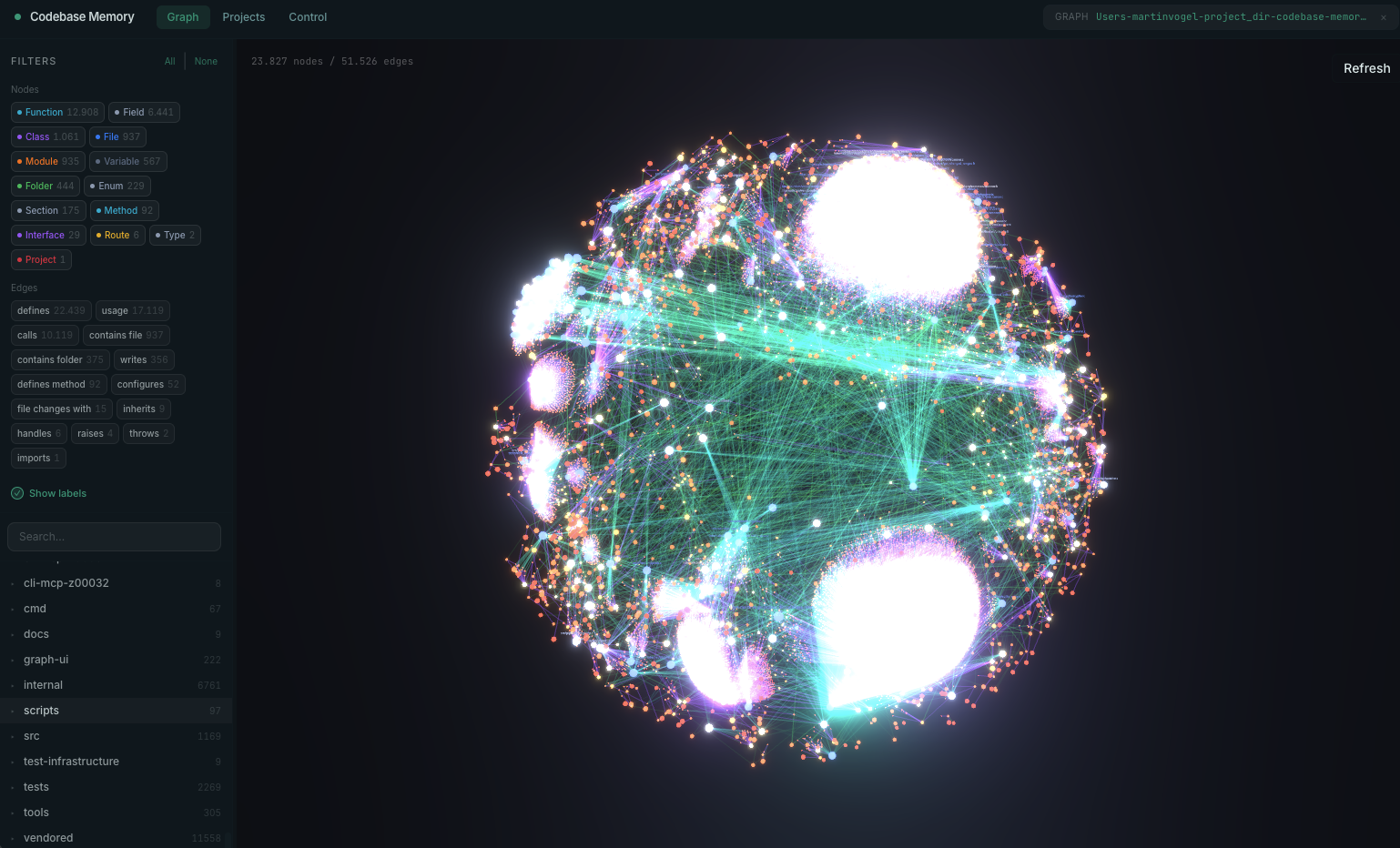
Built-in 3D graph visualization (UI variant) — explore your knowledge graph at localhost:9749
Why codebase-memory-mcp
- Extreme indexing speed — Linux kernel (28M LOC, 75K files) in 3 minutes. RAM-first pipeline: LZ4 compression, in-memory SQLite, fused Aho-Corasick pattern matching. Memory released after indexing.
- Plug and play — single static binary for macOS (arm64/amd64), Linux (arm64/amd64), and Windows (amd64). No Docker, no runtime dependencies, no API keys. Download →
install→ restart agent → done. - 158 languages — vendored tree-sitter grammars compiled into the binary. Nothing to install, nothing that breaks.
- 120x fewer tokens — 5 structural queries: ~3,400 tokens vs ~412,000 via file-by-file search. One graph query replaces dozens of grep/read cycles.
- 11 agents, one command —
installauto-detects Claude Code, Codex CLI, Gemini CLI, Zed, OpenCode, Antigravity, Aider, KiloCode, VS Code, OpenClaw, and Kiro — configures MCP entries, instruction files, and pre-tool hooks for each. - Built-in graph visualization — 3D interactive UI at
localhost:9749(optional UI binary variant). - Infrastructure-as-code indexing — Dockerfiles, Kubernetes manifests, and Kustomize overlays indexed as graph nodes with cross-references.
Resourcenodes for K8s kinds,Modulenodes for Kustomize overlays withIMPORTSedges to referenced resources. - 14 MCP tools — search, trace, architecture, impact analysis, Cypher queries, dead code detection, cross-service HTTP linking, ADR management, and more.
Quick Start
One-line install (macOS / Linux):
curl -fsSL https://raw.githubusercontent.com/DeusData/codebase-memory-mcp/main/install.sh | bash
With graph visualization UI:
curl -fsSL https://raw.githubusercontent.com/DeusData/codebase-memory-mcp/main/install.sh | bash -s -- --ui
Windows (PowerShell):
# 1. Download the installer
Invoke-WebRequest -Uri https://raw.githubusercontent.com/DeusData/codebase-memory-mcp/main/install.ps1 -OutFile install.ps1

# 2. (Optional but recommended) Inspect the script
notepad install.ps1

# 3. Run it
.\install.ps1
Options: --ui (graph visualization), --skip-config (binary only, no agent setup), --dir=<path> (custom location).
Restart your coding agent. Say "Index this project" — done.
Manual install
-
Download the archive for your platform from the latest release:
codebase-memory-mcp-<os>-<arch>.tar.gz(macOS/Linux) or.zip(Windows) — standardcodebase-memory-mcp-ui-<os>-<arch>.tar.gz/.zip— with graph visualization
-
Extract and install (each archive includes
install.shorinstall.ps1):macOS / Linux:
tar xzf codebase-memory-mcp-*.tar.gz
./install.sh
Windows (PowerShell):
Expand-Archive codebase-memory-mcp-windows-amd64.zip -DestinationPath . .\install.ps1 -
Restart your coding agent.
The install command automatically strips macOS quarantine attributes and ad-hoc signs the binary — no manual xattr/codesign needed.
The install command auto-detects all installed coding agents and configures MCP server entries, instruction files, skills, and pre-tool hooks for each.
Graph Visualization UI
If you downloaded the ui variant:
codebase-memory-mcp --ui=true --port=9749
Open http://localhost:9749 in your browser. The UI runs as a background thread alongside the MCP server — it's available whenever your agent is connected.
Auto-Index
Enable automatic indexing on MCP session start:
codebase-memory-mcp config set auto_index true
When enabled, new projects are indexed automatically on first connection. Previously-indexed projects are registered with the background watcher for ongoing git-based change detection. Configurable file limit: config set auto_index_limit 50000.
Keeping Up to Date
codebase-memory-mcp update
The MCP server also checks for updates on startup and notifies on the first tool call if a newer release is available.
Uninstall
codebase-memory-mcp uninstall
Removes all agent configs, skills, hooks, and instructions. Does not remove the binary or SQLite databases.
Features
Graph & analysis
- Architecture overview:
get_architecturereturns languages, packages, entry points, routes, hotspots, boundaries, layers, and clusters in a single call - Architecture Decision Records:
manage_adrpersists architectural decisions across sessions - Louvain community detection: Discovers functional modules by clustering call edges
- Git diff impact mapping:
detect_changesmaps uncommitted changes to affected symbols with risk classification - Call graph: Resolves function calls across files and packages (import-aware, type-inferred)
- Dead code detection: Finds functions with zero callers, excluding entry points
- Cypher-like queries:
MATCH (f:Function)-[:CALLS]->(g) WHERE f.name = 'main' RETURN g.name
Search
- Semantic search (
semantic_query): vector search across the entire graph, powered by bundled Nomicnomic-embed-codeembeddings (40K tokens, 768d int8) compiled into the binary — no API key, no Ollama, no Docker. 11-signal combined scoring (TF-IDF, RRI, API/Type/Decorator signatures, AST profiles, data flow, Halstead-lite, MinHash, module proximity, graph diffusion). - BM25 full-text search via SQLite FTS5 with
cbm_camel_splittokenizer (camelCase / snake_case aware) - Structural search (
search_graph): regex name patterns, label filters, min/max degree, file scoping - Code search (
search_code): graph-augmented grep over indexed files only
Cross-service linking
- HTTP route ↔ call-site matching with confidence scoring
- gRPC, GraphQL, tRPC service detection with protobuf Route extraction
- Channel detection (
EMITS/LISTENS_ON) for Socket.IO, EventEmitter, and generic pub-sub patterns across 8 languages with constant resolution
Cross-repo intelligence
CROSS_*edges link nodes across multiple repos indexed under the same store- Multi-galaxy 3D UI layout for cross-repo architecture visualization
- Cross-repo architecture summary combining services, routes, and dependencies across the indexed fleet
Edge types (selected)
CALLS,IMPORTS,DEFINES,IMPLEMENTS,INHERITSHTTP_CALLS,ASYNC_CALLS(cross-service)EMITS,LISTENS_ON(channels)DATA_FLOWSwith arg-to-param mapping + field access chainsSIMILAR_TO(MinHash + LSH near-clone detection, Jaccard scored)SEMANTICALLY_RELATED(vocabulary-mismatch, same-language, score ≥ 0.80)
Indexing pipeline
- 158 vendored tree-sitter grammars compiled into the binary
- Generic package / module resolution — bare specifiers like
@myorg/pkg,github.com/foo/bar,use my_crate::fooresolved via manifest scanning (package.json,go.mod,Cargo.toml,pyproject.toml,composer.json,pubspec.yaml,pom.xml,build.gradle,mix.exs,*.gemspec) - Infrastructure-as-code indexing — Dockerfiles, Kubernetes manifests, Kustomize overlays as graph nodes
- Hybrid LSP semantic type resolution for Python, TypeScript / JavaScript / JSX / TSX, PHP, C#, Go, C, C++, Java, Kotlin, and Rust — a lightweight C implementation of language type-resolution algorithms, structurally inspired by and compatible with major language servers including tsserver / typescript-go, pyright, gopls, Roslyn, Eclipse JDT, and rust-analyzer (parameter binding, return-type inference, generic substitution, JSX component dispatch, JSDoc inference for plain JS files, namespace + trait + late-static-binding resolution for PHP, file-scoped namespaces + records + LINQ method syntax for C#, class-hierarchy + overload + lambda resolution for Java, extension-function + scope-function resolution for Kotlin, trait-method + UFCS resolution for Rust)
- RAM-first pipeline: LZ4 compression, in-memory SQLite, single dump at end. Memory released after.
Distribution & operation
- Single static binary, zero infrastructure: SQLite-backed, persists to
~/.cache/codebase-memory-mcp/ - Auto-sync: Background watcher detects file changes and re-indexes automatically
- Route nodes: REST endpoints are first-class graph entities
- CLI mode:
codebase-memory-mcp cli search_graph '{"name_pattern": ".*Handler.*"}' - Available on: npm, PyPI, Homebrew, Scoop, Winget, Chocolatey, AUR,
go install
Team-Shared Graph Artifact
Commit a single compressed file to your repo and your teammates skip the reindex.
.codebase-memory/graph.db.zst is a zstd-compressed snapshot of the knowledge graph that lives next to your source. When you index, the artifact is written or refreshed; when a teammate clones the repo and runs codebase-memory-mcp for the first time, the artifact is decompressed and incremental indexing fills in their local diff.
- Format: SQLite database, indexes stripped,
VACUUM INTOcompacted, then zstd 1.5.7 compressed (8–13:1 ratio typical) - Two tiers:
- Best (
zstd -9+ index strip +VACUUM INTO) — written on explicitindex_repository - Fast (
zstd -3) — written by the watcher for low-latency incremental updates
- Best (
- Bootstrap: when no local DB exists but the artifact is present,
index_repositoryimports the artifact first, then runs incremental indexing — avoiding the full reindex cost - No merge pain: a
.gitattributesline withmerge=oursis auto-created on first export, so concurrent edits don't produce conflicts on the binary artifact - Optional: never committed unless you want it. Add
.codebase-memory/to.gitignoreif you prefer everyone to reindex from scratch.
The result is similar in spirit to graphify's graphify-out/ directory, but as a single compressed file with explicit two-tier export, integrity-checked import, and zero merge friction.
How It Works
codebase-memory-mcp is a structural analysis backend — it builds and queries the knowledge graph. It does not include an LLM. Instead, it relies on your MCP client (Claude Code, or any MCP-compatible agent) to be the intelligence layer.
You: "what calls ProcessOrder?"

Agent calls: trace_path(function_name="ProcessOrder", direction="inbound")

codebase-memory-mcp: executes graph query, returns structured results

Agent: presents the call chain in plain English
Why no built-in LLM? Other code graph tools embed an LLM for natural language → graph query translation. This means extra API keys, extra cost, and another model to configure. With MCP, the agent you're already talking to is the query translator.
Performance
Benchmarked on Apple M3 Pro:
| Operation | Time | Notes |
|---|---|---|
| Linux kernel full index | 3 min | 28M LOC, 75K files → 4.81M nodes, 7.72M edges |
| Linux kernel fast index | 1m 12s | 1.88M nodes |
| Django full index | ~6s | 49K nodes, 196K edges |
| Cypher query | <1ms | Relationship traversal |
| Name search (regex) | <10ms | SQL LIKE pre-filtering |
| Dead code detection | ~150ms | Full graph scan with degree filtering |
| Trace call path (depth=5) | <10ms | BFS traversal |
RAM-first pipeline: All indexing runs in memory (LZ4 HC compressed read, in-memory SQLite, single dump at end). Memory is released back to the OS after indexing completes.
Token efficiency: Five structural queries consumed ~3,400 tokens via codebase-memory-mcp versus ~412,000 tokens via file-by-file grep exploration — a 99.2% reduction.
Installation
Pre-built Binaries
| Platform | Standard | With Graph UI |
|---|---|---|
| macOS (Apple Silicon) | codebase-memory-mcp-darwin-arm64.tar.gz | codebase-memory-mcp-ui-darwin-arm64.tar.gz |
| macOS (Intel) | codebase-memory-mcp-darwin-amd64.tar.gz | codebase-memory-mcp-ui-darwin-amd64.tar.gz |
| Linux (x86_64) | codebase-memory-mcp-linux-amd64.tar.gz | codebase-memory-mcp-ui-linux-amd64.tar.gz |
| Linux (ARM64) | codebase-memory-mcp-linux-arm64.tar.gz | codebase-memory-mcp-ui-linux-arm64.tar.gz |
| Windows (x86_64) | codebase-memory-mcp-windows-amd64.zip | codebase-memory-mcp-ui-windows-amd64.zip |
Every release includes checksums.txt with SHA-256 hashes. All binaries are statically linked — no shared library dependencies.
Windows note: SmartScreen may show a warning for unsigned software. Click "More info" → "Run anyway". Verify integrity with
checksums.txt.
Setup Scripts
Automated download + install
macOS / Linux:
curl -fsSL https://raw.githubusercontent.com/DeusData/codebase-memory-mcp/main/scripts/setup.sh | bash
Windows (PowerShell):
irm https://raw.githubusercontent.com/DeusData/codebase-memory-mcp/main/scripts/setup-windows.ps1 | iex
AUR (Arch Linux)
yay -S codebase-memory-mcp-bin
paru -S codebase-memory-mcp-bin
The codebase-memory-mcp-bin package is available at: https://aur.archlinux.org/packages/codebase-memory-mcp-bin
Install via Claude Code
You: "Install this MCP server: https://github.com/DeusData/codebase-memory-mcp"
Build from Source
Prerequisites: C compiler + zlib
| Requirement | Check | Install |
|---|---|---|
| C compiler (gcc or clang) | gcc --version or clang --version | macOS: xcode-select --install, Linux: apt install build-essential |
| C++ compiler | g++ --version or clang++ --version | Same as above |
| zlib | — | macOS: included, Linux: apt install zlib1g-dev |
| Git | git --version | Pre-installed on most systems |
git clone https://github.com/DeusData/codebase-memory-mcp.git
cd codebase-memory-mcp
scripts/build.sh                    # standard binary
scripts/build.sh --with-ui          # with graph visualization
# Binary at: build/c/codebase-memory-mcp
Manual MCP Configuration
If you prefer not to use the install command
Add to ~/.claude/.mcp.json (global) or project .mcp.json:
{
  "mcpServers": {
    "codebase-memory-mcp": {
      "command": "/path/to/codebase-memory-mcp",
      "args": []
    }
  }
}
Restart your agent. Verify with /mcp — you should see codebase-memory-mcp with 14 tools.
Multi-Agent Support
install auto-detects and configures all installed agents:
| Agent | MCP Config | Instructions | Hooks |
|---|---|---|---|
| Claude Code | .claude/.mcp.json | 4 Skills | PreToolUse (Grep/Glob graph augment, non-blocking) |
| Codex CLI | .codex/config.toml | .codex/AGENTS.md | SessionStart reminder |
| Gemini CLI | .gemini/settings.json | .gemini/GEMINI.md | BeforeTool (grep reminder) + SessionStart reminder |
| Zed | settings.json (JSONC) | — | — |
| OpenCode | opencode.json | AGENTS.md | — |
| Antigravity | .gemini/config/mcp_config.json (shared) | antigravity-cli/AGENTS.md | SessionStart reminder |
| Aider | — | CONVENTIONS.md | — |
| KiloCode | mcp_settings.json | ~/.kilocode/rules/ | — |
| VS Code | Code/User/mcp.json | — | — |
| OpenClaw | openclaw.json | — | — |
| Kiro | .kiro/settings/mcp.json | — | — |
Hooks are structurally non-blocking (exit code 0, every failure path).
For Claude Code, the PreToolUse hook intercepts Grep/Glob (never Read —
gating Read breaks the read-before-edit invariant) and, when the search
token matches indexed symbols, injects them as additionalContext via
search_graph so the agent gets structured context alongside its normal
search results. For Codex, Gemini CLI, and Antigravity, a SessionStart hook
injects a one-line code-discovery reminder as session context (Gemini CLI also
keeps its BeforeTool reminder).
The installed Claude shim file is named cbm-code-discovery-gate for
backward compatibility with existing installs; despite the legacy name it
never gates and never blocks.
CLI Mode
Every MCP tool can be invoked from the command line:
codebase-memory-mcp cli index_repository '{"repo_path": "/path/to/repo"}'
codebase-memory-mcp cli search_graph '{"name_pattern": ".*Handler.*", "label": "Function"}'
codebase-memory-mcp cli trace_path '{"function_name": "Search", "direction": "both"}'
codebase-memory-mcp cli query_graph '{"query": "MATCH (f:Function) RETURN f.name LIMIT 5"}'
codebase-memory-mcp cli list_projects
codebase-memory-mcp cli --raw search_graph '{"label": "Function"}' | jq '.results[].name'
MCP Tools
Indexing
| Tool | Description |
|---|---|
index_repository | Index a repository into the graph. Auto-sync keeps it fresh after that. |
list_projects | List all indexed projects with node/edge counts. |
delete_project | Remove a project and all its graph data. |
index_status | Check indexing status of a project. |
Querying
| Tool | Description |
|---|---|
search_graph | Structured search by label, name pattern, file pattern, degree filters. Pagination via limit/offset. |
trace_path | BFS traversal — who calls a function and what it calls (alias: trace_call_path). Depth 1-5. |
detect_changes | Map git diff to affected symbols + blast radius with risk classification. |
query_graph | Execute Cypher-like graph queries (read-only). |
get_graph_schema | Node/edge counts, relationship patterns, property definitions per label. Run this first. |
get_code_snippet | Read source code for a function by qualified name. |
get_architecture | Codebase overview: languages, packages, routes, hotspots, clusters, ADR. |
search_code | Grep-like text search within indexed project files. |
manage_adr | CRUD for Architecture Decision Records. |
ingest_traces | Ingest runtime traces to validate HTTP_CALLS edges. |
Graph Data Model
Node Labels
Project, Package, Folder, File, Module, Class, Function, Method, Interface, Enum, Type, Route, Resource
Edge Types
CONTAINS_PACKAGE, CONTAINS_FOLDER, CONTAINS_FILE, DEFINES, DEFINES_METHOD, IMPORTS, CALLS, HTTP_CALLS, ASYNC_CALLS, IMPLEMENTS, HANDLES, USAGE, CONFIGURES, WRITES, MEMBER_OF, TESTS, USES_TYPE, FILE_CHANGES_WITH
Qualified Names
get_code_snippet uses qualified names: <project>.<path_parts>.<name>. Use search_graph to discover them first.
Supported Cypher (openCypher read subset)
query_graph is a read-only openCypher subset:
- Clauses:
MATCH,OPTIONAL MATCH, multipleMATCH,WHERE,WITH(+WITH … WHERE),RETURN,ORDER BY,SKIP,LIMIT,DISTINCT,UNWIND,UNION/UNION ALL,CASE. - Patterns: labelled nodes, label alternation
(n:A|B), relationship types/direction, variable-length paths[*1..3], inline property maps. - WHERE:
= <> < <= > >=,AND/OR/XOR/NOT,IN,CONTAINS,STARTS WITH,ENDS WITH,IS [NOT] NULL, regex=~, label testn:Label, andEXISTS { (n)-[:TYPE]->() }(single-hop existence — great for dead-code, e.g.WHERE NOT EXISTS { (f)<-[:CALLS]-() }). - Aggregates:
count(+DISTINCT),sum,avg,min,max,collect. - Functions:
labels,type,id,keys,properties;toLower/toUpper/toString/toInteger/toFloat/toBoolean;size,length,trim/ltrim/rtrim,reverse;coalesce,substring,replace,left,right.
Anything outside this subset (write/MERGE/CALL clauses, unsupported functions, list/map literals, comprehensions, path functions, parameters) fails with a clear unsupported … error rather than returning empty results.
Ignoring Files
Layered: hardcoded patterns (.git, node_modules, etc.) → .gitignore hierarchy → .cbmignore (project-specific, gitignore syntax). Symlinks are always skipped.
Configuration
codebase-memory-mcp config list                          # show all settings
codebase-memory-mcp config set auto_index true           # auto-index on session start
codebase-memory-mcp config set auto_index_limit 50000    # max files for auto-index
codebase-memory-mcp config reset auto_index              # reset to default
Environment Variables
| Variable | Default | Description |
|---|---|---|
CBM_CACHE_DIR | ~/.cache/codebase-memory-mcp | Override the database storage directory. All project indexes and config are stored here. |
CBM_DIAGNOSTICS | false | Set to 1 or true to enable periodic diagnostics output to /tmp/cbm-diagnostics-<pid>.json. |
CBM_DOWNLOAD_URL | (GitHub releases) | Override the download URL for updates. Used for testing or self-hosted deployments. |
CBM_LOG_LEVEL | info | Set the minimum log level. Accepted values (case-insensitive): debug, info, warn, error, none — or their numeric equivalents 0–4 matching the internal enum. Logs go to stderr; stdout is reserved for MCP JSON-RPC. |
CBM_WORKERS | (detected) | Override the parallel-indexing worker count returned by cbm_default_worker_count. Useful inside containers where sysconf(_SC_NPROCESSORS_ONLN) reports host CPUs rather than the cgroup's effective quota. Range 1–256; invalid values are ignored with a warning. |
# Store indexes in a custom directory
export CBM_CACHE_DIR=~/my-projects/cbm-data
Custom File Extensions
Map additional file extensions to supported languages via JSON config files. Useful for framework-specific extensions like .blade.php (Laravel) or .mjs (ES modules).
Per-project (in your repo root):
// .codebase-memory.json
{"extra_extensions": {".blade.php": "php", ".mjs": "javascript"}}
Global (applies to all projects):
// ~/.config/codebase-memory-mcp/config.json  (or $XDG_CONFIG_HOME/...)
{"extra_extensions": {".twig": "html", ".phtml": "php"}}
Project config overrides global for conflicting extensions. Unknown language values are silently skipped. Missing config files are ignored.
Persistence
SQLite databases stored at ~/.cache/codebase-memory-mcp/. Persists across restarts (WAL mode, ACID-safe). To reset: rm -rf ~/.cache/codebase-memory-mcp/.
Troubleshooting
| Problem | Fix |
|---|---|
/mcp doesn't show the server | Check .mcp.json path is absolute. Restart agent. Test: echo '{}' | /path/to/binary should output JSON. |
index_repository fails | Pass absolute path: index_repository(repo_path="/absolute/path") |
trace_path returns 0 results | Use search_graph(name_pattern=".*PartialName.*") first to find the exact name. |
| Queries return wrong project results | Add project="name" parameter. Use list_projects to see names. |
| Binary not found after install | Add to PATH: export PATH="$HOME/.local/bin:$PATH" |
| UI not loading | Ensure you downloaded the ui variant and ran --ui=true. Check http://localhost:9749. |
Hybrid LSP
Semantic type resolution beyond tree-sitter.
Tree-sitter alone gives a syntactic AST. That handles naming, structure, and call sites well, but it can't tell you that user.profile.display_name() resolves to Profile.display_name declared three modules away — tree-sitter doesn't track imports, generics, inheritance, or stdlib types.
codebase-memory-mcp ships a lightweight C implementation of language type-resolution algorithms, structurally inspired by and compatible with major language servers (tsserver / typescript-go, pyright, gopls, Roslyn, Eclipse JDT, rust-analyzer), embedded directly into the static binary. No language server process, no per-project setup, no API key. We call this layer Hybrid LSP: it runs alongside tree-sitter on every parse and refines CALLS, USAGE, and RESOLVED_CALLS edges with type information, so the resulting graph mirrors what an IDE "Go to Definition" would resolve.
Languages with full Hybrid LSP:
| Language | What it handles |
|---|---|
| Python (new in v0.7.0) | imports + dotted submodule walks, dataclasses, Self return types, generics, @property, match/case class patterns, SQLAlchemy 2.0 Mapped[T], Pydantic BaseModel, typing.Annotated / ClassVar / Final / InitVar, async/await, classmethod/staticmethod, narrowing (isinstance / is not None / walrus), typing.cast / assert_type, common stdlib (logging, pathlib, json, functools). Target ~95% resolution on idiomatic code. |
| TypeScript / JavaScript / JSX / TSX | generics, JSX component dispatch, JSDoc inference for plain JS, .d.ts declarations, module re-exports, method chaining via return-type propagation, per-file overlay chained to a shared cross-file registry |
| PHP (new in v0.7.0) | namespaces, traits, late-static-binding, PHPDoc inference, parameter binding, return-type inference |
| C# (new in v0.7.0) | global usings, file-scoped namespaces, records (incl. C# 12 primary constructors), LINQ method syntax, async Task<T> / ValueTask<T> unwrap, generic methods, this / base dispatch, var inference, common BCL stdlib |
| Go (sharpened in v0.7.0) | pre-built per-package cross-file registry, generics, embedded structs, interface satisfaction, package-aware import resolution |
| C / C++ (sharpened in v0.7.0) | pre-built per-language cross-file registry shared across C and C++; C side handles macros + typedef chains + header-vs-source linking; C++ side handles templates, namespaces, auto inference, and method resolution via class hierarchy |
| Java (new in v0.8.0) | imports (single-type, on-demand, static), class hierarchies with this / super dispatch, generics, annotations, overload matching by arity and parameter types, lambdas / method references bound to functional interfaces, field-type inference, common JDK stdlib |
| Kotlin (new in v0.8.0) | imports + same-package resolution, classes / objects / companion objects, extension functions, data classes, nullable-type unwrapping, scope functions (let / apply / run / also / with), infix calls, common stdlib |
| Rust (new in v0.8.0) | use declarations + module paths, impl blocks and trait methods, struct fields, generics with trait bounds, operator-trait desugaring, derive-macro method synthesis, UFCS static paths, common std prelude |
Two-layer architecture:
- Tree-sitter pass — fast, syntactic, runs for every one of the 158 languages. Extracts definitions, calls, imports.
- Hybrid LSP pass — type-aware, runs above the tree-sitter pass per-language. Refines call edges using the import graph plus a per-file or pre-built cross-file definition registry. Languages without a Hybrid LSP pass yet fall back to textual resolution, so you always get some answer.
The result is a knowledge graph accurate enough to drive trace_path across packages, inheritance hierarchies, and stdlib calls — without paying for a language server process per project.
Language Support
158 languages, all parsed via vendored tree-sitter grammars compiled into the binary. Benchmarked against 64 real open-source repositories (78 to 49K nodes):
| Tier | Score | Languages |
|---|---|---|
| Excellent (>= 90%) | Lua, Kotlin, C++, Perl, Objective-C, Groovy, C, Bash, Zig, Swift, CSS, YAML, TOML, HTML, SCSS, HCL, Dockerfile | |
| Good (75-89%) | Python, TypeScript, TSX, Go, Rust, Java, R, Dart, JavaScript, Erlang, Elixir, Scala, Ruby, PHP, C#, SQL | |
| Functional (< 75%) | OCaml, Haskell |
Also supported (not yet benchmarked): Ada, Agda, Apex, Assembly (NASM), Astro, AWK, Beancount, BibTeX, Bicep, Bitbake, Blade, Cairo, Cap'n Proto, Clojure, CMake, COBOL, Common Lisp, Crystal, CSV, CUDA, D, Devicetree, Diff, .env, Elm, Emacs Lisp, F#, Fennel, Fish, FORM, Fortran, FunC, GDScript, .gitattributes, .gitignore, Gleam, GLSL, GN, Go module, Go template, GraphQL, Hare, HLSL, Hyprlang, INI, ISPC, Janet, Jinja2, JSDoc, JSON, JSON5, Jsonnet, Julia, Just, Kconfig, KDL, Lean 4, Linker Script, Liquid, LLVM IR, Luau, Magma, Makefile, Markdown, MATLAB, Mermaid, Meson, Move, Nickel, Nim, Nix, Odin, Pascal, Pkl, PO (gettext), Pony, PowerShell, Prisma, .properties, Protobuf, Puppet, PureScript, Racket, Regex, requirements.txt, ReScript, RON, reStructuredText, Scheme, Slang, Smali, Smithy, Solidity, SOQL, SOSL, Squirrel, SSH config, Starlark, Svelte, Sway, SystemVerilog, TableGen, Tcl, Teal, Templ, Thrift, TLA+, Typst, Verilog, VHDL, Vim script, Vue, WGSL, WIT, Wolfram, XML, Zsh.
Architecture
src/
  main.c              Entry point (MCP stdio server + CLI + install/update/config)
  mcp/                MCP server (14 tools, JSON-RPC 2.0, session detection, auto-index)
  cli/                Install/uninstall/update/config (10 agents, hooks, instructions)
  store/              SQLite graph storage (nodes, edges, traversal, search, Louvain)
  pipeline/           Multi-pass indexing (structure → definitions → calls → HTTP links → config → tests)
  cypher/             Cypher query lexer, parser, planner, executor
  discover/           File discovery (.gitignore, .cbmignore, symlink handling)
  watcher/            Background auto-sync (git polling, adaptive intervals)
  traces/             Runtime trace ingestion
  ui/                 Embedded HTTP server + 3D graph visualization
  foundation/         Platform abstractions (threads, filesystem, logging, memory)
internal/cbm/         Vendored tree-sitter grammars (158 languages) + AST extraction engine
Security
Every release binary is verified through a multi-layer pipeline before publication:
- VirusTotal — all binaries scanned by 70+ antivirus engines (zero detections required to publish)
- SLSA Level 3 — cryptographic build provenance generated by GitHub Actions; verify with
gh attestation verify <file> --repo DeusData/codebase-memory-mcp - Sigstore cosign — keyless signatures on all artifacts; bundles included in every release
- SHA-256 checksums —
checksums.txtpublished with every release; verified by both install scripts before extraction - CodeQL SAST — blocks release pipeline if any open alerts remain
- Zero runtime dependencies — no transitive supply chain; all libraries vendored at compile time
v0.7.0 VirusTotal scans
| Binary | SHA-256 | VirusTotal |
|---|---|---|
linux-amd64 | 8e12bb2d6ead7f20a6d3... | 0/72 ✅ |
linux-arm64 | 10f7136bfbf3950c6b2a... | 0/72 ✅ |
darwin-arm64 | 7062a7408906344bf4f8... | 0/72 ✅ |
darwin-amd64 | 28c6d640e1a0ac7bfcab... | 0/72 ✅ |
windows-amd64 | 9c3ddcf78368fd4fa891... | 0/72 ✅ |
Scan links for every release are also included in the GitHub Release notes automatically.
License
MIT
Discover Repositories
Search across tracked repositories by name or description